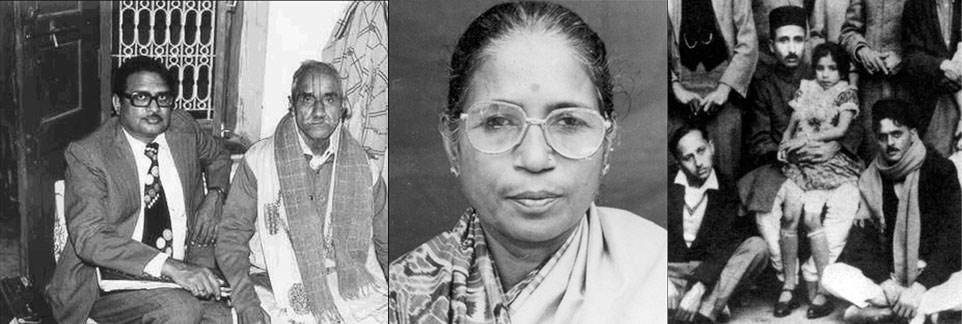
Shanti Devi, a girl growing up in Delhi in the 1930s, spoke very little until she was four years old. When she did start talking, she alarmed everyone in her family. “This is not my real home! I have a husband and a son in Mathura! I must return to them!”
This was India, so instead of taking their daughter to a psychiatrist for a dose of Ritalin, her parents told her, “That was then. This is now. Forget your past life. You’re with us this time.”
But Shanti Devi wouldn’t give up. She talked about her former family to anyone who would listen. One of her teachers at school sent a letter to the address Shanti Devi gave as her “real home” in Mathura, inquiring if a woman who had died there not too many years ago. To his astonishment, he soon received a reply from Shanti Devi’s previous husband, admitting that his young wife Lugdi Devi had passed away some years previously, after giving birth to their son. The details Shanti Devi had given about her old house and members of her previous family were all confirmed.
This launched the most thoroughly researched investigation of a case of reincarnation in modern history. Everyone got in on the act, including Mahatma Gandhi and several prominent Indian members of the Indian government. A team of researchers, working under stringent conditions to ensure that Shanti Devi couldn’t possibly be getting her information from any other source, accompanied the little girl to Mathura. On her own, she was able to lead them to her previous home, and correctly described what it had looked like years earlier before its recent refurbishing. She was also able to relate extremely intimate information, such as extramarital affairs of family members, that no one outside the family could possibly have known.
The award-winning Swedish journalist Sture Lonnerstrand spent several weeks with Shanti Devi later in her life, recording her story and verifying information about the famous government investigation.
Why Don’t I Remember?
I know you’re thinking, “If we lived before, how come we don’t remember?” Shanti Devi may have recalled her previous life, but most of us sure don’t.
Actually we do, according to the Hindus. The very fact that we’re drawn to a certain people and certain places is a reflection of the dim memory of pervious lives we all possess. The fact that most of us don’t remember our last life in detail like Shanti Devi is due to the nature of the soul.
In the West, those of us who believe in a soul at all think of it in very straightforward way. There’s the body. It dies. There’s the soul. It lives forever. For Hindus the topic is not so simple. Hindus believe the universe is multidimensional, and so is the soul.
******
At the moment of rebirth, Hindus believe, the infant takes its first gulp of air and becomes a breathing being. This jolts the brain and subtle body, causing a force called vaishnava shakti to act. In most people, it cuts off detailed memories of the past life.
In fact, it also cuts off detailed memories of this life, which is why people don’t’ remember much of what happened in the first three or four years of their current life either. The soul is still completing its “hook up” to the new physical brain, and not all the data from the previous file is downloaded. It’s still there though, preserved in an internal drive called the karmashaya, a storage bin of previous thoughts and actions that’s a little hard for us to access because it’s buried deep in the subtle body, not the physical brain.
Presence of Mind
I’m guessing your next question is, “Well, then how did Shanti Devi remember her past life?” This gets interesting.
Perhaps you’ve heard of the Egyptian Book of the Dead. Numbers of ancient, spiritually advanced cultures carefully trained people so they would know how to go through the process of death consciously. Often-as in the Egyptian texts and some Gnostic Christian books, too-this involved memorizing lots of key phrases and detailed imagery.
The point in all these traditions is that if you don’t want to lose yourself, if you want to attain the type of immortality that comes from the ability to hang on to your present identity from life to life, then during the process of death you must keep your presence of mind!
Lugdi Devi, Shanti Devi’s previous self, had been using an old trick recommended by yogis for thousands of years. During her Lugdi life she had kept repeating the name of God constantly, with full devotion, day and night. At the time of her death, her mind stayed with the divine name. It helped her remain calm and alert through a process when most people lose consciousness. As she was being reborn, her awareness remained with the name of God rather than locking into her new physical brain. So she didn’t forget her previous identity.
What’s My Karma?
The process of reincarnation is driven by karma. Where, when, and in what circumstances we next reincarnate is due, in large measure, to our thoughts, words, and actions in the past and present.
To be reborn in a human body is a great blessing. Human bodies, far more so than animal and plant bodies, are capable of devoting themselves to the spiritual life.
We can lose our human status, Hindu sages warn. If we don’t take advantage of our human birth but continue living like animals, we may return an animal body in our next life. Particularly pernicious people, one holy text warns, could even be reborn as “flies, gnats, and biting insects”!
Don’t assume that reincarnation takes place in linear time. To the Hindu, time and space are multidimensional. According to a Hindu classic called the Yoga Vasishtha, your next incarnation, or your last incarnation for that matter, may be happening right now. Your next life may actually occur in the past! This is because your innermost spirit exists outside of time and space, and can travel to wherever and to whenever it wants.
~ Linda Johnsen, Excerpted with permission of Pearson Education Company.