IndianSanskriti
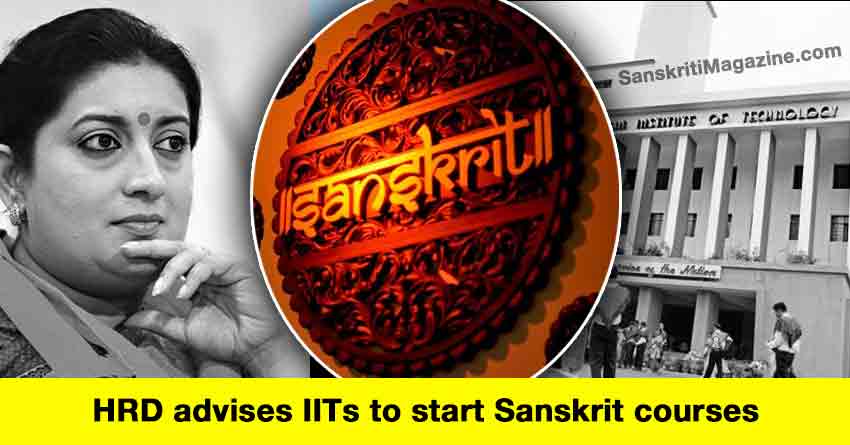
HRD advises IITs to start Sanskrit courses

HRD advises IITs to start Sanskrit courses

The HRD Ministry has despatched an advisory to all Indian Institutes of Technology (IITs) to consider the idea of offering the ancient language as an elective course to their students.

Sources said, the advisory, which was sent Thursday, also requests the IITs to create posts and appoint teachers for the above purpose with the approval of their respective Board of Governors. The letter carries a link to the soft copy of a report submitted by an expert panel, headed by former Chief Election Commissioner N Gopalaswami, in February.

The committee, which had economist and NITI Aayog member Bibek Debroy, PM Narendra Modi’s yoga guru H R Nagendra and UGC chairman Ved Prakash as members, was entrusted with the job of recommending a 10-year roadmap for promotion of Sanskrit. It had suggested the setting up of Sanskrit cells in all IITs, NITs, IISERs and central universities “in order to facilitate the student of science and technology in Sanskrit literature and inter-disciplinary study of various modern subjects and its corresponding subjects in Sanskrit literature”.

“Atharavaveda, Vaisheshika Darshana etc. are, it is acknowledged, the treasure house of scientific concepts which are hitherto studied from Science point of view. There are hundreds of works like Siddhanta Shiromani, Vriksha Ayurveda, Upavana Vinoda, Mayamatam, etc. to name a few, which are of great relevance in the context of research and innovation. The proposed cell should also offer various types of Sanskrit Courses for the students in the campus for credits,” the report states.

The HRD Ministry’s advisory, however, isn’t the first of its kind. In July 2000, under NDA-I, it had issued notices to around 40 institutions, including the IITs and IISC, asking them to consider introducing Sanskrit courses. Several IITs have since then integrated the knowledge available in ancient Indian texts in the mainstream engineering curriculum.

IIT Bombay director Devang Khakhar told The Sunday Express that his institute currently has a ‘Cell for Indian Science and Technology in Sanskrit’ which aims to bring the science-related materials (in Sanskrit) to the fore.

IIT Gandhinagar, on the other hand, offers a course on ‘Introduction to Sanskrit language and literature’ which covers literary genres, such as kavya, nataka, Purana and Niti and basic information about scientific and technical literature in Sanskrit.

IIT Madras director Bhaskar Ramamurthi said, “We currently don’t offer a Sanskrit course, but once we receive the ministry’s communication, we’ll forward it to the humanities department to assess the demand for learning of Sanskrit among students. If there is a need, we can definitely start a course. We already have one on Chinese languages.”

(Source)
You may also like

Search the website

Like us on Facebook

Get daily updates via Email

Enter your email address:

Recent Posts

Yogini Ekadashi 2026 — The Yaksha Who Missed the Morning Flowers, and the Ekadashi That Undid His Curse

On Friday, July 10, 2026, the rare Krishna Paksha Ekadashi of Nija Ashadha arrives. The Padma Purana tells the story of Hemamali — the Yaksha gardener of Bhagavan Kubera in Alaka, whose single morning of distraction with his wife Vishalakshi cost him his form, his wife, and his celestial city. Cursed to wander the earth of Bharata as a leper for a long time, he was at last shown the way back by Sage Markandeya — a single sincere keeping of Yogini Ekadashi.

Jamai Shashthi 2026 — The Story of Maa Shashthi, the Cat, and the Wife Who Was Forgiven

Jamai Shashthi 2026 — The Story of Maa Shashthi, the Cat, and the Wife Who Was Forgiven

On Saturday, June 20, 2026, Bengali households across Bharata will welcome their married daughters and sons-in-law home for the legendary jamai-aador feast and perform the Shashthi Vrata. But behind the warmth lies a story most Bengalis know by heart and most non-Bengalis have never heard — the wife who stole the hilsa, blamed the cat, lost six sons to Maa Shashthi’s wrath, and was finally forgiven. The Vrat Katha, the vidhi, the mantras, and the deeper teaching.

Vat Purnima 2026 — The Wife Who Argued Yama Into Returning Her Husband’s Life

On Monday, June 29, 2026, women across Maharashtra, Gujarat, and southern Bharata will tie red thread around banyan trees and hear the story of Savitri — the wife who walked behind Yamaraja Himself when He came for her husband, and out-argued the Lord of Dharma into returning Satyavan’s life. The Mahabharata’s Pativrata Mahatmya Parva, the vrat vidhi, and why the banyan witnessed everything.

Nija Jyeshtha 2026 — The Real Jyeshtha Begins, and the Calendar Resumes

Nija Jyeshtha 2026 — The Real Jyeshtha Begins, and the Calendar Resumes

With Adhik Maas now closed on the Somvati Amavasya of June 15, the long-postponed festivals of Jyeshtha return — Vat Purnima (June 29, the Savitri-Yamaraja katha), Jamai Shashthi (June 20, the Bengali festival of Maa Shashthi), Sankashti Chaturthi (June 28), Yogini Ekadashi (July 10), and Devshayani Ekadashi (July 16, opening the four-month Chaturmas of Bhagavan Vishnu’s yoga-nidra). A guide to what the next four weeks hold and what the household that kept Purushottam Maas now carries forward.

The Closing of Purushottam Maas 2026 — Adhik Amavasya and the Sealing of the Month-Long Vrat

On Monday, June 15, 2026 — a rare Somvati Amavasya — the intercalary month that bears Bhagavan Vishnu’s own name comes to its close. The Acharyas teach that a vrat is not measured by its duration but by its closing. Here are the Padma Purana’s instructions for sealing the month-long Purushottam Maas vrat: the morning snan, the closing puja with the Vishnu Sahasranama, the day of dana, the Somvati Amavasya gift, and the final sarva-arpana — the offering of all merit at the feet of the Lord.

css.php