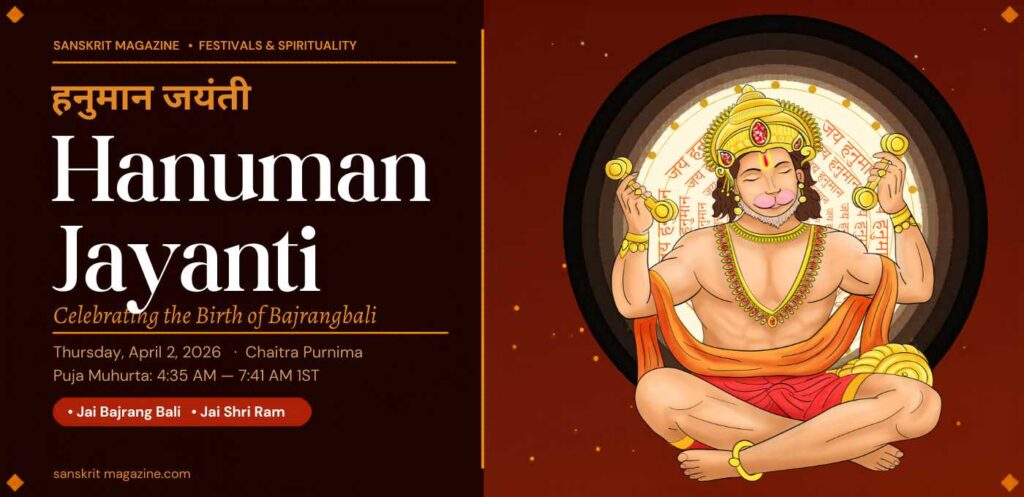
🚩 Hanuman Jayanti 2026
Celebrating the Janmotsav of Bajrangbali
Every Tuesday and Saturday, in countless cities and villages across India and the world, a particular name rises in the air — from ancient stone temples festooned with marigolds and vermilion, from small home altars lit with mustard oil diyas, from the lips of wrestlers who begin their morning practice with a stotra, from the hearts of ordinary people facing extraordinary difficulty. Jai Bajrang Bali. Jai Hanuman.
There is no deity in the Sanatana Dharma tradition who is more universally beloved, more immediately accessible, or more viscerally present than Lord Hanuman. He does not ask for elaborate rituals or expensive offerings. A single laddoo, a pinch of sindoor, a sincere chanting of the Hanuman Chalisa — and he is there. Devotees across millennia have testified to this: Hanuman responds. He shows up. He protects, strengthens, and liberates the one who calls on him with genuine faith.
Tomorrow — Thursday, April 2, 2026 — is Hanuman Jayanti: the birth anniversary of this extraordinary being on the auspicious full moon of Chaitra. That it falls on a Thursday — Guruvar, the day of Jupiter, the planet of wisdom and divine grace — makes it doubly significant. This complete guide covers everything you need: the correct date and tithi, the sacred birth account from the Valmiki Ramayana, the muhurat, the puja vidhi, the mantras, the Hanuman Chalisa, and the eternal teachings that Hanuman's life holds for every devotee.
Hanuman Jayanti 2026: Why April 2 Is the Correct Date
Hanuman Jayanti is observed each year on Chaitra Shukla Purnima — the full moon of the first month of the Hindu lunisolar calendar. In 2026, this has caused some confusion because the Purnima Tithi spans two calendar days. Here is the precise Panchang calculation:
- Purnima Tithi begins: April 1, 2026 at 7:06 AM IST
- Purnima Tithi ends: April 2, 2026 at 7:41 AM IST
- Sunrise on April 1: 6:12 AM — Purnima had not yet begun
- Sunrise on April 2: 6:11 AM — Purnima Tithi is still active ✓
- Correct observance: Thursday, April 2, 2026
The classical Dharmashastra texts Dharmasindhu and Nirnayasindhu establish the Udaya Tithi rule: the tithi prevailing at sunrise determines the festival date. Since Purnima is active at sunrise on April 2, that is the correct day of celebration. Confirmed by DrikPanchang and all major Panchang authorities across India.
The Janma Katha of Lord Hanuman: The Sacred Account from the Valmiki Ramayana
The birth of Lord Hanuman is one of the most extraordinary accounts in all of Vedic and Puranic literature — a convergence of divine grace, cosmic necessity, and the fruit of deep tapasya. It is narrated across several scriptures: the Valmiki Ramayana, the Shiva Purana, the Ananda Ramayana, and the Parashar Samhita, each enriching the account with further layers of meaning and significance.
Anjana Devi: The Apsara Who Became a Vanara
Anjana Devi was a celestial apsara of extraordinary beauty who, due to a rishi's shaap (curse), was born in the terrestrial world as a female vanara. The shaap carried within it its own resolution: it would be lifted when she gave birth to an avatara of Lord Shiva himself. She married Kesari — a powerful and dharmic vanara king — and together they lived on the sacred Anjana Mountain in the Himalayas, performing intense tapasya and offering devoted upasana for a divya child.
Vayu Deva and the Prasad of the Putrakameshti Yajna
Simultaneously, in Ayodhya, the great King Dasharatha was performing the Putrakameshti Yajna under the guidance of Maharishi Rishyashringa, seeking the blessings of the Divine for a son. As the sacred payasam (kheer) emerged from the yajna agni as a direct gift of the Devas, Vayu Deva — the lord of wind and prana — carried a sacred portion of this prasad from Queen Kaushalya's hands and delivered it to Anjana Devi, who sat in deep dhyana on a nearby hillside, arms raised toward Swarga in upasana.
Anjana Devi received this celestial prasad with wonder and complete surrender, recognising it as the direct anugraha (grace) of Lord Shiva. She consumed it with devotion. And in due course, on the full moon of Chaitra — at the precise moment the sun rose over the Anjana Mountain — Lord Hanuman was born into this world: the son of Anjana Devi and Kesari, the spiritual son of Vayu Deva, and the avatar of Lord Shiva in his Rudra aspect.
The Child Who Reached for the Sun
From his very first moments, the infant displayed powers that astonished even the Devas. As a child, he saw the rising sun — brilliant, golden, and perfectly round — and, hungry and full of the fearless curiosity of a divine being, mistook it for a ripe fruit. With a single mighty leap, the infant Hanuman shot into the sky to grasp it.
Indra, the king of the Devas, saw this and struck the child with his vajra (thunderbolt), fearing the sun would be swallowed and all creation would be plunged into darkness. The blow struck the child's jaw (hanu) and he fell to earth, unconscious.
Vayu Deva, witnessing what had been done to his son, withdrew his presence entirely from the cosmos. Every living being — from the smallest creature to the mightiest Deva — began to suffocate. Creation itself trembled. The Devas rushed to Vayu Deva, imploring him to restore the breath of life. One by one, they bestowed upon the unconscious child extraordinary boons — Brahma granted immunity from his own weapon; Lord Vishnu gifted his Sudarshana Chakra and a sacred garland; Surya Deva bestowed a fraction of his own brilliance and the knowledge of all scriptures; Lord Shiva granted him invincibility. Indra, filled with remorse, restored the child to life — and from the mark left on his jaw (hanu), the child received the name by which the entire cosmos would know him forever: Hanuman.
Who Is Lord Hanuman? The Eight Aspects of Bajrangbali
Lord Hanuman is known across the Sanatana Dharma tradition by dozens of names — each one illuminating a different dimension of his being. He is simultaneously the greatest warrior, the greatest scholar, the greatest bhakta, the greatest seva-dharta, and the greatest yogi that any loka has ever known. The Valmiki Ramayana describes him as a master of all four Vedas, all the Shastras, and all the arts of warfare — a being of complete, integrated perfection. Let us understand him through his eight most essential aspects:
The Hanuman Chalisa: Forty Verses of the Greatest Stotra
If there is a single text that has defined Hanuman bhakti for the last five centuries, it is the Hanuman Chalisa — the forty (chalis) verses composed by the sant-kavi Tulsidas in the Awadhi dialect of Hindi. As narrated in the Bhaktamal, Tulsidas composed it while imprisoned at the orders of the Mughal emperor, and such was the power of his upasana that Lord Hanuman himself appeared in response and secured his liberation.
The Hanuman Chalisa is not merely a stotra — it is a complete portrait of Hanuman, a manual for invoking his protection, a summary of his deeds as recorded in the Itihasa, and a profound declaration of the nature of true bhakti. On Hanuman Jayanti, chanting it 11, 21, or 108 times is the most powerful act of devotion one can perform.
बरनउँ रघुबर बिमल जसु, जो दायकु फल चारि ॥
Barnau Raghubar Bimal Jasu, Jo Dayaku Phal Chari
"Cleansing the mirror of my mind with the dust of the Guru's lotus feet, I recite the pure glory of Raghuvara, which bestows the four fruits of life — Dharma, Artha, Kama, and Moksha."
जय कपीस तिहुँ लोक उजागर ॥
Jai Kapis Tihu Lok Ujagar
"Victory to Hanuman, the ocean of jnana (wisdom) and guna (virtue). Victory to the lord of vanaras who illuminates all three lokas."
जितेन्द्रियं बुद्धिमतां वरिष्ठम् ।
वातात्मजं वानरयूथमुख्यं
श्रीरामदूतं शरणं प्रपद्ये ॥
Vatatmajam Vanarayuthamukhyam Shri Rama Dutam Sharanam Prapadye
विश्वरूपाय अमित विक्रमाय ।
प्रकट पराक्रम सत्यपराक्रमाय
राम दूताय स्वाहा ॥
Prakata Parakrama Satya Parakramay Rama Dutay Svaha
Complete Hanuman Jayanti Puja Vidhi 2026
Lord Hanuman is perhaps the most accessible divinity in the entire Sanatana Dharma tradition. He does not require elaborate preparation or costly samagri. He requires shraddha (sincere faith), niyama (discipline of timing), and love. Here is the complete puja for April 2:
- Rise at Brahma Muhurta (4:35 AM). Bathe before sunrise. Wear red or saffron — Lord Hanuman's sacred colours, representing courage and devotion to Shri Rama.
- Prepare the altar. Place an image or murti of Lord Hanuman on a clean red cloth. Face south or east. Always place images of Lord Rama and Mata Sita alongside — Hanuman is never venerated in isolation from his Rama.
- Offer sindoor mixed with chameli oil. Mix sindoor (vermilion) with chameli (jasmine) oil and apply it lovingly to Hanuman's image or murti. This is the single most distinctive and beloved offering in Hanuman puja — rooted in the sacred account of Hanuman covering his entire body in sindoor out of boundless devotion to Shri Rama.
- Abhishekam. Bathe the murti with Panchamrit — milk, curd, ghee, honey, and sugar — followed by clean water or Gangajal. Apply sandalwood paste after bathing.
- Offer flowers. Red hibiscus, marigolds, and red roses. Lord Hanuman holds red flowers in great reverence. A garland of meetha paan (sweet betel leaves) is also deeply traditional and auspicious.
- Light the diya. A mustard oil lamp (sarson ka tel ka diya) is the preferred offering. Keep it burning throughout the puja.
- Chant the Hanuman Chalisa. Chant at minimum once with full attention and sincere bhav (inner feeling). On this Janmotsav, 11, 21, or 108 recitations carry extraordinary spiritual merit. If time permits, recite the Sundarkand — the chapter of the Valmiki Ramayana that is entirely Hanuman's own story.
- Offer prasad. Boondi laddoo (Lord Hanuman's most beloved prasad), jaggery and roasted chana (gur-chana), banana, and coconut. Offer with folded hands, a bow of the head, and sincere inner surrender.
- Aarti. Conclude with Aarti Kije Hanuman Lala Ki — the beloved Hanuman aarti. Ring the bell, wave the diya in a gentle clockwise motion, and distribute prasad to all present.
- Evening puja under the Chaitra Purnima full moon. Step outside at dusk. Offer jal (water) to the full moon — Chandra Arghya. Chant the Hanuman Chalisa once more under the full moonlight. This is the Chaitra Purnima Vrat's most auspicious closing ritual.
The Sacred Offerings of Hanuman Puja: The Meaning Behind Each
Sindoor — The Offering That Comes from Boundless Love
As narrated in the Ramcharitmanas of Sant Tulsidas, on one occasion Lord Hanuman observed Mata Sita applying sindoor to the parting of her hair. When he asked its purpose, she explained: "I apply this for the long life, wellbeing, and victory of Shri Rama." Hanuman, in his characteristic completeness of devotion that admits no measure or limit, immediately took a fistful of sindoor and smeared it across his entire body — reasoning that if a little sindoor in one place was auspicious for Rama, sindoor everywhere must be infinitely more so. Lord Rama was deeply moved. He declared: "Whoever offers sindoor to Hanuman on Tuesdays and Saturdays shall be freed from all misfortune." This is why sindoor is not merely a ritual offering in Hanuman puja — it is a declaration of love that transcends all calculation.
Boondi Laddoo — The Sweetness of Bhakti
The round, golden boondi laddoo is Hanuman's most beloved prasad — and distributing it to every devotee who comes to the temple or home altar on Hanuman Jayanti is one of the most meritorious acts of the day. The very roundness and completeness of the laddoo mirrors the completeness of Hanuman's character: nothing lacking, nothing excessive, everything in its perfect place.
Gur-Chana — The Prasad of Strength
Jaggery (gur) and roasted chana are the simplest and most ancient prasad in the Hanuman tradition. This is the food of physical and spiritual strength — precisely the twin gifts that Bajrangbali bestows. Offering it to the needy on Hanuman Jayanti multiplies its merit immeasurably, for Hanuman served not the powerful but the suffering.
For the laddoo: Heat ghee in a heavy pan. Fry pre-made boondi (tiny besan flour rounds, available at any halwai or grocery) until golden. Separately, prepare a light sugar syrup — one cup sugar, half cup water — with green cardamom. Mix warm boondi into the syrup. While still warm and pliable, shape into rounds using cupped palms. Add chopped kaju (cashew), kishmish (raisins), and a pinch of saffron for a richer prasad. Allow to set before offering to Lord Hanuman and distributing.
Gur-Chana Prasad: Roast chana dal in a dry pan until golden and fragrant. Mix with broken pieces of clean, unrefined jaggery. Offer in a small steel or brass plate. This is Hanuman's simplest prasad — and among his most beloved.
Hanuman Jayanti Vrat: The Fasting Tradition
Observing a vrat on Hanuman Jayanti is one of the most powerful forms of upasana for invoking his protection and anugraha (grace). The same vrat is observed by devoted Hanuman bhaktas every Tuesday and throughout the year — and Hanuman Jayanti, falling on a Thursday in 2026 with the full force of Chaitra Purnima, makes fasting especially meritorious.
- Permitted (sattvic vrat food): Fruits, milk, curd, sabudana (tapioca), rajgira (amaranth) flour preparations, potato, sweet potato, dry fruits, nuts, ghee, sendha namak (rock salt)
- To be avoided: All grains (wheat, rice, regular flour), onion, garlic, non-vegetarian food, regular table salt, intoxicants of any kind
- Breaking the vrat: After the evening aarti and prasad distribution — or the following morning after the sunrise puja on April 3
- If a full fast is not possible: One sattvic meal without grains is fully accepted. Lord Hanuman values the sincerity of the bhav (intention) above the strictness of the form.
Hanuman and Shri Rama: The Eternal Bond of Bhakti and Seva
The relationship between Lord Hanuman and Shri Rama is the living heart of Hanuman Jayanti — and it is a relationship that surpasses all ordinary understanding. It contains within it the bond of sevaka and swami (servant and lord), the relationship of bhakta and ishta devata (devotee and chosen deity), and something yet deeper: a union of Atmas so complete that the two became, in the subtlest sense, one.
The Yoga Vasistha records one of the most celebrated exchanges in all of Vedantic literature. A learned pandita once asked Hanuman to describe his relationship with Shri Rama. Hanuman replied:
These three sentences are the complete map of the adhyatmik (spiritual) journey. Body-level awareness is dvaita — duality, the devotee distinct from the Divine. Jivatma-level awareness is vishishta advaita — unity in difference, a wave on the ocean of Brahman. Atma-level awareness is advaita — pure non-duality, the ocean itself. Lord Hanuman inhabited all three levels simultaneously, seamlessly, without contradiction. This is why Bhagavan Ramana Maharshi called Hanuman's statement "the most perfect possible description of Advaita Vedanta."
The Sundarkand: The Itihasa of Hanuman's Greatest Seva
The fifth kanda of the Valmiki Ramayana — the Sundarkand ("the beautiful chapter") — is Hanuman's alone. It narrates his solo crossing of the ocean to Lanka in search of Mata Sita, his finding her in the Ashoka Vatika, his offering of Lord Rama's sandesh (message) and the auspicious mudrika (ring) as proof of his identity, his deliberate capture by Ravana's forces, his burning of Lanka with his own blazing tail, and his triumphant return to Shri Rama with the news that Mata Sita lives and awaits her lord's arrival.
The Sundarkand is the longest section of the Valmiki Ramayana dedicated entirely to one being, and its recitation on Hanuman Jayanti — or at any time of difficulty or crisis — is among the most powerful acts of upasana in the Vaishnava and Shakta traditions alike. It is said that no obstacle can withstand a sincere Sundarkand path performed with full concentration and bhakti.
How Bharat Celebrates Hanuman Jayanti: Regional Traditions
One of the glories of Sanatana Dharma is the richness of regional expression within a shared devotion. Hanuman Jayanti is celebrated with distinct customs and calendars across different parts of Bharata:
North India — Chaitra Purnima Utsav
In Uttar Pradesh, Rajasthan, Bihar, Delhi, and Madhya Pradesh, Hanuman Jayanti on April 2 is observed with massive temple processions, Sundarkand path, distribution of prasad to thousands of devotees, and akhand (unbroken, continuous) chanting of the Hanuman Chalisa from the evening of April 1 through sunrise on April 2. The Sankat Mochan Mandir in Varanasi, Mehandipur Balaji in Rajasthan, Salasar Balaji in Churu, and the ancient Hanuman Mandir at Connaught Place in Delhi all draw lakhs of devotees on this day.
Andhra Pradesh & Telangana — The 41-Day Deeksha
In the Telugu-speaking states, Hanuman Jayanti is not a single day but a forty-one-day spiritual commitment. Devotees take a deeksha (sacred vow) beginning on Chaitra Purnima and observe it through the Dashami of Krishna Paksha in Vaishakha month — performing daily puja, upavasa (fasting), and continuous Hanuman upasana. This 41-day deeksha is unique in the Dharmic tradition and reflects the extraordinary depth of Hanuman bhakti in the Telugu-speaking world.
Tamil Nadu — Hanumath Jayanti in Margashirsha
Tamil Nadu follows a distinct scriptural tradition that places Hanuman's Janmotsav on the Amavasya (new moon) of Margashirsha month (December–January). This is a vivid illustration of how Sanatana Dharma holds space for regional Panchang traditions within a single, unified devotional spirit.
Karnataka — Hanuman Vratam on Trayodashi
Karnataka observes Hanuman Jayanti on the Trayodashi (thirteenth tithi) of Shukla Paksha in Margashirsha. Temples across the state conduct elaborate Vedic pujas, abhishekam with 108 pots of sacred water, and all-night recitations of the Ramayana. The Uttara Kannada region is particularly renowned for its Hanuman temples and the grandeur of its observances.
The Eight Eternal Teachings of Lord Hanuman
Hanuman Jayanti is not only a ritual observance — it is an invitation to study the life of the greatest being any loka has produced, and to ask with sincerity: what does this life teach me about my own dharma? Here are eight teachings that flow directly from Hanuman's sacred account in the Valmiki Ramayana and the Ramcharitmanas:
- Shakti is the sevaka of prema. Every extraordinary power Lord Hanuman possessed was placed entirely, without reservation, at Shri Rama's service. The teaching: what we are capable of becomes meaningful only when offered to something larger than the individual self.
- Vinaya (humility) and bala (strength) are not opposites. Hanuman could lift the Dronagiri mountain and leap across the ocean, and yet he bowed before every rishi, every elder, and before Shri Rama with complete sincerity. True power needs no announcement.
- Ekagrata (one-pointed focus) is the foundation of all achievement. When Hanuman leapt to Lanka, he held a single thought: Sita Mata. No distraction, no fear, no doubt reached him. In our age of fractured attention, Hanuman's focused bhakti is perhaps his most radical teaching for modern life.
- Every obstacle is an invitation. When a great mountain rose from the sea to block his path, Hanuman did not circumvent it — he flew above it. Each difficulty in life is simultaneously an invitation to discover what we are truly capable of.
- Commit fully to every seva. When asked to locate Mata Sita, Hanuman did not merely find her and return. He comforted her, assessed the full power of Lanka's defences, burned the city as a declaration to Ravana, and returned to Shri Rama with a complete and detailed account. When you undertake a task in the spirit of dharma, offer it everything you have.
- Bhakti must be embodied, not merely felt. Hanuman did not only love Shri Rama in his heart — he applied sindoor to his entire body for Rama's wellbeing. He carried the Dronagiri mountain to save Lakshmana. His bhakti was inseparable from concrete, physical, total action. Devotion that does not express itself in the world remains incomplete.
- You do not yet know your own shakti. There is a moment in the Kishkindha Kanda when Hanuman sat paralysed by self-doubt, uncertain whether he could cross the ocean. The elder Jambavan reminded him of his own nature — and Hanuman, remembering who he was, rose to his full magnificence and leapt. We all carry powers we have forgotten. Hanuman Jayanti is the annual reminder.
- The Nama carries the presence. Sant Tulsidas writes in the Ramcharitmanas that the nama of Rama and the name of Hanuman carry within them the direct presence of the Divine. To chant Jai Hanuman with sincere bhav is to invoke not merely a sound but a living force. This is the deepest teaching of the entire Hanuman tradition: the Nama and the Nami — the name and the named — are one.
🚩 Jai Hanuman! Jai Bajrang Bali!
Tomorrow, April 2, 2026 — rise before the sun. Bathe with intention. Wear red or saffron. Light a mustard oil diya. Apply sindoor with chameli oil to Hanuman's image — and as you do, remember the story: it is an act of love, not ritual. Offer a laddoo. Chant the Hanuman Chalisa — not as a recitation to complete, but as a conversation to enter. And at some point in the day, sit quietly and receive this truth: whatever you are afraid of, whatever sankata stands before you, whatever obstacle seems immovable — Hanuman has already shown every devotee across every age that it can be crossed.
May Bajrangbali remove every obstacle from your path. May his shakti flow through your hands. May his bhakti inspire your Atma. May his fearlessness silence every doubt in your mind. Jai Hanuman! Jai Shri Ram! 🙏
Published by Sanskriti Magazine — India's largest digital platform for Hindu heritage, culture, and spirituality.
Read more at sanskritimagazine.com · Follow us on Instagram & Facebook: @indian_sanskriti
🚩 Jai Hanuman! May Bajrangbali's anugraha protect and strengthen every reader this Janmotsav.