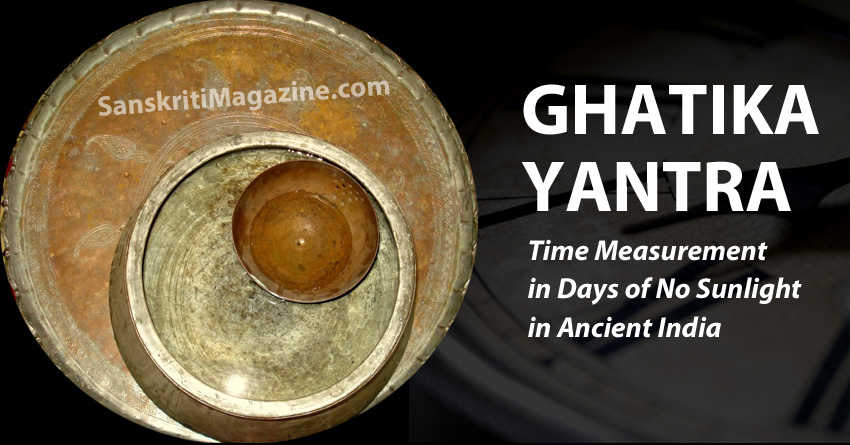
A simple stick in the ground can be used to create a sun dial, but what do you do when there is no sun, such as on a cloudy day. Ancient Indians devised a different type of clock, one that is based on water, called as Ghatika Yantra.
The description of a water clock in astrologer Varahimira’s Pancasiddhantika (505) adds further detail to the account given in the Suryasiddhanta. The description given by mathematician Brahmaguptha in his work Brahmasphuta Siddhanta matches with that given in the Suryasiddhanta. Astronomer Lallacharya describes this instrument in detail. In practice, the dimensions were determined by experiment.
How Did Ancient Indians Measure Time In Days of No Sunlight ?
During ancient and medieval times time was measured in India by a water clock called Ghatika. Indians had divided day and night into 60 parts, each of which is called a ghari. Moreover the night and day are each divided into four parts each of which is called pahar. In all important towns, a group of men called ghariyalis were appointed to measure time. To measure time a vessel with a hole at the bottom was place over another big vessel containing water.
When the vessel with the hole was filled with water, they used to strike the ghariyal, a thick brass disc hung at a high place with a mallet.This indicated a certain period of time. The Chinese traveler who visited India during the 7th century A.D had given an account of how this clepsydra (water clock) worked at Nalanda. Commencing from the morning at the first immersion of the vessel, one stroke of a drum was sounded, at the 2nd immersion, two strokes, at the 3rd immersion, three strokes and at the 4th immersion, two blasts of a conch-shell and one more beat of a drum were added to the announcement. This period was called the first hour, when the sun was in the east between the zenith and the horizon.
When the 2nd turn of the 4th immersion of the vessel was over, four strokes of the drum were struck, a conch blown and two more strokes sounded. This time known as the 2nd hour was previously the horse hour of the beginning of the noon. Similarly two hours were sounded in the afternoon and four in the course of the night also.
It works on very simple mechanism, it consists of a copper cup with a small hole at its bottom in large water bowl/tank, and every time the cup sank a gong was sounded. When it sinks in and touches the bottom, that’s fixed time probably around 30 minutes( depends on the materials made and their sizes).