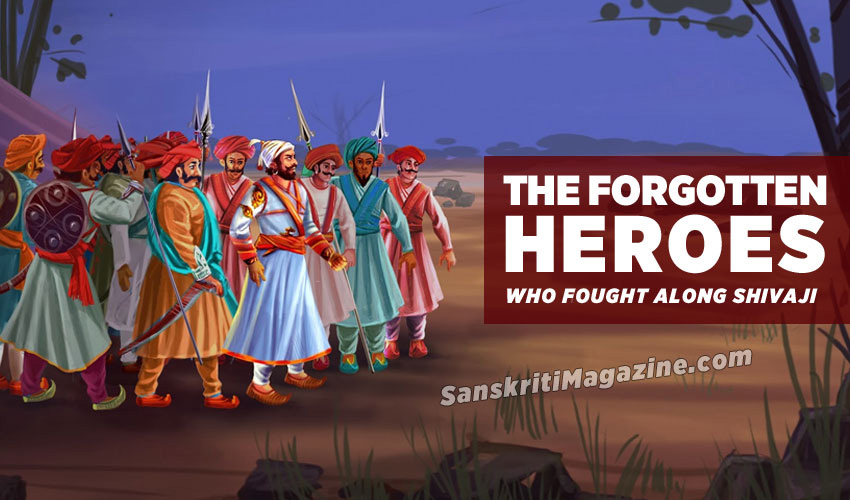
The year was 1665. Diler Khan, Emperor Aurangzeb’s Pathan commander, had laid siege to the gigantic fort of Purandar near Pune. Behind the massive walls were Chhatrapati Shivaji’s soldiers led by Murar Baji, a Kayastha commander. With just 60 men, Baji stormed the Mughal army, slaying 500 Pathans. Legend has it that Khan stopped the battle midway and addressed Baji, “I have never seen a braver soldier and better swordsman than you. We will be privileged to have you. Join us and you will be rewarded.” Baji refused. In the ensuing battle, he was killed by an arrow shot by Khan.
During the 17th century, the Marathas stood fast against Aurangzeb, not allowing him to venture into their lands even once. Maratha generals like Santaji Ghorpade, Dhanaji Jadhav, Vithoji Chavan Himmat Bahadur, Kanhoji Jedhe and Shivaji’s son-in-law Harji Rajemahadik repeatedly defeated the Mughals in south India between 1685 and 1707. They captured many Mughal generals till Shivaji’s death in 1680, after which Aurangzeb left Agra for south India to annihilate them. It took Aurangzeb 22 long years to defeat the Marathas in the south.
The Marathas-along with Shivaji and his two sons, Sambaji and Raja Ram – are household names in Maharashtra today. Many others share the honour-Shivaji’s commander-in-chief Hambirrao Mohite; Muslim commanders Noor Beg and Darya Khan; and Khanderao Dabhade, who headed the Maratha army under Shivaji’s grandson Sahu, and Bajiprabhu Deshpande, who sacrificed his life to save Shivaji in 1660 during the famous battle of Pawankhind.
This small group of soldiers was not just blueblooded Kshatriyas, the warrior clan, but people from all sections of society, including high-caste Brahmins-like Moro Pant Pingle and Shankaraji Narayan-and low-caste barbers as well as Muslims. While Shivaji is the most famous name in Maratha history, these unknown warriors are hardly known outside Maharashtra.
Four centuries down the line, descendants of these soldiers live a middle-to-higher middle-class existence in and around Pune and Kolhapur in wadas (havelis) and modern bungalows. Some are farmers; others are professionals and businessmen. The descendant of Jiva Mahale –Shivaji’s bodyguard who saved him by killing Bijapur’s general Afzal Khan-lives in poverty. But the one thing that binds them together is pride in the deeds of chivalry and loyalty of their ancestors and an urge to live up to their great reputation.
Ranojirao Ghorpade, grandson of Shivaji’s general Santaji Ghorpade, an ace marksman and a one-time hunter, is bitter. “When India fails to give an effective reply to Pakistan’s covert aggression, I feel like picking up a gun and taking on the Pakistanis in the tradition of my ancestors. I regret I didn’t join the army.” His grandfather had continued to fight Aurangzeb’s armies after the death of Sambaji, who was killed by the emperor for not converting to Islam. Ranojirao is a farmer in his ancestral village of Kapshi near Kolhapur; his living room boasts of 103 hunting trophies.
Like Ranojirao, Dilip Singh Himmat Bahadur Chavan is also a farmer in Nigwe near Kolhapur. His ancestor Vithoji earned the title of Himmat Bahadur from Shivaji’s son Raja Ram for his bravery against the Mughals. He says, “History has not given generals like Santaji Ghorpade, Dhanaji Jadhav and Vithoji their true place. They had terrorised Aurangzeb and had almost captured him once.” The trio once entered Aurangzeb’s camp, plundered it and cut off the penants at its gate.
Vikramsinhraje Jadhavrao, the Raja of Malegaon Budruk near Baramati and a descendant of Dhanaji Jadhav, is a builder in Pune, known for getting slumdwellers good deals for their land and constructing buildings on them. “The new generation is still tuned into history and culture, at least in Maharashtra.”
~ Uday Mahurkar