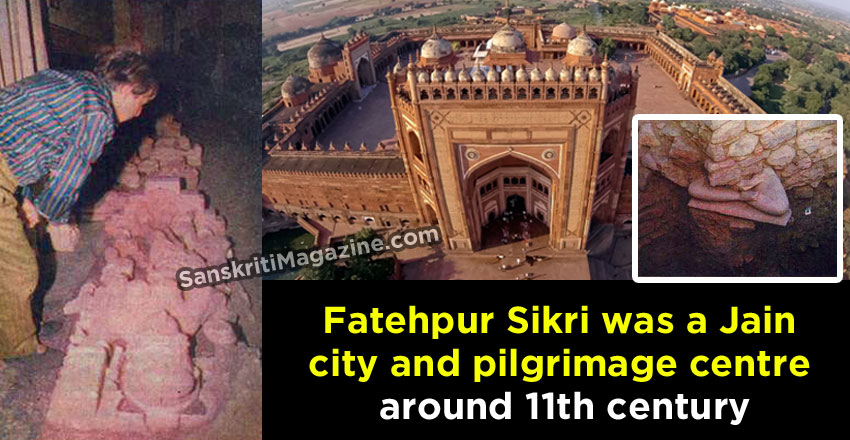
Fatehpur Sikri, that Mughal emperor Akbar established as his capital and is now a World Heritage site, was once a “flourishing trade and Jain pilgrimage centre”.
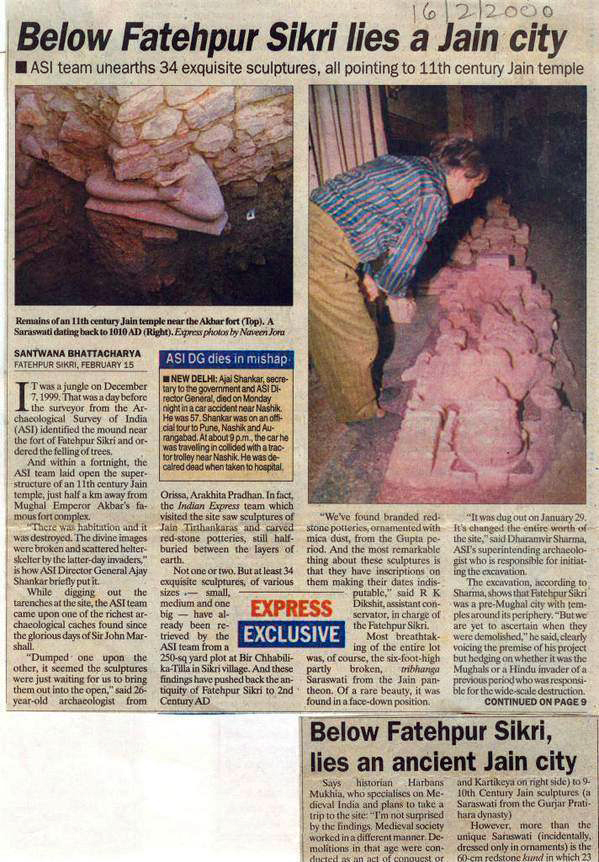
Basing his arguments on the excavations by the Archaeological Survey of India (ASI) in 1999-2000 at the Chabeli Tila, senior Agra journalist Bhanu Pratap Singh said the antique pieces, statues, and structures all point to a lost “culture and religious site,” more than 1,000 years ago.
“The excavations yielded a rich crop of Jain statues, hundreds of them, including the foundation stone of a temple with the date. The statues were a thousand years old of Bhagwan Adi Nath, Bhagwan Rishabh Nath, Bhagwan Mahavir and Jain Yakshinis,” said Swarup Chandra Jain, senior leader of the Jain community. The Jains comprise about 0.4 percent of India’s population of 1.2 billion and are a generally religious, prosperous and literate community.
Historian Sugam Anand said: “The findings should have led to serious research, but that was not done. You need time and resources. Definitely before Akbar built his capital in Fatehpur Sikri, there is proof of habitation, of temples and commercial centres. The open space on the ridge was used by Akbar to build his capital. But we still need a lot of research.”
The statues and artifacts discovered buried in a pond have been kept in a guest house in Fatehpur Sikri by the ASI.
Bhanu Pratap Singh, the author of “Jain Dharm Ka Pramukh Kendra Tha Fatehpur Sikri,” said: “Sikri existed much before Akbar. The excavations have clearly established this fact.”
D.V. Sharma, former superintending archaeologist of the ASI in Agra, who supervised the excavations, said: “We found scores of damaged statues piled up, and with dates, also a manuscript. These are now lying in the guest house at Fatehpur Sikri. They should have gone ahead with the excavations and engaged historians to research on the subject.”
“My book on Fatehpur Sikri excavations is there in the ASI library with complete details of the findings which unmistakably point to a flourishing trade and pilgrimage centre of both the Jains and the Sikarwars. Akbar built a few structures and modified others that were already there. Who demolished the temples and the statues is a subject which further research alone can establish,” Sharma added.
The ASI, for reasons known only to itself, abruptly stopped excavations at Fatehpur Sikri. “Had they pursued and dug up all the mounds, startling revelations would have been made that would have changed the course of our historical understanding,” Bhanu Pratap Singh claimed.
Prior to the excavations in 1999, the ASI, in its various publications, had categorically stated: “Before Akbar’s time, the higher ridge was uninhabited, its former glory and present fame are the result of a sufi saint’s choice of it as a hermitage.”
But ASI’s documents do refer to Sikri village, “a site full of interest and promise for archaeological exploration”.
Bhanu Pratap Singh said the Fatehpur Sikri area was under the Sikarwar Rajputs, who had many structures and palaces, including a fort and temples, which were either demolished or suitably modified by the Mughals and before them by the Muslim rulers. Fatehpur Sikri was earlier Vijay Pur, according to the ASI’s D.V. Sharma.
The Jain community in Agra plans to develop a museum in Fatehpur Sikri to tell the world “the real history of the area”, according to philanthropist Ashok Jain, a chartered accountant.