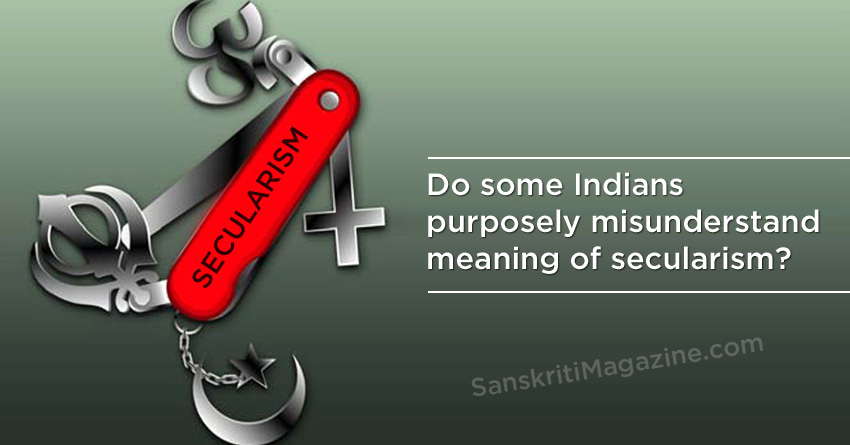
Do you remember the frenzied appeals to the Indian electorate before the elections in May 2014 to vote “secular”? They came from all quarters – from Bollywood, from “intellectuals”, and even from American universities. The foreign press had already given up. They were certain that the electorate would make a big mistake and vote communal instead of secular.
They all had underestimated the Indian masses. They did not vote communal. Grudgingly, even the foreign press now acknowledges that the voters did not make the big mistake they had predicted. However, several intellectuals and Christian and Muslims in India still feel that the electorate did vote “communal” and not secular. Those people clearly don’t understand the concept of secularism, which basically means that the demands by dogmatic religions are ignored by the state. Yet Dharma of course should not be ignored.
Let me explain, since secularism is a western ‘invention’:
Contrary to the perception of some Indians, secular is not the opposite of communal. Communal as such is not objectionable either. It simply means ‘pertaining to a community’.
Secular is the opposite of ‘religious’ and means worldly. Now ‘religious’ in this context referred to Christianity – to a well-organized, dogmatic religion that claims that it is the sole keeper of the ‘truth’ which was revealed by God himself.
Now this truth does not make sense as such, but has to be believed blindly. In short: some 2000 years ago, the creator-God had mercy on ‘sinful’ humanity, and sent his only son Jesus to earth to redeem us by dying for our sins. However to be able to get the benefit of Jesus’ sacrifice, one must be baptized as a Christian, otherwise one will be singled out for eternal hell on Judgment Day.
Such claims did not appeal to Europeans who used their brains, but for many centuries they had to keep quiet or risk their lives. The reason was that for long the Church was intertwined with the state, and harsh laws made sure that people did not question the ‘revealed truth’. Heresy was punished with torture and death.
Significantly, those centuries, when Church and State were intertwined, are called the dark ages. And the time when the Church was forced to loosen its grip, is called the age of enlightenment. Scientific discoveries, which could no longer be brushed under the carpet, played a crucial role for putting the Church into place. A new idea took root in the west: Reason, not blind belief, should guide society and this lead to the demand for separation between State and Church. Such separation is called secularism. It is a recent phenomenon.
In India, however, the situation was different. Here, the dominant faith never had a power centre that dictated unreasonable dogmas and needed to be propped up by the State. Their faith was based on insights of the Rishis, reason and direct, inner experience. It expressed itself freely in a multitude of ways. Their faith was about trust and reverence for the One Source of all life. It was about The Golden Rule: not to do to others what one does not want to be done to oneself. It was about having noble thoughts. It was about how to live life in an ideal way.
However, this open atmosphere changed when Islam and Christianity entered India. Indians, who good naturedly considered the whole world as family, were despised, ridiculed and under Muslim rule killed in big numbers only because they were ‘Hindus’. Indians did not realise that dogmatic religions were very different from their own, ancient Dharma. For the first time they were confronted with merciless killing in the name of God.
Guru Nanak left a testimony how bad the situation was, when he cried out in despair: “Having lifted Islam to the head, You have engulfed Hindustan in dread…. Such cruelty they have inflicted, and yet Your mercy remains unmoved…” (Granth Sahib, Mahla 1.360 quoted from Eminent Historians by Arun Shourie).
In spite of the ruthlessness of the invaders, Hindu Dharma survived in India, whereas the west succumbed to Christianity and over 50 countries to Islam in a short span of time.
Though Hindu Dharma survived and never dictated terms to the state, ‘secular’ was added to the Constitution of India in 1976. And indeed, since Independence, several non-secular decisions had been taken which favoured the dogmatic religions. For example, Muslims and Christians had pushed for special civil laws and got them.
However, after adding ‘secular’ to the Constituion, the situation did not improve. The government continued to grant benefits specifically to the dogmatic religions.
This was inexplicable. Why would ‘secular’ be added and then not acted upon? And the strangest thing: ‘secular’ got a new, specific Indian meaning. For decades it meant: giving in to demands by those two big religions which have no respect for Hindus and whose dogmas condemn all of them to eternal hell.
It is an irony. Islam and Christianity that have gravely harmed Indians over centuries, got preferential treatment by the Indian State, and their own beneficial dharma that has no other home except the Indian subcontinent, was egged out. And to top it, this was called ‘secular’!
The Indian electorate however understood that secularism in India meant ‘favouring Christianity and Islam’, and communalism meant the motto by which Modi had tried to govern Gujarat: “Justice for all and appeasement to none”. So the people of India voted overwhelmingly for Narendra Modi.
Yet media and several politicians still try to peddle their wrong understanding: They still call political parties that represent a religious group, ‘secular’, instead of ‘religious’. Why would they do this? Do they want to give Indians first-hand experience of the dark ages that had haunted Europe when the Church wielded power or of the experience when Sharia rules?
However, western secular states are not role models either. There is a lot of depression, drug abuse, alcohol and people are generally not happy in spite of doing everything to ‘enjoy life’. Here, India has an advantage. Her rishis have left a great heritage of valuable treatises not only dealing with how to live life in an ideal way, but also how to conduct economy, politics, diplomacy, etc. If those guidelines are considered, and if India becomes a state based on her ancient dharma, she has good chances to regain the lost glory as the wealthiest country in the world whose citizen are open-minded and contented.
-by Maria Wirth