IndianSanskriti

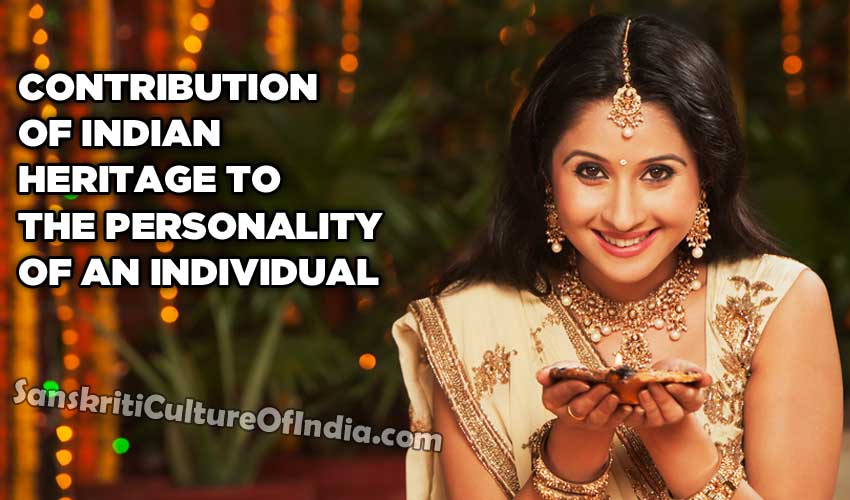
Contribution of Indian Heritage to the Personality of an Individual

The rich heritage of India has contributed to the growth of Intrapersonal development which can be understood as the development which takes place within a person.

Intrapersonal development results in changes in the attitudes, ideas, values, norms and entire personality of an Individual. The impact of heritage on intra personal development can be analysed as follows:

Ethical Values:

The concept of Dharma, religious heritage, has resulted in the development of ethical values such as a sense of ‘right’ and wrong.

Morality:

Moral values such as respect for elders, love and affection for youngsters, respect for women are developed out of Indian heritage.

Sense of unity:

Celebration of various festivals such as Deepavali, Ramzan, Dussehra, Christmas etc. develop a sense of unity among people.

Spirit of tolerance:

It is developed out of Indian heritage. Indians are broad minded and they exhibit a higher degree of tolerance. It is evidenced by ‘unity in diversity’.

Flexibility:

 Indians are adaptable to changes. They are not rigid. It is evident from the fact that many Indians are settled in foreign countries and living a peaceful life.

Loyalty:

The basic institutions of India such as marriage and family nurture values like loyalty towards the life partner, family members etc.

Self control:

Indian religious heritage imposes certain restrictions on food habits, and gratification of other biological needs. It also emphasises the performance of certain rituals. The ‘Hindu’ religion in particular identifies certain stages of life through various “Ashrams”. Such as Brahmacharya, Grihsta Sanyasa and Vanaprasta. Each stage signifies a particular code of conduct.

Work culture:

The great epics like Bahagavad Gita preach that one should be sincere towards work without thinking of the results.

~ Puja Mondal
You may also like

Search the website

Like us on Facebook

Get daily updates via Email

Enter your email address:

Recent Posts

Yogini Ekadashi 2026 — The Yaksha Who Missed the Morning Flowers, and the Ekadashi That Undid His Curse

On Friday, July 10, 2026, the rare Krishna Paksha Ekadashi of Nija Ashadha arrives. The Padma Purana tells the story of Hemamali — the Yaksha gardener of Bhagavan Kubera in Alaka, whose single morning of distraction with his wife Vishalakshi cost him his form, his wife, and his celestial city. Cursed to wander the earth of Bharata as a leper for a long time, he was at last shown the way back by Sage Markandeya — a single sincere keeping of Yogini Ekadashi.

Jamai Shashthi 2026 — The Story of Maa Shashthi, the Cat, and the Wife Who Was Forgiven

Jamai Shashthi 2026 — The Story of Maa Shashthi, the Cat, and the Wife Who Was Forgiven

On Saturday, June 20, 2026, Bengali households across Bharata will welcome their married daughters and sons-in-law home for the legendary jamai-aador feast and perform the Shashthi Vrata. But behind the warmth lies a story most Bengalis know by heart and most non-Bengalis have never heard — the wife who stole the hilsa, blamed the cat, lost six sons to Maa Shashthi’s wrath, and was finally forgiven. The Vrat Katha, the vidhi, the mantras, and the deeper teaching.

Vat Purnima 2026 — The Wife Who Argued Yama Into Returning Her Husband’s Life

On Monday, June 29, 2026, women across Maharashtra, Gujarat, and southern Bharata will tie red thread around banyan trees and hear the story of Savitri — the wife who walked behind Yamaraja Himself when He came for her husband, and out-argued the Lord of Dharma into returning Satyavan’s life. The Mahabharata’s Pativrata Mahatmya Parva, the vrat vidhi, and why the banyan witnessed everything.

css.php