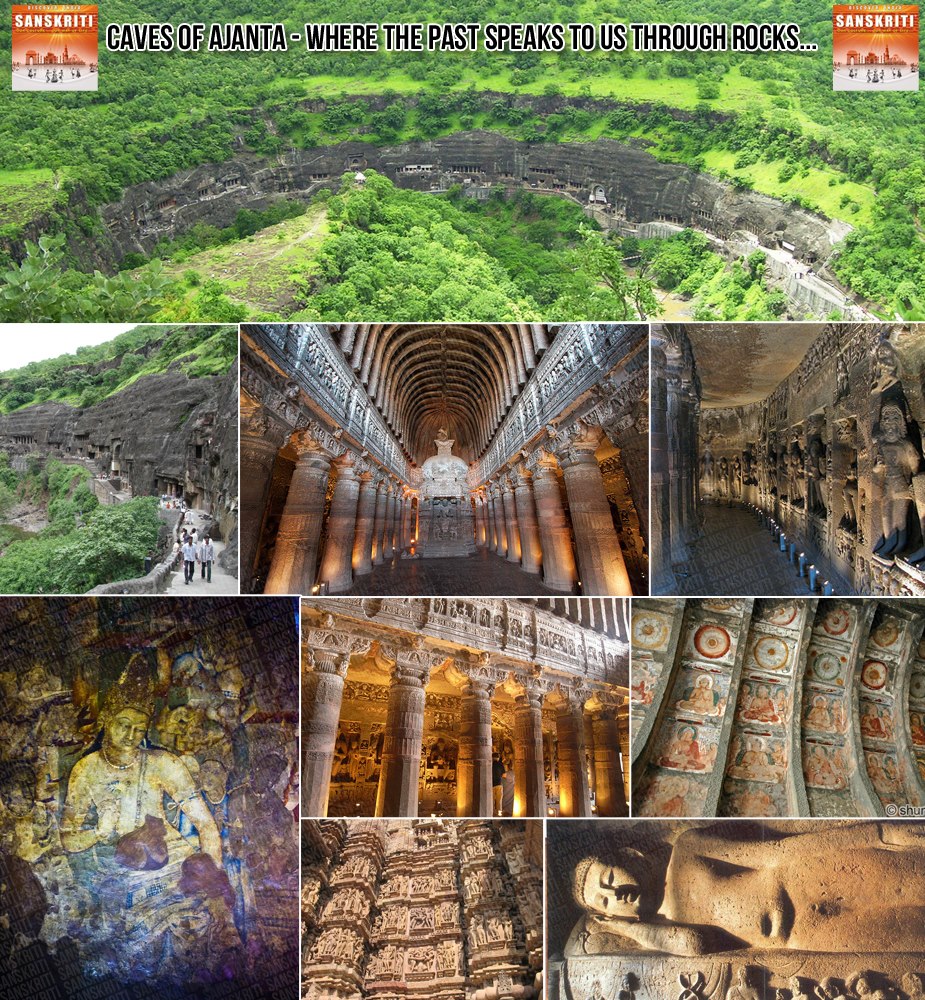
Twenty-two hundred years ago, work began on an extensive series of cave monuments in Maharashtra, India. Over a period of hundreds of years, thirty one monuments were carved piece by piece from the rock face. Then, for some unknown reason, they fell into disuse around 1000AD, slowly surrounded by dense jungle which eventually hid the caves away from human eyes. These caves lay undisturbed for hundreds of years until April of 1819, when a British officer by the name of John Smith accidentally rediscovered a doorway to one of the temples while hunting for tigers. His name and date is still visible even today, where he vandalised one of the walls.
This rediscovery of the caves brought tourists from all across India and around the world to see this wondrous site that had suddenly been given back to the world.The nearest human habitation is Ajinṭhā, a tiny village a few miles away from the caves. The sanctuaries, which are known as chaytia-girhas date from the second century before Christ. They were used primarily as prayer halls and are similar to an extent to the contemporary Roman designs of arch and column. However, these sanctuaries were carved from the immense rock face of the caves, with chisels and, indeed, bare hands.
The first caves were carved from the bare rock at the time of The Sātavāhana Empire which started around 230BC. The Sātavāhanas brought peace to India after several foreign invasions and the decline of the previous, Mauryan Empire. It is not without irony, then, that they were rediscovered by a contemporary invader and representative of a foreign empire.
Although there is widespread debate about the time at which the second period of building took place most now agree that it was probably during the reign of Harishena, from 460AD and over a period of around twenty years. This architectural flowering saw the creation of twenty temples which were used as monasteries.
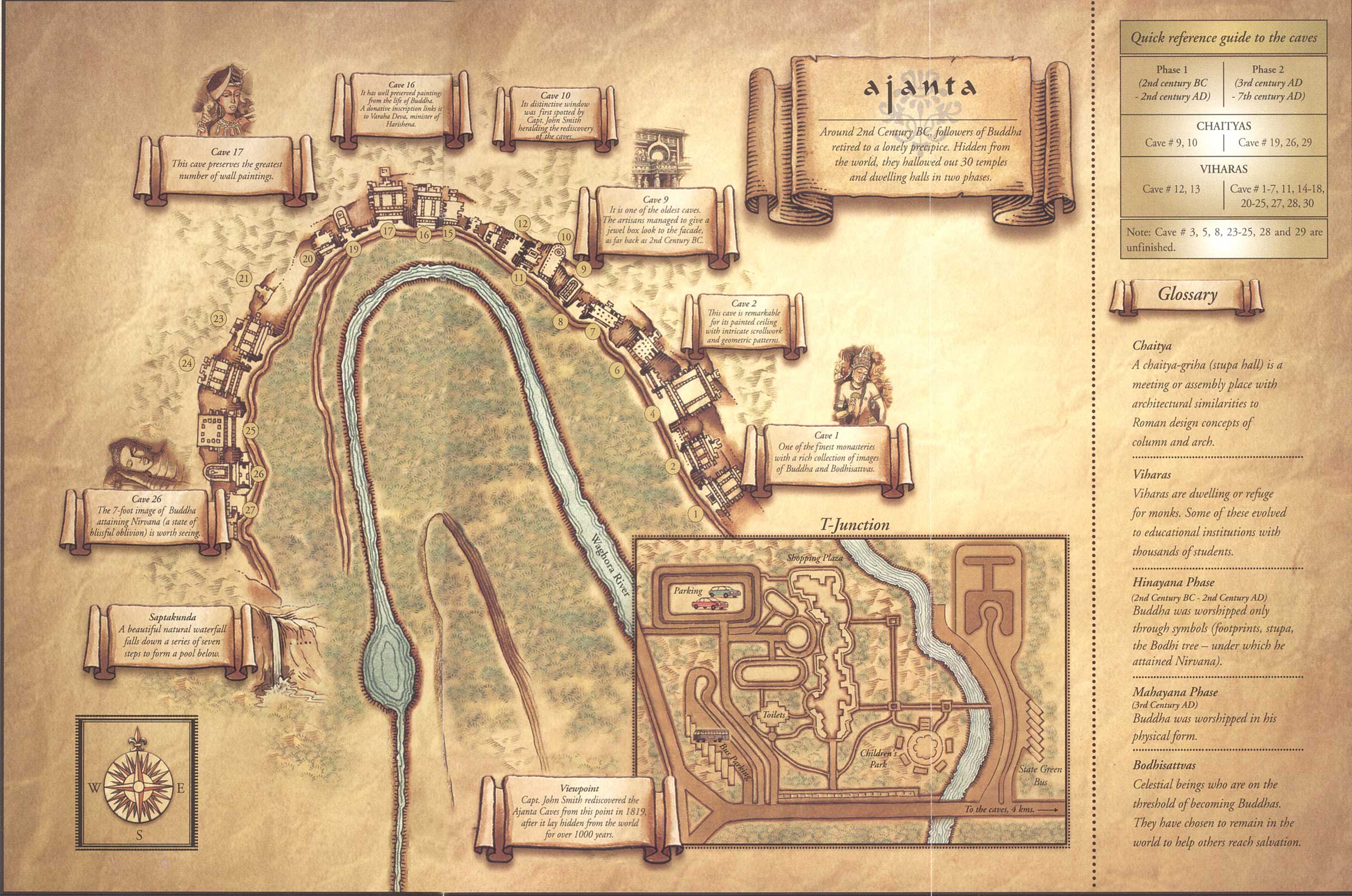
DETAILED MAP OF THE CAVES:
There are paintings everywhere – literally. Every surface apart from the floor is festooned with narrative paintings. Time has taken a serious toll on these marvellous works with many parts simply just fragments of what they were when first created. The stories are almost wholly devoted to Jātakas – tales of the Buddha’s previous lives. These 547 poems were painstakingly and lovingly painted on to the walls by devotees.They were created using an ancient method. The surface was chiselled so it was rough and could hold plaster which was then spread across the surface. Then the master painter would, while the plaster was still wet, commence his work. The colors soaked in to the plaster and so became a part of the surface. Although this meant that it would not peel off as easily, perhaps not even the painters foresaw the temples persevering for over two thousand years.No one knows for sure when and why the caves were abandoned – whether it was a gradual desertion of some event of political and social magnitude took place which precipitated the neglect and final vacation of the site.Yet for hundreds of years the place remained forsaken, to be rediscovered that fateful day in 1819 by John Smith.
Ajanta is also a World Heritage site by UNESCO- http://whc.unesco.org/en/