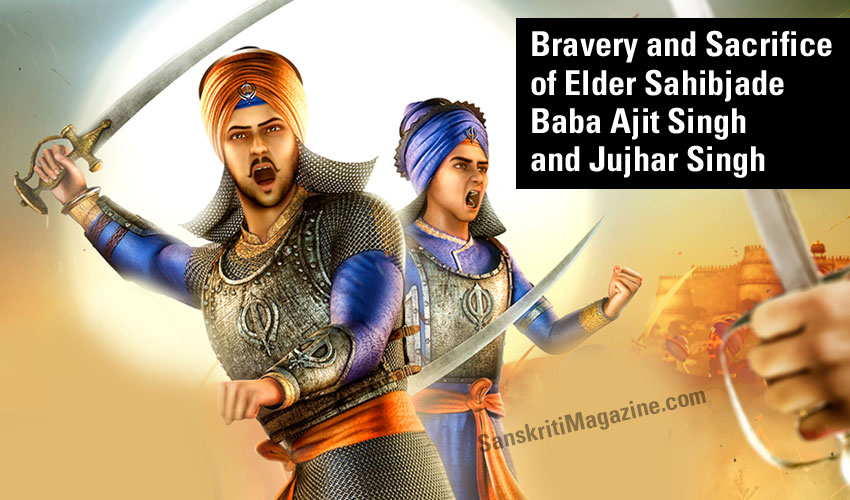
Baba Ajit Singh, Baba Jujhar Singh, Baba Zoravar Singh & Baba Fateh Singh – these names are reverently preserved in Sikh memory and are recalled every time Sikh ardas or prayer of supplication is recited.
The martyrdom of the four sahibzade is an important part of Sikh history and this occasion is remembered and commemorated both with great vigor and very acute sadness, by large numbers of Sikhs, every year in December.
The 21st and 26th of December are days that hold very dear memories for Sikhs around the world, for it was on these days in 1705 that the older sahibzade Baba Ajit Singh and Baba Jujhar Singh first set off for their heavenly abode on the 21st and then on the 26th, as the delicate and tender light of the younger Sahibzade, Baba Zorawar Singh and Baba Fateh Singh was cruelly and inhumanely extinguished by the Mughal ruler of Sirhind.
The Saga of the Vade Sahibzade:
Under the pressure of a prolonged siege with food and ammunition exhausted, Guru Gobind Singh and 400 Sikhs left Sri Anandpur Sahib on the bitter cold and rainy night of December 20, 1704. In the early hours of the [intervening night of 20,21,December 1704] at the rivulet Sarsa, at a distance of about 25km from Anandpur Sahib, the Guru and his Sikhs were attacked by the Mughal army, breaking their oath of assuring safe conduct. In the confusion, which followed the attack in the cold and darkness, many Sikhs became Shaheed (martyrs).
Guru Gobind Singh writes in the Zafarnama:
“Aurangzeb! I have no trust in your oaths anymore. (You have written that) God is one and that He is witness (between us).”
I don’t have trust equivalent to even a drop (of water) in your generals (who came to me with oaths on Koran that I will be given safe passage out of Anandgarh Fort). They were all telling lies.
If anyone trusts (you) on your oath on Koran, that person is bound to be doomed in the end.”
A group of Singh’s fought the armies, keeping them back while the rest of the Sikhs, Guru Sahib and Guru Sahib’s family crossed the rivulet in the heat of the battle. Many Sikhs perished attempting to cross the frigid waters of the turgid, rain swollen rivulet. During the confusion, the Guru’s mother and his two youngest sons got separated from the Khalsa forces. Of the 400 hundred that had left Anandpur, only the Guru, his two eldest sons, the [Panj Piaras] ( Five Beloved ones) and 40 Sikhs were able to cross the river and regroup on the other side.
Gurdwara Parivar Vichora has been built on the spot of the battle, during which the Guru’s mother and his two youngest sons got separated from the band of Sikhs.
On 21 December 1704, Guru Sahib, Panj piaras and 40 Singhs camped in an open space in Chamkaur. In the evening Guru with his sikhs took control of Kachi Garhi a Mud fortress on a small hill.
Mughal generals, yelled over the wall, “Gobind Singh! If you and your Sikhs come out now, you will be spared!” Guru Sahib replied to this with a rain of arrows. There was silence now in the cold morning. Clouds filled the sky followed by thunder and lightening. Guru and the Singhs became ready for the battle.
First one Singh came out and when he was about to become Shaheed (martyr), he roared the Jaikara (slogan) of “Sat Sri Akal!” As soon as the sound of “Sat Siri Akal” echoed throughout the battlefield, the next Singh came out to fight in the battleground. The Nawab was astonished at what these Singhs were made of. He remembered the sayings of the Sikhs that “One Sikh equaled Sava Lakh (125,000)” – the bravery of one Sikh is equal to that of 125,000 ordinary men.
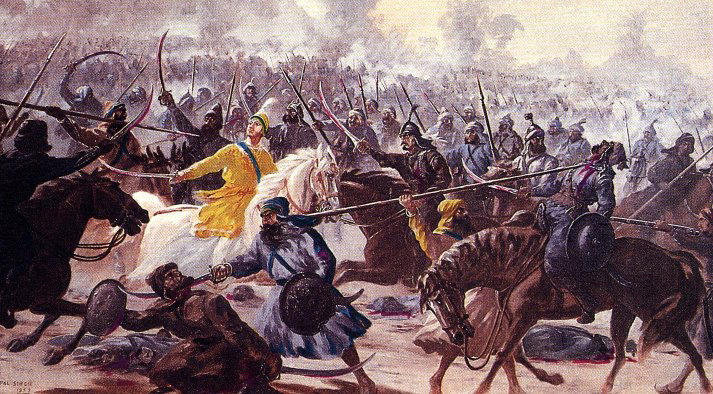
Baba Ajit Singh enters the battlefield:
Baba Ajit Singh then went before Guru Sahib and said, “Pita ji (dear father), permit me to go and fight on the battleground and grace me with the opportunity to make my life fruitful and worthy in service of the panth.”
Guru Gobind Singh hugged his beloved son and gave him a Shastr (weapon). Little of a beard or moustache had yet appeared on Baba Ajit Singh ‘s face, showing how young he was.
Baba Ajit Singh boldly and valiantly came out of fort, accompanied with 5 other Singhs, which included one of the original Panj Piarey, Bhai Mohkam Singh and advanced swiftly onto the battlefield displaying great courage, bravery and skills with weapons.
The Singhs’ weaponry skill on the battlefield reminded the Mughal soldiers of Ali their fabled warrior, and they feared for their lives. While fighting, Baba Ajit Singh’s kirpan(sword) broke. He then began to fight with a Neja (spear).
Now as the army surrounded the sahibzada, the Guru watched with keen interest to see how bravely his son would live his last few minutes of life.
When Baba attained Shaheedi, Guru Sahib roared a Jaikara of “Sat Siri Akal” full of emotions and courage – a salutation to the Almighty for the blessing of such a brave and noble son.
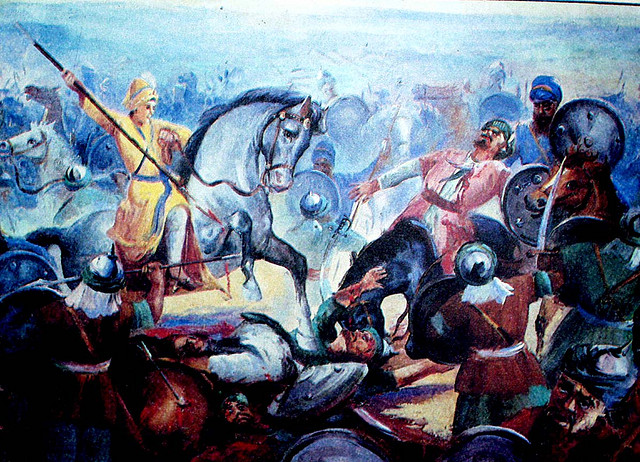
Baba Jujhar Singh goes into battle:
The news of Baba Ajit Singh attaining Shaheedi (martyrdom) spread. Hearing the news of his brother, Baba Jujhar Singh now desired to fight in the battlefield.
He asked Guru Sahib, “Permit me, dear father, to go where my brother has gone. Don’t say that I am too young. I am your son. I am a Singh, a Lion, of yours. I shall prove worthy of you. I shall die fighting, with my face towards the enemy, with the Naam on my lips and the Guru in my heart.”
Guru Sahib gave blessings to Baba Jujhar Singh and added, “I asked my father to give his life for “dharam” (righteousness and justice). Today, what I told my father, I now tell you son.”
Bhai Himmat Singh and Bhai Sahib Singh (two of the original Panj Piarey) along with 3 other Singhs accompanied Sahibzada Baba Jujhar Singh . The Mughals were shocked at what they saw. To the enemy, it looked as if Ajit Singh had come back.
“Whoever dies, let him die such a death, that he does not have to die again. (1)” (Ang 555, SGGS)
The enemy was stunned by the heavy force and thrust of this second attack and had little choice but to retreat back. The Khalsa unit created a huge void in the enemy territory and a small circle of about 35 metres within the enemy ground was under the control of the Sikhs. For over 2 hours the Khalsa unit had continued to desolate the enemy. They were becoming tired.
So Guru Sahib fired volleys of arrows in the area around the Sahibzada’s unit giving ‘protection fire’ to the Sikh soldiers. Baba ji and the 5 Singhs demonstrated the Sikh concept of one equaling the bravery and courage of “Sava Lakh” (125,000) humans.
Baba Jujhar Singh attained Shaheedi but died a hero’s death in the fight against tyranny and falsehood.
“That person alone is known as a spiritual warrior, who fights in defence of religion. They may be cut apart, piece by piece, but they never leave the field of battle. 22.” (Ang 1105, SGGS)
This was truly a sign of a dedicated warrior! By the time Baba Jujhar Singh had attained Shaheedi nightfall had arrived and the moon could be seen in the sky. Guru Sahib wrote in his composition, the Zafarnama:
“What trust can I have on your oath on Koran? Otherwise, why should I have taken this path of taking up the sword?” (Line 23, Zafarnama)
~ Excerpted from SikiWiki