Humans have been organizing themselves in some sort of collective national structure since time immemorial. As much as many intellectuals, including Rabindranath Tagore, may argue that nationalism is a Western construct, which doesn’t apply to India, or advocate the concept of a wider community of humanity, the value of the nation in the lives of its people cannot be trivialised.
While these intellectual ideals are definitely worth pursuing, it is critical to factor in the harsh reality of human nature that has determined the history of humanity and shaped political boundaries. Weak states and kingdoms have been wiped out and untold sufferings have been unleashed on their populace. The ‘nation’ plays a major role in the lives of individuals by providing security and a larger identity. Just like people need the protective umbrella of the nation, the nations itself needs symbols to rally, inspire, and unite its people.
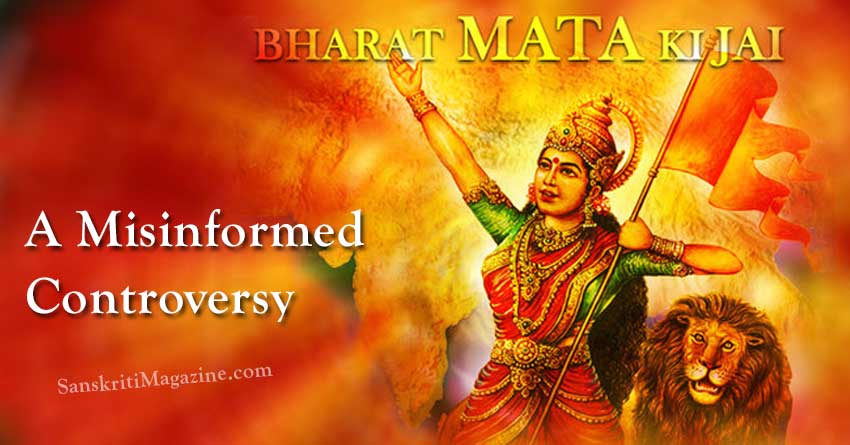
 Flags, national anthems, and emblems are amongst the most prominent symbols that define nations today. The slogan, “Bharat Mata ki Jai” is one such symbol for India and gained widespread acceptance and usage during India’s freedom struggle. This slogan can be translated to mean “long live Mother India” or “victory to Mother India”. The word ‘mata’ is a popular synonym for ‘mother’ and not just another word for ‘goddess’. While some artists may have chosen to interpret and depict Bharat Mata as a goddess, it is by no means a religious slogan or symbol. Think of it as a salute to the Motherland, or ‘matribhoomi’ as it is known in Hindi.
Respect for mothers is an integral part of Indian culture. Hindus, Muslims, Sikhs, Christians, and all other communities virtually venerate the mother. It is natural for this veneration to be extended to the nation as well. To portray the country as the mother is to assign it maternal attributes like affection, nurturing, and fertility, which are again, completely religion neutral.
Most Indian Muslims see this rationale and therefore have never had a problem saying these words. Those who do object to it, either incorrectly interpret the meaning of the slogan, or are being misguided by those with vested interests. Delhi’s Lt. Governor Najeeb Jung and poet Javed Akhtar are amongst the several prominent Indian Muslims who have come out in support of the slogan.
With that said, it is perfectly ok if someone doesn’t want to say ‘Bharat Mata ki Jai’, especially since that alone cannot be a yardstick to judge one’s patriotism. Nowhere has the government made it a mandate either. At the same time, it is also clear that chanting it is not a religious act and does not violate the tenets of the Islamic faith. So just as people should not be forced to chant the slogan, there should be no communal diktats to not chant it either.
When there is no religious element involved, it begs the question about why radicals like Owaisi and are showing such extreme resistance and making such a big deal out of it. Is it just opportunistic posturing to stir the pot of communalism in these sensitive and highly charged times? Or are there deeper issues that are playing out?
The answer to this question lies in the uneasy coexistence of the larger pan-Islamic identity and Indian nationality in the minds of some Indian Muslims. The moment the Indian identity becomes secondary, it opens up avenues for conflict with the interests of the Indian nation.
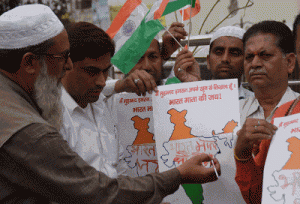 Feelings of nationalism, like love and all other personal emotions, cannot be imposed. For a nation to be truly successful, its citizens must give it primacy over secondary identities such as religion, ethnicity, or language. It is the duty of the citizens to cherish and respect their nation and the nation’s duty to value each individual and allow them the liberty to fully express themselves. An important aspect to consider here is the fact that Rabindranath Tagore was critical of the idea of hyper nationalism or actively seeking homogeneity. Citizens must be free to imagine the nation based on their own idea and ideals. In a diverse and heterogeneous country like India, this is even more relevant. However, there has to be a distinction between not being nationalistic and being anti-national. Not loving someone is not the same as hating them.
In order for this arrangement to function effectively in the Indian context, it is vital for that segment of Indian Muslims to stop seeing themselves through the prism of an Arab driven identity and as exceptions to the fabric of India. Most Indian Muslims are of sub-continental ethnic stock and not of Arab, Turk, or Persian descent. The understanding and acceptance of their Indic roots and civilizational context will lead to smoothening out a lot of the fissures and conflicts that keep erupting in the sub-continent. The comments of Tarek Fatah, a Pakistani author and intellectual, are illuminating in this regard.
Muslims are an integral part of India and are as attached to its soil as any other community. They have made vital contributions to its progress and have also had the opportunity to flourish in its secular and inclusive ecosystem, again, like any other community. Feelings of ‘otherness’ or victimhood are counterproductive since all Indians face common challenges in the path to greater peace and prosperity. Moreover, Islamic heritage and symbols have had widespread, unconditional acceptance and bear significant influence on India’s cosmopolitan identity.
The spirit of give and take becomes an important healer when rifts surface. Just as there is no coercion to chant any slogan, a certain amount of grace and sensitivity towards symbols that have great meaning for a large segment of a country’s population is also vital. Peaceful co-existence and progress are only possible when everyone rises above petty differences and rallies towards the common good. Drawing from shared roots and civilizational ethos are perhaps a good way to make the beginning and strengthen the nation.
~ Amit Nangia