IndianSanskriti
Ancient-`sunken-town'-found-off-Tamil-Nadu

Ancient `sunken town’ found off of Tamil Nadu coast

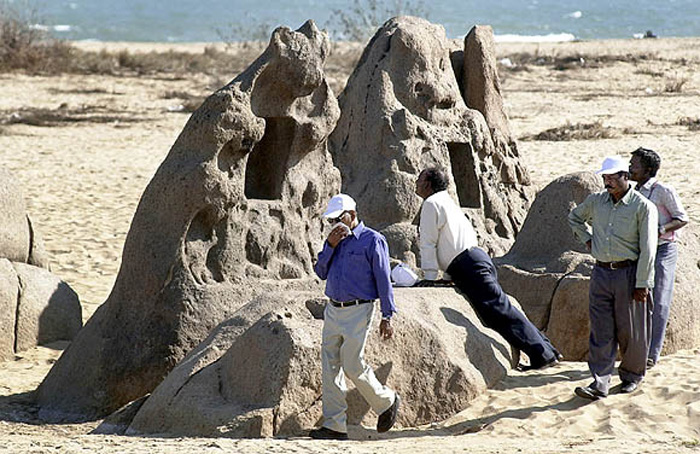
CHENNAI: When the shoreline receded during the 2004 tsunami, tourists in Mamallapuram swore they saw a long row of granite boulders emerge from the sea, before it was swallowed again as the water hurtled forward. More than a decade later, a team of scientists and divers have uncovered what eyewitnesses saw on that fateful day -vestiges of an ancient port.

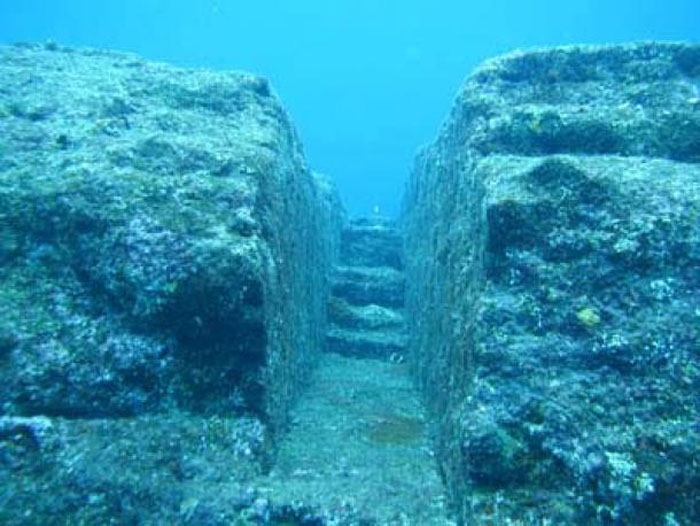
In a discovery that could lead to more underwater explorations off the historic town of Mamallapuram, a group from National Institute of Oceanography (NIO) has found the remains of a port or ruins of one of the six shore temples which, according to legend, went under water. The 10-member team, comprising divers, geologists and archaeologists, found a 10m-long wall, a short flight of stairs, and chiselled stone blocks scattered on the seabed. They were found 800m from the shoreline at a depth of nearly 27ft.

Rajiv Nigam, head of the marine archaeology unit of NIO, said the divers found it difficult to identify many of the structures as they were covered with thick aquatic growth. “Some of them are badly damaged due to strong underwater currents and swells. However, we could make out that they were part of a building complex,” said Nigam, who led the exploration from March 10-18.

Archaeologists on board the vessel that bobbed around the vessel that bobbed around a 12sqkm area, where the remains were found, believe the structures could be around 1,100 to 1,500 years old. “We also found some brick structures, which were sighted more during the Sangam period (300 BC200 AD),” said Nigam, who also pitched in with research after a team in 2001 stumbled upon a 9,000-yearold underwater town in the Gulf of Cambay near Gujarat.
Ancient `sunken town' found off Tamil Nadu

Nigam, a geologist, embarked on the project in Ma mallapuram after studying the history of sea-level pattern. “From the Gujarat experience, we know the sea level around 3,500 years ago was lower than what we see now. But 6,000 years ago it was higher. We wanted to see if the pattern is the same at other coasts,” he said.

T Sathyamurthy , former superintending archaeologist, Archaeological Survey of India, Chennai Circle, said such explorations are gradually proving myths as fact. In April 2005, ASI and the Navy began searching the waters off the coast of Mahabalipuram (Mamallapuram) by boat, using sonar technology . “We discovered that the row of large stones people had seen immediately before the tsunami were part of a 6ft-high, 70m-long wall.We also found remains of two other submerged temples and one cave temple within 500m of the shore,” he said.However, the team wasn’t equipped to take underwater images. Historians say many of these structures, including the port, could have gone under water because of a tsunami-like event that took place in 952AD.

Geophysical survey data from past explorations also confirm the submergence of a large area comprising a building complex, which, they say could be possible remains of a submerged township. A global sea level rise of even 1-2mm per year would inundate up to several hundred metres of coast line over a period of 2,000 years.Other reason for submergence of these structures could be soil erosion and tectonic movement.
Ancient `sunken town' found off Tamil Nadu

You may also like

Search the website

Like us on Facebook

Get daily updates via Email

Enter your email address:

Recent Posts

Yogini Ekadashi 2026 — The Yaksha Who Missed the Morning Flowers, and the Ekadashi That Undid His Curse

On Friday, July 10, 2026, the rare Krishna Paksha Ekadashi of Nija Ashadha arrives. The Padma Purana tells the story of Hemamali — the Yaksha gardener of Bhagavan Kubera in Alaka, whose single morning of distraction with his wife Vishalakshi cost him his form, his wife, and his celestial city. Cursed to wander the earth of Bharata as a leper for a long time, he was at last shown the way back by Sage Markandeya — a single sincere keeping of Yogini Ekadashi.

Jamai Shashthi 2026 — The Story of Maa Shashthi, the Cat, and the Wife Who Was Forgiven

Jamai Shashthi 2026 — The Story of Maa Shashthi, the Cat, and the Wife Who Was Forgiven

On Saturday, June 20, 2026, Bengali households across Bharata will welcome their married daughters and sons-in-law home for the legendary jamai-aador feast and perform the Shashthi Vrata. But behind the warmth lies a story most Bengalis know by heart and most non-Bengalis have never heard — the wife who stole the hilsa, blamed the cat, lost six sons to Maa Shashthi’s wrath, and was finally forgiven. The Vrat Katha, the vidhi, the mantras, and the deeper teaching.

Vat Purnima 2026 — The Wife Who Argued Yama Into Returning Her Husband’s Life

On Monday, June 29, 2026, women across Maharashtra, Gujarat, and southern Bharata will tie red thread around banyan trees and hear the story of Savitri — the wife who walked behind Yamaraja Himself when He came for her husband, and out-argued the Lord of Dharma into returning Satyavan’s life. The Mahabharata’s Pativrata Mahatmya Parva, the vrat vidhi, and why the banyan witnessed everything.

Nija Jyeshtha 2026 — The Real Jyeshtha Begins, and the Calendar Resumes

Nija Jyeshtha 2026 — The Real Jyeshtha Begins, and the Calendar Resumes

With Adhik Maas now closed on the Somvati Amavasya of June 15, the long-postponed festivals of Jyeshtha return — Vat Purnima (June 29, the Savitri-Yamaraja katha), Jamai Shashthi (June 20, the Bengali festival of Maa Shashthi), Sankashti Chaturthi (June 28), Yogini Ekadashi (July 10), and Devshayani Ekadashi (July 16, opening the four-month Chaturmas of Bhagavan Vishnu’s yoga-nidra). A guide to what the next four weeks hold and what the household that kept Purushottam Maas now carries forward.

The Closing of Purushottam Maas 2026 — Adhik Amavasya and the Sealing of the Month-Long Vrat

On Monday, June 15, 2026 — a rare Somvati Amavasya — the intercalary month that bears Bhagavan Vishnu’s own name comes to its close. The Acharyas teach that a vrat is not measured by its duration but by its closing. Here are the Padma Purana’s instructions for sealing the month-long Purushottam Maas vrat: the morning snan, the closing puja with the Vishnu Sahasranama, the day of dana, the Somvati Amavasya gift, and the final sarva-arpana — the offering of all merit at the feet of the Lord.

css.php