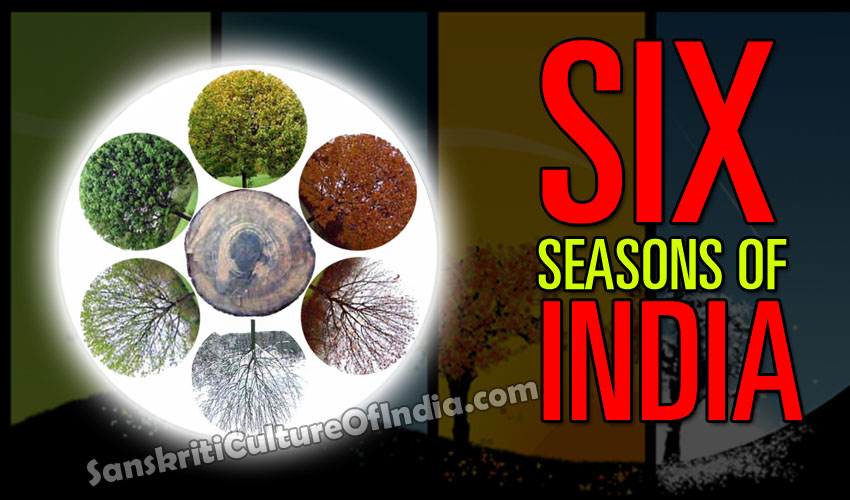
According to the Hindu Calendar, there are 6 seasons or ‘Ritu’ in a year. Since Vedic times, the various seasons in the Indian subcontinent was classified into these six categories. While North India mostly conforms to this marked change of seasons, it is less so in South India which is mostly marked by long summers and light winters. The six Indian seasons classified in the Hindu scriptures are:
- Vasant Ritu or Spring
- Grishma Ritu or Summer
- Varsha Ritu or Monsoon
- Sharad Ritu or Autumn
- Hemant Ritu or Pre-winter
- Shishir / Shita Ritu or Winter
VASANT RITU:
Springtime is called ‘Vasant Ritu’ when it is neither too hot or cold in most parts of India. The two Hindu months of Chaitra and Baisakh fall during this season. It is time for some important Hindu festivals including a number of new years. The auspicious occasions of this season are Vasant Panchami, Ugadi, Gudi Padwa, Holi, Rama Navami, Vishu, Bihu, Baisakhi, Puthandu, Hanuman Jayanti, to name a few. Vasant is also known as ‘Rituraj’ or the king of seasons.
This year, Vasant Ritu starts on February 18, 2014 and ends on April 20, 2014
The mid-point of Vasant Ritu is marked by the Vernal Equinox. Equinoxes occur twice a year, in spring and autumn when the tilt of the Earth’s axis is inclined neither away from nor towards the Sun. The dates for equinoxes are March 20 or 21 (Vernal Equinox) and September 22 or 23 (Autumnal Equinox) every year when days and nights have equal number of hours. Vernal Equinox is springtime in the northern hemisphere and autumn in the southern hemisphere and vice versa. According to Vedic Astrology, Vernal Equinox is called Vasant Vishuva or Vasant Sampat.
GRISHMA RITU:
Summer is called ‘Grishma Ritu’ when the weather is at its hottest in most parts of India. The two Hindu months of Jyeshta and Aashaadha fall during this season. It is time for some such Hindu festivals as Rath Yatra, Guru Purnima, etc.
This year, Grishma Ritu starts on April 20, 2014 and ends on June 21, 2014
Grishma Ritu ends with Summer Solstice. The Solstice occurs twice a year, in summer and in winter when the Sun reaches its highest point in the sky as seen from the North or South Poles. During June, Summer Solstice occurs in the Northern hemisphere and Winter Solstice in the Southern hemisphere. Summer Solstice falls on June 20 and 21 which includes the longest day of the year. In Vedic astrology, Solstice is known as Dakshinayana.
VARSHA RITU:
The monsoon season is called ‘Varsha Ritu’ when it rains in most parts of India. The two Hindu months of Shravana & Bhadrapada or Sawan & Bhado fall during this season. It is time for some such Hindu festivals as Raksha Bandhan, Krishna Janmashtami, Ganesh Chaturthi, Onam, etc.
This year, Varsha Ritu starts on June 21, 2014 and ends on August 23, 2014
Varsha Ritu starts with Summer Solstice. The Solstice occurs twice a year, in summer and in winter when the Sun reaches its highest point in the sky as seen from the North or South Poles. During June, Summer Solstice occurs in the Northern hemisphere and Winter Solstice in the Southern hemisphere. Summer Solstice falls on June 20 and 21 which includes the longest day of the year.
SHARAD RITU:
Autumn is called ‘Sharad Ritu’ when the hot weather recedes gradually in most parts of India. The two Hindu months of Ashwin and Kartik fall during this season. It is festival time in India with the most important Hindu festivals falling during this time – Navaratri, Vijayadashami, and Sharad Purnima, to name a few.
This year, Sharad Ritu starts on August 23, 2014 and ends on October 23, 2014
The mid-point of Sharad Ritu is marked by the Autumnal Equinox. Equinoxes occur twice a year, in spring and autumn when the tilt of the Earth’s axis is inclined neither away from nor towards the Sun. The dates for Autumnal equinox are September 22 or 23 – a time when days and nights have equal number of hours. Autumnal Equinox is autumn in the northern hemisphere and spring in the southern hemisphere and vice versa. According to Vedic Astrology, Vernal Equinox is called Sharad Vishuva or Sharad Sampat.
HEMANT RITU:
The time before winter is called ‘Hemant Ritu’ when it perhaps the pleasant time of the year across India. The two Hindu months of Agrahayana & Pausha or Agahan & Poos fall during this season. It is time for some of the most important Hindu festivals including Diwali, the festival of lights, Bhai Dooj, and a number of new years.
This year, Hemant Rity starts on October 23, 2014 and ends on December 22, 2014
Hemant Ritu ends with Winter Solstice. The Solstice occurs twice a year, in summer and in winter when the Sun reaches its highest point in the sky as seen from the North or South Poles. During December, Winter Solstice occurs in the Northern hemisphere and Summer Solstice in the Southern hemisphere. Winter Solstice falls on December 21 and 22 which includes the shortest day of the year. In Vedic astrology, this Solstice is known as Uttarayana.
SHISHIR / SHITA RITU:
The winter time is called ‘Shita or Shishir Ritu’ when it is the coldest time of the year in most parts of India. The two Hindu months of Magha and Phalguna fall during this season. It is time for some important harvest festivals including Lohri, Pongal,Makar Sankranti, and Uttarayan and the Hindu festival of Shivratri.
This year, Shishir Ritu starts on December 22, 2014 and ends on February 19, 2015
Shishir Ritu starts with Winter Solstice. The Solstice occurs twice a year, in summer and in winter when the Sun reaches its highest point in the sky as seen from the North or South Poles. During December, Winter Solstice occurs in the Northern hemisphere and Summer Solstice in the Southern hemisphere. Winter Solstice falls on December 21 and 22 which includes the shortest day of the year. In Vedic astrology, this Solstice is known as Uttarayana.
~ Author Unknown