 Growing up in India, I took yoga for granted. Part of the country’s collective unconscious, it permeated the fabric of everyday life. When I had a headache, my grandmother would remark that doing a headstand would send some blood to my brain and lessen the pain. My grandfather did the Sun Salutation (Surya Namaskar) on the terrace of our building every morning.
When I was 12, my mother sent my brother and me to take free yoga lessons from a retired army colonel. Every morning, we would join the other neighborhood striplings in the school playground, where the colonel bellowed out the names of the asanas (yoga poses) and corrected our posture with a sharp cane. In India, yoga is as much a part of daily life as Sanskrit chanting, meditation, and oil massages.
Indians don’t separate yoga from daily life by putting it into a gym, as happens in America. Power yoga, for instance, is my pet peeve. Although it may provide a strenuous aerobic workout that is good for the heart, it totally ignores the mind-body connection that is the essence of yoga. Yoga, in India, is a spiritual practice more than a physical one. In America, they have adapted it to reap its physical rewards while paying scant heed to its spiritual aspects.
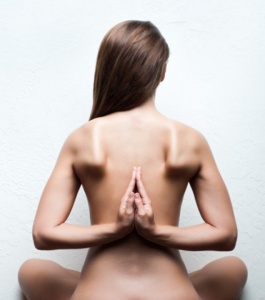 When I speak of yoga, I don’t just mean hatha yoga, which is what most Westerners associate with the word. Hatha yoga–made up of the asanas (poses such as forward and back bends, as well as slow stretches aimed at improving circulation, flexibility, and balance) and pranayama (breathing practice)–is just one type of yoga, and in the grand scheme of things, the least important type as far as serious yogis (yoga disciples) are concerned.
The word yoga is derived from the Sanskrit word yuj, which means “to yoke.” Yoga practices yoke–or unite–the self with God. A great yogi, Patanjali, codified yoga into a book called the Yoga Sutras some 5,000 years ago. Before Columbus discovered America and before Vasco da Gama initiated the spice trade between Portugal and India, Patanjali became obsessed with the mind-body connection and wrote a treatise about it.
Basically, Patanjali had a single goal: to achieve higher consciousness, unity with the cosmos, moksha (nirvana, liberation), oneness with God. He delineated four ways of uniting the Atman (soul) with the Brahman (God or higher consciousness).
The first is jnana yoga, the path of knowledge. As is common in other spiritual traditions, jnana yoga involves gaining wisdom through serious study of ancient texts like the Vedas or Upanishads, the Bible, the Koran, or the Tanakh, depending on your religious inclination. The second is bhakti yoga, the path of devotion, or submerging the ego and surrendering to the will of God. In other words, bhakti yoga is the opposite of everything America teaches you about controlling your own destiny. Bhakti yoga, above all, is about surrendering to fate. In India, people often practice it by venerating statues of religious deities.
The third path is karma yoga, or the path of action. When you do community service, when you help someone without expecting anything in return, that is karma yoga. Habitat for Humanity, Greenpeace, Rain Forest Action Network, Wildlife Conservation Society–all of these are karma yoga in action. The last path towards higher consciousness or Brahman is raja yoga, the path of self-control. When you decide to fast for a day, when you decide to give up chocolates for Lent, when you decide to follow the Atkins diet or the no-carbohydrates diet or the no-tasty-food diet, that is, arguably, Raja yoga. Hatha yoga, which is synonymous with all yoga in the West, is actually a part of Raja yoga, the idea being that through asanas, pranayama, and meditation, you could achieve self-control.
But yoga is not a religion. Rather, it is part of the Hindu religion, just as prayer is part of many world religions. Yoga is a means toward realizing God, a spiritual, mystical path toward higher consciousness.
 Yoga in its more holistic form incorporates many Hindu concepts such as karma, reincarnation, chanting the word Om, and meditation. But just as singing carols doesn’t make you a Christian, doing yoga asanas doesn’t make you Hindu. But if you want to practice yoga as Patanjali envisioned and devised it, that may involve embracing such Hindu concepts as chanting, fasting, and studying the Vedas.
The beauty of yoga is that it is both encompassing and narrow. You can improve concentration and your physical well-being by doing yoga asanas. You can also achieve moksha (liberation) if you “take it all the way” by following a daily regimen of asanas at dawn, adhering to a sattvik diet (one that includes pure and healthful foods), studying Vedic texts, and learning to control the mind and body through celibacy.
Yoga, ultimately, is about mindfulness, about submerging the self and realizing that you are one with God. This realization, encapsulated in the Sanskrit phrase “Aham Brahma Asmi” (I am Brahman), allows you to relax into life and ease into the channels that are guiding you.
Great yogis in India radiate joy as well as a childlike innocence that is devoid of ego, greed, and ambition. When I encountered my first yogi at an ashram near Madras, the thing I noticed beyond his saffron robes, long beard, and penetrating eyes was the fact that he laughed so much. Perhaps that is what yoga is about–the path to happiness.
~ By Shoba Narayan