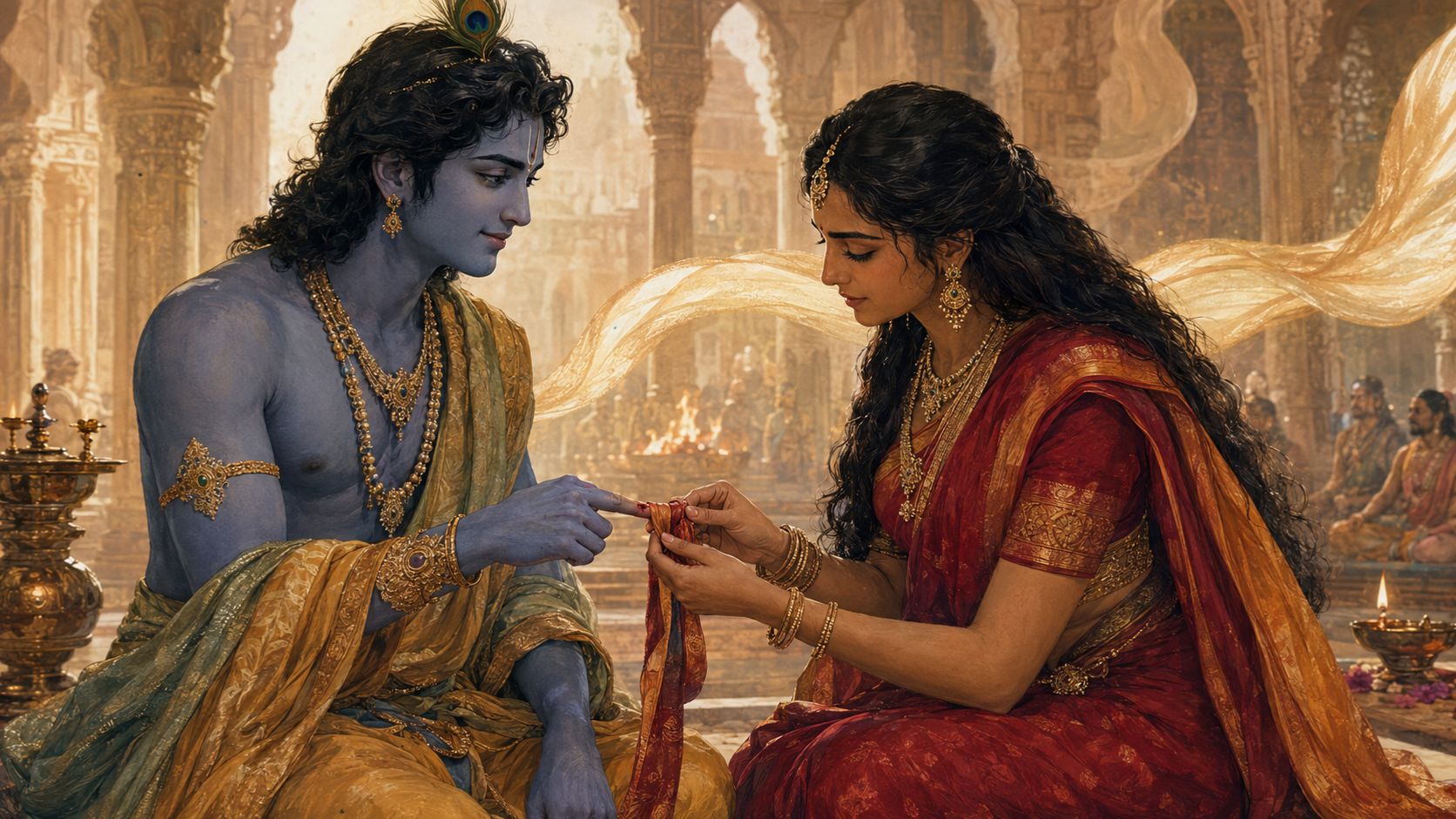
Is mythology merely superstition? Is it to be discarded in this world of scientific advancement, and retained only as stories meant for animation films for children? Sometimes it seems hard to justify a mythology that apparently just breeds superstition, blind beliefs and senseless rituals — stories that seem to take the most erratic and irrational ideas and give them divine ratification. Since early times many scholars have debunked mythology; yet, mythology has survived right down to our practical, even rationalist, hard-headed era. Could there be an explanation for this?
One explanation for mythology is given by allegorical interpretations. Take for example the myth of not looking at the moon on Ganesh Chaturthi night. We are told that if you look at the moon on this particular night, you will be cursed. The threatened dire consequences of this harmless act have influenced tens of thousands of believers to not look at the guiltless moon for centuries! What explanation can there be for this? Those who seek an explanation are told a story. Once when Lord Ganesha was on his vehicle, the rat, the moon looked down on this ludicrous sight and laughed. The rotund Ganesha on the tiny rat apparently tickled the moon’s funny bone! Ganesha however was not amused. It is said he cursed the moon – “If anyone looks at you on this day, he will be doomed!”
If we go beyond the apparent absurdity of this story one may find a deep allegorical significance. Ganesha represents a person of enlightenment. The moon represents the mind. There always seems to have been this connection drawn between the moon and the mind; the moon is said to affect the mind. The rotund Ganesha riding the tiny rat is representative of the person of enlightenment using his limited equipments, his body-mind-intellect to convey the Infinite.
The infinite cannot be captured in the finite. The enlightened person cannot completely tell us the truths he has experienced. Hence his attempts may appear ludicrous to the ignorant. But it behooves us well not to discard his words randomly. Any society or individual who will not listen to wise, enlightened souls will be doomed. They will deprive themselves of the wisdom of the masters and will suffer the stresses and strains, the agitations of life. This is the teaching and warning given by this story about Ganesha and his ‘curse’.
Every ancient civilization had its own mythology. The Greeks and Romans have a well-documented mythology too. They too apparently used their mythology similarly. Take for example the story of Kronos. The story goes that Kronos was a most unnatural father. Whenever his children were born he would swallow them. This seems horrendous until one understands that Kronos represents time. Time is the father that destroys all his offspring.
One may wonder: why such abstruse stories to explain philosophical ideas? Two reasons are probable. It is a way of communicating subtle truths to the uneducated. Besides, it is valuable for intellectuals, too, for to them, these stories serve as a tool for reflection. Only through reflection can knowledge dawn. The startling and bizarre stories make one wonder what they could possibly mean. This forces one to think and with thinking, wisdom dawns.
The trouble is that even the most bizarre stories are taken at face value and believed. And that is a fertile ground for the creation of superstitions. The sublime message is lost and irrationality is developed. The myths contain a message and the message is lost in the labyrinth of ‘beliefs’.
~ Janki Santoke