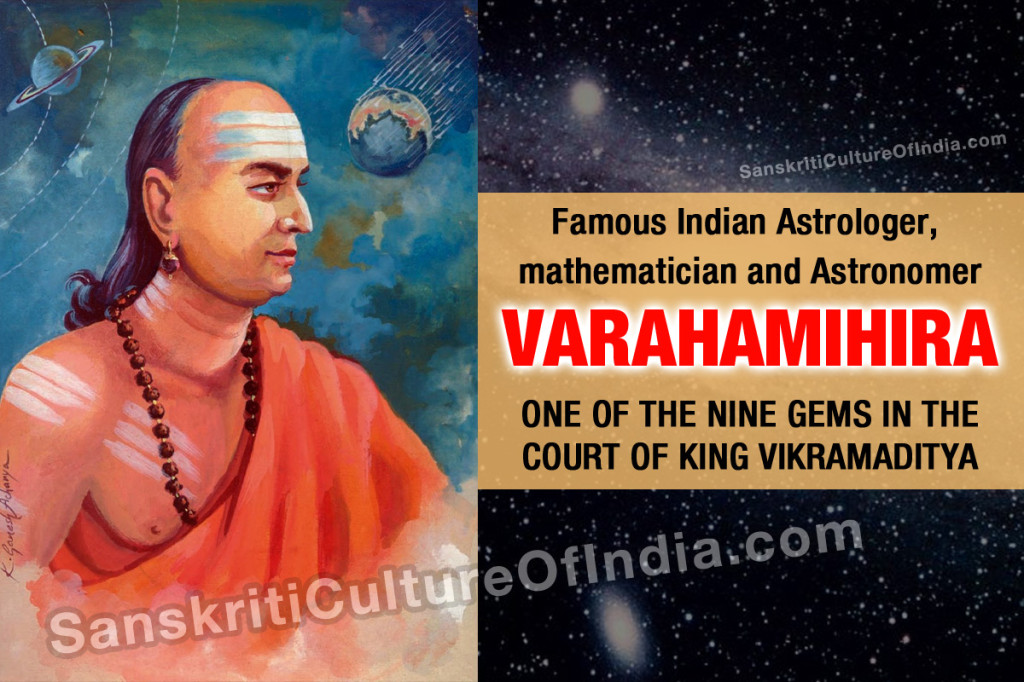
Varahamihira (499-587 CE):
Varahamihira was one of the renowned Indian astronomer, mathematician, and astrologer. He was honored with a special decoration and status as one of the nine gems in the court of King Vikramaditya in Avanti (Ujjain). Varaha Mihira wrote several important works on Jyotish including but not limited to: Brhat Jataka, Bruhat Samhita, Yoga Yatra, Pancha Siddhantika (on astronomy) and Prasna Vallabha (apocryphal).
Varahamihir’s book “panchsiddhant” holds a prominent place in the realm of astronomy. He proposed that the moon and planets are lustrous not because of their own light but due to sunlight. The work is a treatise on mathematical astronomy and it summarizes five earlier astronomical treatises, namely the Surya, Romaka, Paulisa, Vasistha and Paitamaha siddhantas. Shukla states in The Pancasiddhantika of Varahamihira is one of the most important sources for the history of Hindu astronomy before the time of Aryabhata I I
In the “Bruhad Samhita” and “Bruhad Jatak,” he has revealed his discoveries in the domains of geography, constellation, science, botany and animal science. In his treatise on botanical science, Varamihir presents cures for various diseases afflicting plants and trees. The rishi-scientist survives through his unique contributions to the science of astrology and astronomy.
Varahamihira was one of the most famous astrologers in Indian history. His work Brihatsamhita (The Great Compilation) discusses topics such as :- Descriptions of heavenly bodies, their movements and conjunctions, meteorological phenomena, indications of the omens these movements, conjunctions and phenomena represent, what action to take and operations to accomplish, sign to look for in humans, animals, precious stones, etc.
Varahamihira summarizes was the Romaka-Siddhanta which was based on the epicycle theory of the motions of the Sun and the Moon given by the Greeks in the 1st century AD. The Romaka-Siddhanta was based on the tropical year of Hipparchus and on the Metonic cycle of 19 years. Other works which Varahamihira summarises are also based on the Greek epicycle theory of the motions of the heavenly bodies. He revised the calendar by updating these earlier works to take into account precession since they were written. The Pancasiddhantika also contains many examples of the use of a place-value number system.
Varahamihira made some important mathematical discoveries. Among these are certain trigonometric formulas which translated into our present day notation correspond to:
sin2 x + cos2 x = 1
sin x = cos(π/2 – x),
{1 – cos 2x}/{2} = sin2x
Another important contribution to trigonometry was his sine tables where he improved those of Aryabhata I giving more accurate values. It should be emphasised that accuracy was very important for these Indian mathematicians since they were computing sine tables for applications to astronomy and astrology. This motivated much of the improved accuracy they achieved by developing new interpolation methods. The Jaina school of mathematics investigated rules for computing the number of ways in which r objects can be selected from n objects over the course of many hundreds of years. They gave rules to compute the binomial coefficients nCr which amount to
nCr= n(n-1)(n-2)…(n-r+1)/r!