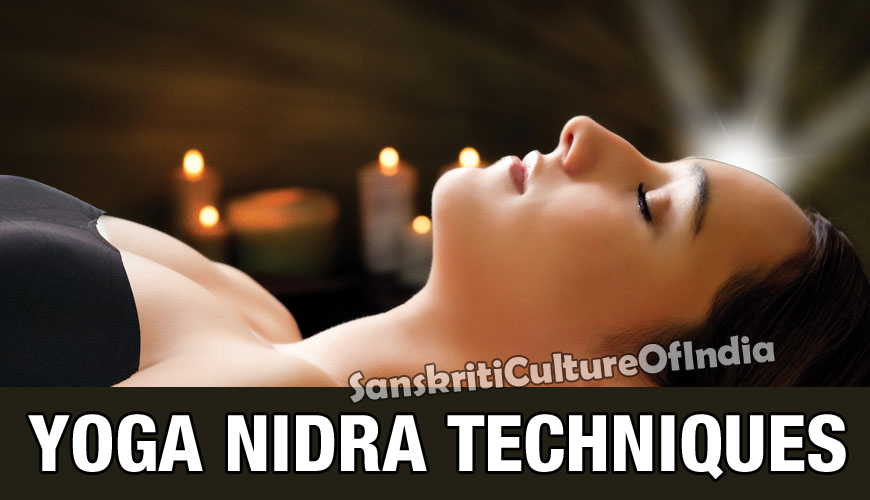
Yoga Nidra is one of the most powerful methods, not only for inducing deep relaxation in a minimum amount of time, but also for reawakening the degenerated brain nuclei and centres. One hour of yoga nidra is equal to four hours of sleep. The practice of yoga nidra is not only for those who are physically mentally exhausted. It is also for those who tired of taking rest and those who have little interest in life. Yoga nidra will rejuvenate and revive the physical, mental and emotional personality. It will help those with tamasic nature by inducing and extra influx of blood and energy. The practice of yoga nidra is particularly recommended for spiritual aspirants who suffer from fear, tension, anger, greed and other imbalances. It is also for those who want to develop greater awareness and mental clarity.
In the borderline yoga nidra state, between sleep and wakefulness, you make contact with the subconscious and unconscious mind where all your past memories are stored. Those experiences that were particularly negative or painful have been pushed deep into the unconscious, beyond conscious recall.
It is recommended that, for the first few times, you practice yoga nidra is a class environment with a teacher to give directions. Then you will understand the purpose of the technique more fully and will be better acquainted with the method of practising each stage. If you do not have access to a yoga teacher, try to obtain a class recording.
In yoga nidra, you do not sleep. You must remain aware throughout the practice and try to follow all the instructions without intellectualizing. Of course one can also use yoga nidra as a prelude to sleep. If one practises for 20 or 30 minutes before sleeping the quality of the sleep will be greatly improved.
Sankalpa
During yoga nidra a resolve or sankalpa is made. It should be something of immence importance to you. Repeat it mentally three times with feeling and emphasis. It is best if your sankalpa has a spiritual objective, but you can also make a resolve to break a habit or to improve some aspect of your personality. In yoga nidra the resolutions and decisions we make and the thoughts we create, become potentially powerful. They go into the depths of the subconscious and in the course of time they will definitely become realities.
Technique
Preparation:
Get ready for yoga nidra. Lie down in shavasana, the dead man’s pose and make yourself as comfortable as possible. Keep your feet apart and let them fall a little to the sides, arms slightly away from the body with the palms of the hands facing upwards. Make sure your position and clothing are comfortable so that you will not need to move during the practice.
Close your eyes and do not open them at all until the practice is completed.
Make any final adjustments to your posture and clothing now.
During yoga nidra you must try to remain aware. Do not allow yourself to sleep. Say to yourself mentally, “I will not sleep”.
Now take a deep breath and as you breath in, feel calmness spreading throughout the body. As you breathe out, let your whole body relax completely.
Relaxation:
Become aware of your body lying on the floor in total stillness.
Awareness of the whole body from the tips to the toes to the top of the head. Let each part of the body relax completely. Make sure there is no tension anywhere.
Awareness of all the parts of the body which are in contact with the floor. Awareness of the arms, the hands and the floor, the elbows and the floor, shoulder blades and the floor… Awareness of the legs, the heel in contact with the floor, the calf muscles and the floor, back of the thighs and the floor, buttocks and the floor… Awareness of all parts of the back which are in contact with the floor. The head resting on the floor… Awareness of every part of the body which is in contact with the floor.
Feel that the whole body is becoming very heavy. Awaken the feeling of heaviness in every part of the body. The whole body is feeling so light that it seems to be floating away from the floor. Awareness of heaviness.
Experience the feeling of lightness in the body. The whole body is feeling so light that it seems to be floating away from the floor.
Experience this lightness.
Resolve or Sankalpa:
Now is the time to make your resolve. You must find a resolve for yourself and repeat it mentally three times. Repeat it to yourself when emphasis ad feeling. Remember that the resolve you make in yoga nidra is bound to come true.
Rotation of consciousness:
Rotate your awareness to all the different parts of the body. As each part of the body is named, without any physical moment, take your awareness to that part. Your awareness is to jump from point to point as quickly as possible.
Become aware of the right hand thumb. The right hand thumb, second finger, third, fourth, little finger, back of your hand, palm, wrist, lower arm, elbow, upper arm, shoulder, armpit, right side of the chest, right side of the waist, the right hip…
Become aware of the left hand thumb. The left hand thumb, second finger, third, fourth, little finger, back of the hand, palm, wrist, lower arm, elbow, upper arm, shoulder, armpit, left side of the chest, left side of the waist, the left hip…
Become aware of the right big toe. The right big toe, second toe, third, fourth, little toe, top of the foot, sole of the foot, heel, ankle, calf muscle, the knee, thigh, the right buttock…
Become aware of the left big toe. The left big toe, second, toe, third, fourth, little toe, top of the foot, sole of the foot, heel, ankle, calf muscle, the knee, thigh, the left buttock…
Awareness of the right buttock, the left left buttock, the whole of the back, lower portion of the back, middle portion of the back, upper portion of the back, the right shoulder blade, left shoulder blade, the whole of the neck, the back of the head, and the whole of the face…
Awareness of the chin, the lower lip, upper lip, right cheek, left cheek, right ear, left ear, the nose, right nostril, left nostril, tip of the nose, the right eye, the left eye, right eyelid, left eyelid, right eyebrow, left eyebrow, the forehead, the eyebrow centre.
Awareness of eyebrow centre…
(You can repeat rotation of consciousness once or twice more if you need to further relax the body).
Awareness of the whole of the right leg, whole of the left leg, both legs together… Whole of the right arm, whole of the left arm, both arms together… Whole of the back, whole of the front, whole of the head… The whole body together, the whole body… the whole body…
~ Sure Ways to Self-Realization by Swami Satyananda Saraswati.