Wednesday, May 20, 2026 · Adhika Jyeshtha, Shukla Paksha Chaturthi · Religion · Festivals
There are twelve Vinayaka Chaturthis in an ordinary year — one Shukla Paksha Chaturthi each lunar month, each one carrying the name and the grace of Bhagavan Ganesha. The devotee who keeps the monthly Chaturthi vrat across the wheel of the year walks with the Vighnaharta — the Remover of Obstacles — at every threshold.
But once every two and a half to three years, when the calendar opens the rare thirteenth chamber called Adhika Maas, a thirteenth Vinayaka Chaturthi appears. It bears a different name. The Mudgala Purana calls it Varada Chaturthi — the Boon-Giving Chaturthi — and singles it out as the rarest and most fruit-bearing Ganesha day in the entire wheel of the calendar.
This year, that day is today — Wednesday, May 20, 2026 — the Shukla Paksha Chaturthi of Adhika Jyeshtha, falling on Budhvar, the day of the week most beloved of Ganesha Himself. Wednesday + Adhika Maas + Chaturthi is a confluence the Acharyas describe as a trayee-yoga — the threefold convergence — and the merit promised to the one who keeps the vrat today is, the Puranas say, beyond ordinary measure.
The Lord Who Is Invoked First
Of all the deities of the Sanatana pantheon, none stands at quite the place Bhagavan Ganesha stands. He is not the highest. He is not the most powerful. He is the first. Before any puja, before any yajna, before any new beginning — even before the worship of the Ishta Devata Himself — Ganesha must be invoked. The Acharyas explain it simply: no offering reaches its destination until the Vighnaharta clears the path.
This is the role given to Him at the very dawn of creation.
The story is preserved across the Ganesha Purana, the Mudgala Purana, and the Skanda Purana — the famous pradakshina contest between Ganesha and His brother Kartikeya. Bhagavan Shiva and Maa Parvati, the parents, set before the two brothers a divine fruit and a challenge: whoever circumambulates the universe three times and returns first shall receive the fruit.
Kartikeya, swift and sure, mounted His peacock and set off across the cosmos at the speed of light.
Ganesha did not move. He sat where He was. Then, slowly, He rose to His feet, walked once around His parents, twice around them, three times — and held out His small hand for the fruit.
“What is this?” Shiva asked, gently amused. “You have not gone anywhere.”
“Father,” said Ganesha, “what is the universe except a turning around its source? You and Mother are the source of all that is. To go around You is to go around the cosmos itself.”
Shiva and Parvati looked at one another. The fruit was placed in Ganesha’s hand. And Bhagavan Shiva spoke the decree that has held in every household and every temple of Bharata ever since: “From this day, no puja shall begin without you. No yajna shall be completed without you. No mantra shall reach its destination unless your name has been spoken first.”
This is the Lord whose day Varada Chaturthi belongs to.
Why “Varada” — The Name That Promises a Boon
The other twelve Chaturthis of the year are called Vinayaka Chaturthi — “the Chaturthi of the Remover.” This thirteenth one alone is called Varada Chaturthi — “the Boon-Giving Chaturthi.”
The distinction is not ornamental. The Mudgala Purana places careful weight on the difference. Vinayaka points to what Ganesha takes away — the obstacles, the vighnas, the entanglements that bind the devotee. Varada points to what He gives — the varadana, the explicit boon, the answered sankalpa.
The Adhika Maas Chaturthi, the Purana says, is the one Chaturthi of the year on which the Lord does not merely clear the path — He bestows the destination.
The Acharyas teach further that there are four classes of boon that Bhagavan Ganesha gives on this day, in this order:
- The removal of long-standing vighnas — obstacles that the devotee has carried for years without resolution
- The steadying of buddhi — the intellect, the discriminating faculty, the inner compass
- The fulfilment of a sankalpa — a specific, sincere intention placed before Him with the vrat
- The gradual loosening of moha — the deepest of the inner enemies, the one that disguises itself as clarity
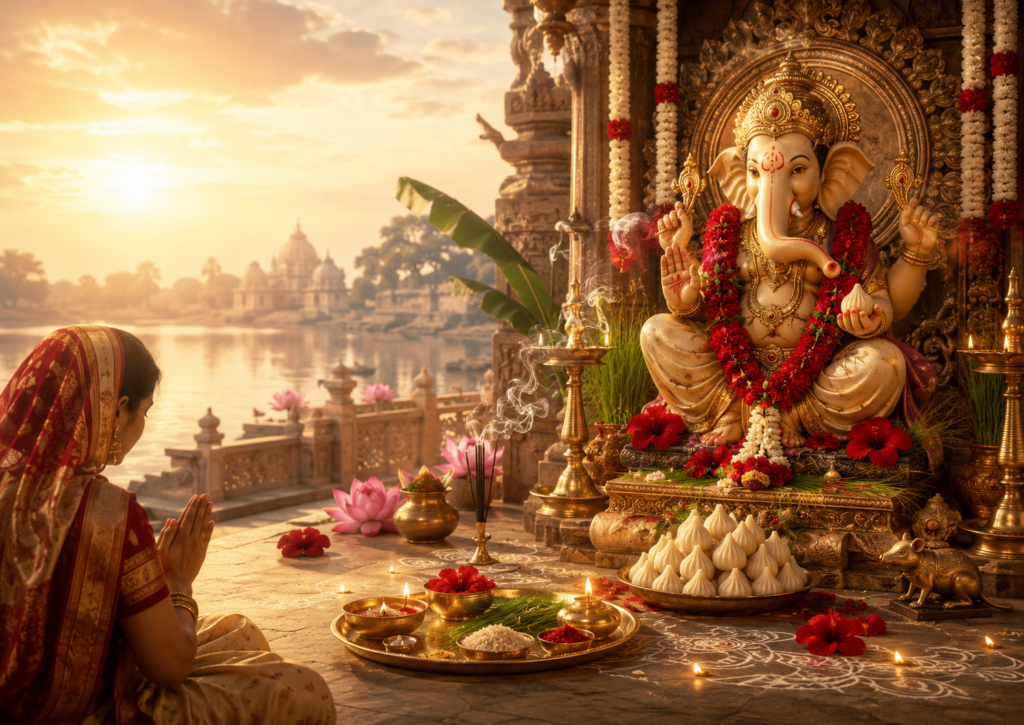
For each of these, the devotee places a corresponding offering on the altar: a single durva blade for the removal of vighnas, a small bowl of unbroken rice for the steadying of buddhi, a single modak for the sankalpa, and a tulsi-less garland of red flowers — Ganesha does not accept tulsi — for the loosening of moha.
Varada Chaturthi 2026 — Key Timings
All timings as per Drik Panchang (IST). Please verify with your local panchang for regional variations.
| Chaturthi Tithi Begins | Late evening, Tuesday, May 19, 2026 |
|---|---|
| Chaturthi Tithi Ends | Late evening, Wednesday, May 20, 2026 |
| Vrat Observance Day | Wednesday, May 20, 2026 |
| Madhyahna Puja Muhurta | Late morning to early afternoon — the most auspicious window for the puja |
| Parana (breaking the fast) | After moonrise on Wednesday evening, or sunrise on Thursday |
The combination of Budhvar (Wednesday — the day of Bhagavan Ganesha and of Budh Graha) with Adhika Maas Shukla Chaturthi is what the Acharyas call a trayee-yoga — a threefold convergence — and is considered the most auspicious form the Varada Chaturthi can take.
Vrat Vidhi — How to Observe Varada Chaturthi
The vrat is among the gentlest in the Hindu calendar in its outer form and among the most fruit-bearing in its inner effect. The vidhi below follows the Mudgala Purana and common practice across Bharata.
On the morning of Chaturthi: Rise during Brahma Muhurta. Bathe in cool water and wear clean clothes — red, saffron, or yellow are the preferred colours. Take the sankalpa before an image or murti of Bhagavan Ganesha: a quiet vow to keep the vrat with sincerity, and a clear inner naming of the one sankalpa the heart wishes to place at His feet.
The puja: Establish a small altar with a murti of Ganesha. Offer the shodashopachara — sixteen acts of worship — or, in the simpler householder form, the panchopachara: a deepa, dhoop, durva, flowers, and naivedya. The single most important offering is durva — the three-blade or five-blade tufts of dhruva grass that no other deity receives in quite this way. Offer twenty-one durva tufts where possible — the Mudgala Purana names twenty-one as the most fruitful count. Add red flowers (hibiscus is ideal), a tilaka of sindoor or red sandal, a small bowl of unbroken rice, and the day’s naivedya — modak, the sweet most beloved of Ganesha.
Through the day: Keep the fast — phalahari (fruits, milk, water) is the common form; the stricter observe nirjala until moonrise. Avoid sleep during the day. Engage in japa of the Ganesha Mool Mantra, in reading the Ganapati Atharvashirsha, or in listening to the recitation of the Mudgala Purana.
The Madhyahna puja: The most important hour of the day. Between roughly late morning and early afternoon, perform a second, more elaborate puja — this is the window the Mudgala Purana names as the time the Lord most actively bestows His varadana. Place the household sankalpa formally before Him at this hour.
At moonrise: Take darshan of the moon. Offer arghya (a small libation of water with sandal and rice) to Chandra. Break the fast with a single modak and a sip of milk — the parana is gentle, in keeping with the gentleness of the deity.
Mantras for the Day
Om Gam Ganapataye Namah
निर्विघ्नं कुरु मे देव सर्वकार्येषु सर्वदा ॥
Vakratunda Mahakaya Suryakoti Samaprabha | Nirvighnam Kuru Me Deva Sarvakaaryeshu Sarvada ||
Om Ekadantaaya Vidmahe, Vakratundaaya Dheemahi, Tanno Dantih Prachodayaat
A mala — 108 repetitions — of the Mool Mantra at dawn and another at the Madhyahna puja is the householder’s measure for Varada Chaturthi. For the sincere observer who can spare the time, the count is doubled.
Recommended recitations: the Ganapati Atharvashirsha in full (the single most powerful Ganesha stotra in the Vedic corpus), the Sankatanashana Ganesha Stotra, the Mudgala Purana‘s account of the pradakshina contest, and the Ganesha Sahasranama.
The Deeper Teaching — The Lord Who Cleared His Own Path
There is a small detail in the pradakshina story that the Acharyas point to whenever they speak of Bhagavan Ganesha.
Kartikeya was swift. Kartikeya was strong. Kartikeya had every advantage a contestant could be given. He mounted His peacock and set off to circumnavigate the cosmos at the speed of light.
Ganesha — slow, round, child-formed, riding only a mouse — would have lost any ordinary race before it began. He did not even try. He sat where He was, and He looked at the contest differently. He saw that the entire universe was a turning around a centre — and that if He could only identify the right centre, He would not need to move at all.
The boon was His.
This is what Bhagavan Ganesha teaches, again and again, to every devotee who places a sankalpa at His feet: the obstacle is not in the path. The obstacle is in the way you are looking at the path. The vighna dissolves not because Ganesha removes the world’s resistance — but because, when His grace falls on the buddhi, the devotee suddenly sees that the resistance was never the real problem.
The varadana of Varada Chaturthi is not always the thing we asked for. It is, more often, the seeing-rightly that makes the original asking dissolve.
When that seeing comes, the obstacle has already been removed.