IndianSanskriti
The Tamil Chola Empire

The Tamil Chola Empire

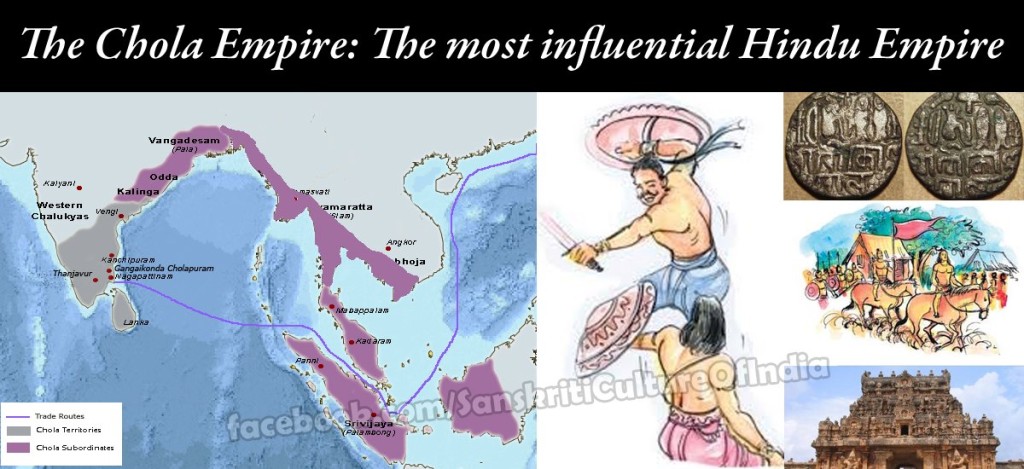
The Tamil Chola Empire was one of the most significant Indian kingdoms and is considered the most influential Hindu kingdom in Indian history. The Chola kings were very famous in India for their great deeds. The Chola dynasty belongs to the Vellalar caste (“noble Tamil warrior caste”) and to the lineage of Suryavamsam (Sun dynasty).The Cholas, Pandyas and Cheras were all descended from the Sangam periods. The reign of King Raja Raja Chola is considered the Golden Age of the Tamils. The capital of the Cholas was the royal city Thanjavur and the emblem of the Chola kingdom was the tiger. Even today, Tamil movements use the tiger in their symbols. Improvements in Dravidian Art, architecture, economy, military and government were also observed in the Chola age.Under the reign of Rajendra Chola, the Cholas defeated enemies and expanded their empire outside India. They ruled over South / East India, Indian islands like Andaman, Nicobar and Lakshadweep, Sri Lanka, Malaysia, Burma, Cambodia, Vietnam, Thailand, Laos, Singapore, Bangladesh, Maldives and Indonesia. It is possible that the influence of the Cholas was much greater and extended over to the Philippines as well.

The Cholas were very religious Hindus and followers of Shaivism (teaching of Lord Shiva). The Chola kings would not tolerate any concept of a God higher than Lord Shiva. It was tradition of the Cholas in conquered territories to build a Shiva temple to thank Lord Shiva for victory and glory. Generally, the Chola Kings consider it as a measurement of power. The greater the monument, the greater the power.

The Cholas also spread their cultural and religious influence on neighboring countries as well. They built temples and Culture Schools all over Southeast Asia.

During Chola dynasty, South Indian merchant guilds had shown great maritime influence as well. The Indian government even named the Merchant Navy Training Centre in Mumbai as TSRAJENDRA as a tribute to this. Rajendra Chola was the founder of the first Indian Navy.

The Brihadisvara temple is one of the famous monument built by the Cholas. The temple, which is more than 1000 years old, is located in Thanjavur and listed as one of UNESCO World Heritage Site. A statue of Nataraja, from the Chola period, is also considered one of the world famous symbol of Hinduism.

However, the later Cholas were not mighty kings, like their great ancestors. The resurgence of the archenemy Pandyas spelt the end of the Cholas.

By SATHIYA SEELAN
 

You may also like

Search the website

Like us on Facebook

Get daily updates via Email

Enter your email address:

Recent Posts

Jamai Shashthi 2026 — The Story of Maa Shashthi, the Cat, and the Wife Who Was Forgiven

Jamai Shashthi 2026 — The Story of Maa Shashthi, the Cat, and the Wife Who Was Forgiven

On Saturday, June 20, 2026, Bengali households across Bharata will welcome their married daughters and sons-in-law home for the legendary jamai-aador feast and perform the Shashthi Vrata. But behind the warmth lies a story most Bengalis know by heart and most non-Bengalis have never heard — the wife who stole the hilsa, blamed the cat, lost six sons to Maa Shashthi’s wrath, and was finally forgiven. The Vrat Katha, the vidhi, the mantras, and the deeper teaching.

Vat Purnima 2026 — The Wife Who Argued Yama Into Returning Her Husband’s Life

On Monday, June 29, 2026, women across Maharashtra, Gujarat, and southern Bharata will tie red thread around banyan trees and hear the story of Savitri — the wife who walked behind Yamaraja Himself when He came for her husband, and out-argued the Lord of Dharma into returning Satyavan’s life. The Mahabharata’s Pativrata Mahatmya Parva, the vrat vidhi, and why the banyan witnessed everything.

Nija Jyeshtha 2026 — The Real Jyeshtha Begins, and the Calendar Resumes

Nija Jyeshtha 2026 — The Real Jyeshtha Begins, and the Calendar Resumes

With Adhik Maas now closed on the Somvati Amavasya of June 15, the long-postponed festivals of Jyeshtha return — Vat Purnima (June 29, the Savitri-Yamaraja katha), Jamai Shashthi (June 20, the Bengali festival of Maa Shashthi), Sankashti Chaturthi (June 28), Yogini Ekadashi (July 10), and Devshayani Ekadashi (July 16, opening the four-month Chaturmas of Bhagavan Vishnu’s yoga-nidra). A guide to what the next four weeks hold and what the household that kept Purushottam Maas now carries forward.

The Closing of Purushottam Maas 2026 — Adhik Amavasya and the Sealing of the Month-Long Vrat

On Monday, June 15, 2026 — a rare Somvati Amavasya — the intercalary month that bears Bhagavan Vishnu’s own name comes to its close. The Acharyas teach that a vrat is not measured by its duration but by its closing. Here are the Padma Purana’s instructions for sealing the month-long Purushottam Maas vrat: the morning snan, the closing puja with the Vishnu Sahasranama, the day of dana, the Somvati Amavasya gift, and the final sarva-arpana — the offering of all merit at the feet of the Lord.

Parama Ekadashi 2026 — The Other Rare Ekadashi of Purushottam Maas, and the Poor Brahmin Who Kept It

Two weeks ago, Vaishnavas across Bharata kept Padmini Ekadashi — the rare Shukla Paksha Ekadashi of Adhik Maas. Padmini has a twin. On Thursday, June 11, 2026, the Krishna Paksha Ekadashi of the same intercalary month appears: Parama — the Supreme Ekadashi. The Padma Purana names it the rarer and more secret of the two, and reserves it for those whose poverty or sorrow has refused to lift in spite of every other vrat already kept. The story of Sumedha and Pavitra of Kampilya, the rishi Kaundinya, the prince sent by Bhagavan Brahma — and the vidhi for the day.

css.php