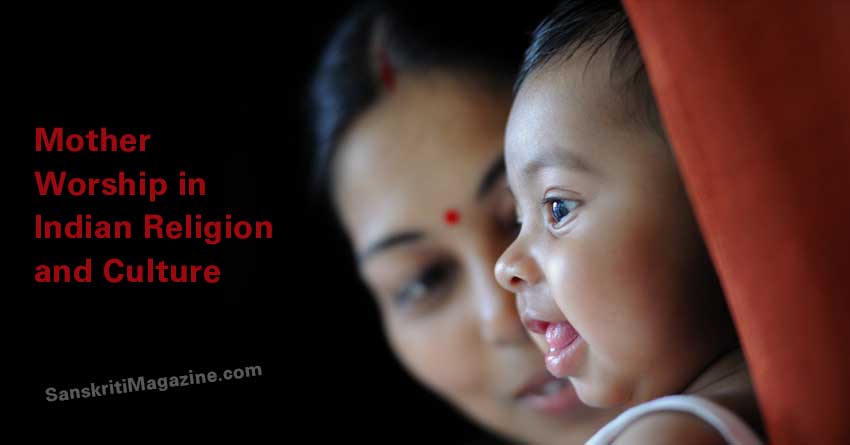
The concept of celebrating Mother’s Day on the second Sunday of May is very new in India, but tradition of ‘Mother Worship’ is very ancient, and has been part of Indian Religion and culture. In India mother is given a status, if not equal to God than next to god at least, always. Indians are so fond of mother worship that they consider besides their own mother, earth as mother. Also they call their country ‘Bharat Mata’ (India our Mother)/Mother India.It can be easily said that Indians are fond of concepts related to Mother. It is for this reason we see that within last decade mother’s day has become a part of number of existing festivals in spite of being a festival of foreign origin and its presence can be easily felt in modern urban India. A reason may be found in the acceptability of Christian religion, culture and worship of ‘Mother Mary’ as part of the tapestry of Indian religion and culture from British days, along with their own love to worship of God as Mother. But Indians have always been worshiping mother in various forms:
Mother as God:
“If God is our father, why cannot God be our Mother! If we are the children of our heavenly Father, why cannot we be the children of our heavenly Mother!.” This rhetorical question is the basis of why Hindus recognize and accept both male and female aspects of Nature and worship the Supreme Reality in the form of Mother, Father, Friend, Master, Guru, and Savior. Thus Lord Krishna declares in the Bhagwada Gita:
“I am the Father of this Universe. I am the Mother of this universe, and the Creator of all. I am the Highest to be known, the Purifier, the holy OM, and the three Vedas.” (BG 9.17).Based on this is a Prayer of GOD as follows:
“ Twame-wa mata cha pita twame-wa,
twame-wa bandhuscha sakha twame-wa;
Twame vva vidya dravmam twame wa,
twame-wa sarvam mama de-vadeva.
(Oh God! You alone are my mother, my father, my friend, my brother. You alone are all wisdom and wealth. Indeed, you alone are everything to me.)
Both Hinduism and Buddhism have long traditions of goddess worship. In Hinduism, every deity is accompanied by a female counterpart, or goddess, such as Parvati-Shiva, Lakshmi-Vishnu, Sita-Rama and Radha-Krishna. Many temples are dedicated first to the goddess, who represents the merciful, loving side of the deity. In Buddhism, Tara and Gayatri are both often seen as goddesses of compassion. Such deities are usually considered officially as secondary deities, though popular devotion seems to accord them a higher significance.
Goddess is called Devi and has been worshiped in various forms, Durga, Kali (The Goddess of yogic Transformation), Tripur Sundari (Beauty of the Three worlds), Bhuveneshwari (The queen of the Universe), Bhairavi (The warrior Goddess), Chinnamasta (headless-goddess), Dhumavati (The Goddess with the colour of smoke), Baglamukhi (Goddess of Hypnosis), Mattangi (Goddess of Divine words), Kamlatmika (Goddess of wealth).
Land as mother:
Vedas (Ancient Indian Scriptures) are full of praise for Earth as Mother.
O Mother Earth
Let Thy bosom be free
From sickness and decay
May we through long life
Be active and vigilant
And serve Thee with devotion
(Atharv-Veda 12.1.62)The worship of God in the form of Mother is a unique contribution of the Hindu Mind. When a devotee worships God as Divine Mother, he or she appeals to Her tenderness and unconditional love. Such love unites the devotee with God, like a child with its mother. Just as a child feels safe and secure in the lap of its mother, a devotee feels safe and secure in the presence of the Divine Mother. Paramahansa Sri Ramakrishna, one of the greatest Indian sages of modern times, worshipped the Divine Mother Kali during his entire life. He established a personal relationship with Her and was always conscious of Her presence by his side.
The worship of God as Mother has had a significant impact on Hinduism. The position of women in the Hindu religion is dignified because each woman is considered a manifestation of the Divine Mother.
Country as Mother (‘Bharat Mata’- Mother India):
Indians Call country –‘Bharatmata’ (Mother India). Dr. Rajendra Prasad (First President of India) who was presiding the Constituent Assembly on January, 24th 1950, made the following statement declaring Vande Mataram as National Song:
“The composition consisting of words and music known as Jana Gana Mana is the National Anthem of India, subject to such alterations as the Government may authorise as occasion arises, and the song Vande Mataram (National Song), which has played a historic part in the struggle for Indian freedom, shall be honored equally with Jana Gana Mana and shall have equal status with it. (Applause) I hope this will satisfy members. (Constituent Assembly of India, Vol. XII, 24-1-1950) “
The continuing popularity of “Vande Mataram” today is documented by the fact that in 2002 it was voted the second most requested song by listeners on the BBC’s World Service radio.
My obeisance to Mother India!
With flowing beneficial waters
Filled with choicest fruits
With Sandal scented winds
Green with the harvest
O mother! My obeisance to you!
Ecstatic moonlit nights
The plants blooming with flowers
Sweet speaker of sweet languages
Fount of blessings,
Mother, I salute you!
-By Arun Raghuwanshi