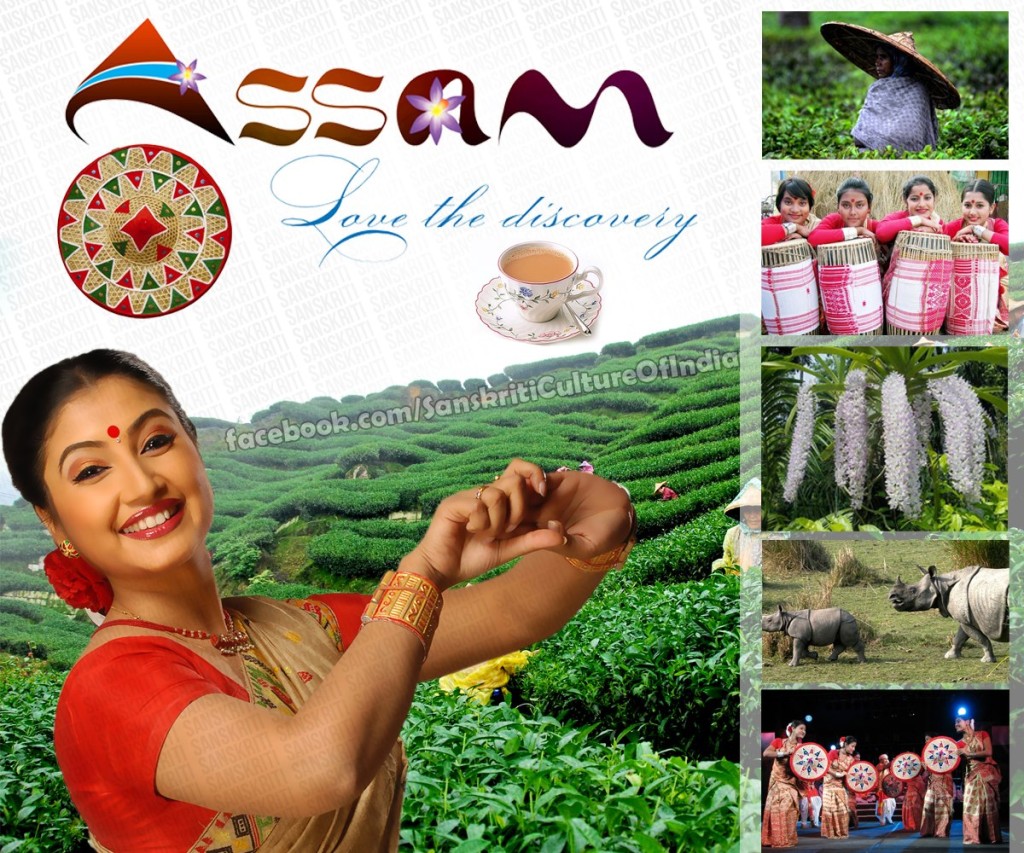
The Assamese culture is a rich and exotic tapestry of all these races evolved through a long assimilative process. The natives of the state of Assam are known as “Asomiya” (Assamese), which is also the state language of Assam.The state has a large number of tribes, each unique in it’s tradition, culture, dresse and exotic way of life. Diverse tribes like Bodo, Kachari, Karbi, Miri, Mishimi, Rabha, etc co-exist in Assam, most tribes have their own languages though Assamese is the principal language of the state.A majority of the Assamese is the Vaishnavas (a sect of Hinduism). The Vaishnavas do not believe in idol worshiping and perform Namkirtana where the glory of Lord Vishnu is recited. The two important cultural and religious institutions that influence the cultural fabric of Assam: the Satras, the site of religious and cultural practice which have been in existence for over 400 years and and the Naamghar, the house of prayers.Villagers generally associate on the basis of membership of a local center of devotional worship called “Naamghar”. Villages are usually made up of families from a number of distinct castes. In Assam, the caste system, although it exists, is not as prominent as in other parts of India.
Other religions such as Buddhism, Christianity, Hinduism, Islam etc. are also practiced in Assam. The national festival of Assam is the Bihu which is celebrated in three parts during a year with great pomp and grandeur by all Assamese, irrespective of caste, creed or religion.
Bengali-speaking Hindus and Muslims represent the largest minorities, followed by Nepalis and populations from neighboring regions of India.
The most important social and cultural celebrations are the three Bihu festivals observed with great enthusiasm irrespective of caste, creed and religious affinity.
From time immemorial, the people of Assam have traditionally been craftsmen. Artists, sculptors, masons, weavers, spinners, potters, goldsmiths, artisans of ivory, wood, bamboo, cane and hide have flourished in Assam from ancient times.
Weaving is one traditional craft that every Assamese woman takes pride in. The Assamese women produce silk and cotton clothes of exquisite designs in their looms. Assam is renowned for its exquisite silks namely Eri, Pat and the world famous Muga silk. Gandhiji complimented the Assamese weavers as artists who could weave dreams in their looms.
The Gamocha is one of the most easily recognizable cultural symbols of the Assamese people besides the tamol-paan (areca nut & betel leaf) which is an integral part of almost all socio-religious ceremonies.
The Gamocha, a white rectangular piece of cotton hand woven cloth with primarily a red border on three sides and red woven motifs on the fourth (in addition to red, other colors are also used) is put to many uses. It is used as a towel, as a waistcloth or a loincloth; a Bihu dancer wraps it around the head in a knot, it is also hung around the neck at the prayer hall and thrown over the shoulder to signify social status or respect. Gamochas, also known as bihuwaans, are offered during Bihu as a token of love.
Significantly the gamocha is used equally by all, irrespective of religious and ethnic backgrounds.
DANCES
Bihu
Satriya Nritya is the classic dance form of Assam which represents the Satriya culture, the basis of the religious and cultural fabric of Assam.Barpeta’s Bhortal Nritya
Bhortal Nritya of Barpeta district is an extension of Sankari culture.Tea Folk’s Jhumur Dance
The tea tribes have a synthesized form of dance called “Jhumur Nach”, performed by girls and boys together, or, sometimes by the girls alone, with precision of footwork while clasping tightly each other’s waist.Bagurumba
Bagurumba is the most attractive dance of the Bodo community. Girls dressed in colourful attires perform this dance in tune of Bodo traditional musical instruments.
Deodhani
The Deodhani dance is associated with the worship of the snake goddess Manasa. A Deodhani girl, in a inspired state, goes on dancing to the accompaniment of Kham (drum) and Ciphung (flute) propitiating many a deity beginning with Shiva and ending with Lakshmi.