By Suresh Kurl {Dedicated to Lord Shiva & His Devotees}
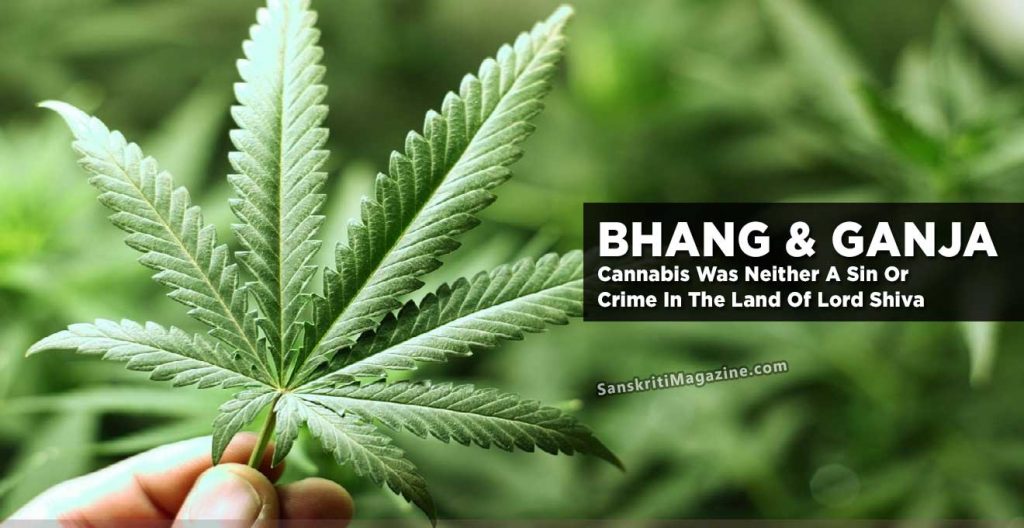
I have hard time recalling ever lighting up a joint or even a leftover roach, though I grew up in India in a culture where the use of Cannabis (Bhang/Ganja) was neither a sin nor a crime. Historically speaking, this bounty of nature has always thrived in my motherland under the protection of our sacred scriptures — the Vedas, compiled as early as 2000 to 1400 B.C.
“To the five kingdoms of the plants, which Soma rules as Lord we speak,darbha, bhang, barley, mighty power: may these deliver us from woe.”
–Atharva Veda; Book 8, 7; Verse 20
There is a legend about the birth of this divine gift. It says that when the gods and demons churned the ocean, nectar (Amrit) as well as poison (Vish) emerged in two separate pitchers. The gods and demons then fought over the pitcher of Amrit and during this battle, which the gods won, a few drops of it spilled out and scattered on the ground. These drops grew then into magical Cannabis loaded with supernatural powers.
During the Vedic-fire sacrifices (Yagna) priests used to offer Cannabis-stems to the fire to please the god of fire (Agni) to overcome evil forces.
The Vedas consider Cannabis a stimulant of happy feelings and liberator from fear and anxiety. Another legend about a domestic dispute between Lord Shiva and his wife, Parvati, in which cannabis played a positive role by bringing peace to the family, seems to confirm this belief.
The Legend recounts that once Lord Shiva, after an argument with Parvati, left home in a huff and wandered off into the surrounding Himalayan woods. Drained from the anger and fatigue, he fell asleep under a tree. When he woke up, he noticed a beautiful plant growing nearby. Curiously he decided to taste the leaves of that plant. The after-effects of those leaves were a surge of energy and a mood change – a transformation from feeling angry to feeling happy. He instantly decided to add those leaves to his regular diet. By including these newly discovered leaves to his daily menu, Shiva not only elevated the status of Bhang, but also made it his cherished birthday present.
Cannabis in India is consumed in four forms. First, as a drink, it is called, “Bhang” or “Vijaya.” Vijaya means something that brings you victory (Vijay). During battles, Vijaya was consumed to seek freedom from fear and boost courage.
There is a story about the tenth Sikh Guru, Shri Gobind Singh, who was a warrior, philosopher and a poet. Once he watched his soldiers feeling scared of an attacking elephant with a sword in his trunk. Guru Gobind Singh found one man in the group, who was willing to face the elephant. He gave him a mixture of Bhang and opium to drink. It gave the soldier courage to slip under the elephant and take away the sword from him.
These days, Bhang is often consumed as a recreational drink during festive celebrations such as, weddings or during Holi, the spring festival of colours.
The preparation of Bhang has a simple process. First, grounded Cannabis leaves are combined with spices and nuts such as, black pepper, cardamom, poppy seeds and almonds and pistachios and then diluted in water or milk with sugar or in fruit juice. Come to think of it, it sounds pretty yummy!
Second, Bhang is also ground and rolled in small balls and swallowed.
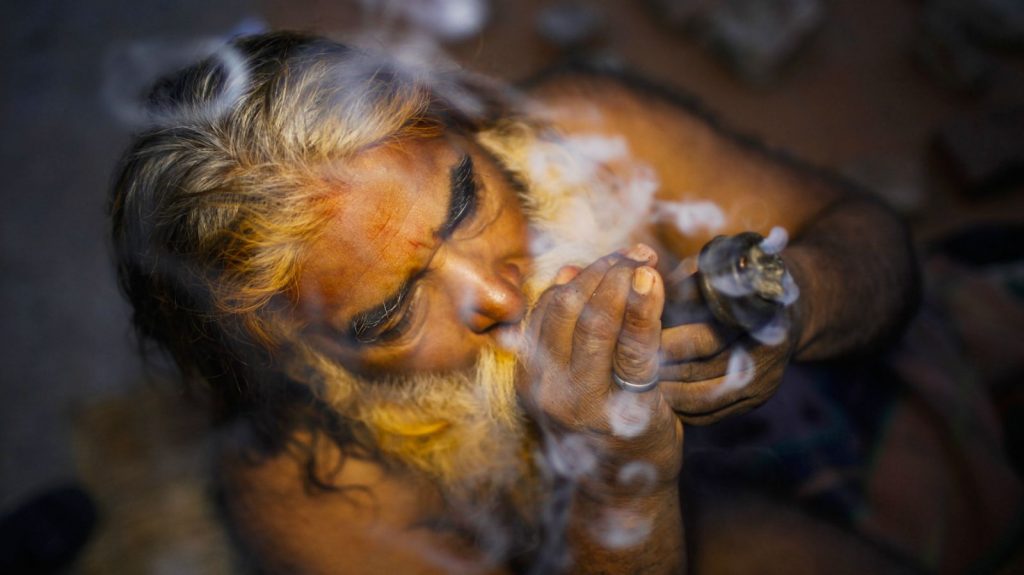
Third, when smoked, it is called, “Ganja.” It is made from the Cannabis flowers and upper leaves of its female plant. I recall walking down the Ganges river banks in Haridwar (India), and watching the matted-long- haired saffron robed holy men, smoking their clay pipes packed with Ganja and burning charcoal to attain a state of trance.
I have similar memories of students smoking joints, getting high and protesting the Vietnam War in front of the University Library or Student Union Building of the University of Michigan. Shunya, one of my students, always wanted to visit India only to smoke Ganja, freely.
The fourth form of Cannabis’s consumption is “Majoon.” My maternal grandfather, a man of a yogic calm and patience used to prepare it by hard boiling the Cannabis leaves and poppy seeds in milk, ghee, nuts and sugar, but he never shared it with children, not even a portion as small as an ant’s head.
Cannabis in Tibet has always been considered sacred. According to a legend, the Buddha before he attained enlightenment subsisted only on one Cannabis seed a day.
That said despite all the virtues Cannabis has and its close associations with divinities like Shiva and the Buddha, the majority of its modern-day consumers, lacking in spiritual discipline and ritualistic maturity, have dragged this holy stimulant into disrepute. As a member of the National Parole Board, my experience with the majority of offenders whose cases came before me, confirms my observation. They only used Cannabis as a means to psych themselves up before committing a crime or an offence. I, without hesitation, would suggest that its availability and use be controlled by all levels of governments, internationally.
Suresh Kurl is a former university professor; a retired Registrar of the BC Benefits Appeal Board, a former Member of the National Parole Board, a writer and a Public Speaker.