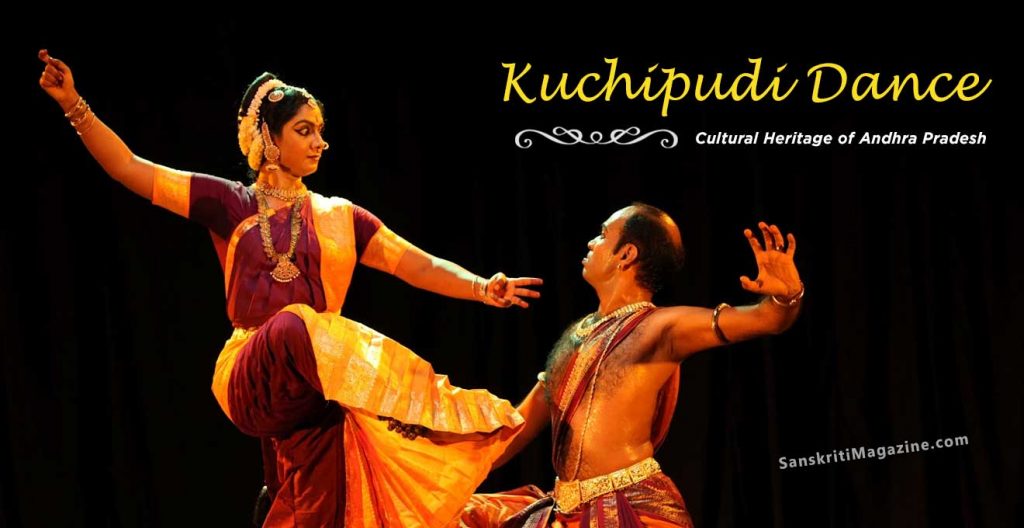
Many wonderful stories exist about the origin of the Bhagavata Mela Natakam of Andhra Pradesh. In the 14th century, the southern parts of India were ruled by a succession of dynasties committed to the propagation of art and literature. The rulers not only gave land and money to gurus and performers, but also paid for the upkeep of several hundred temple dancers, the rajanartakis and devadasis.
Bhagavatars, Bhaagavata Mela Natakam and Kuchipudi
It was under Siddhendra Yogi at the village Kuchelapuram in Divi seema, at the confluence of the river Krishna and the Bay of Bengal that the actual training of the actors was developed to make them into Bhagavatulu, performers of the Bhagavata Mela Natakams. It was here that Siddhendra Yogi first developed a unique and particular style based on the Natya Shastra and Nandikeshwar’s Bharatarnava.
Hasta Bhedas
According to Bharatamava, there are two major varieties of hasta mudras (symbols of the hand), the asamyuta (single) and the samyuta (combined). These are used at different levels of the body, in different directions and in various configurations to mean a variety of things.
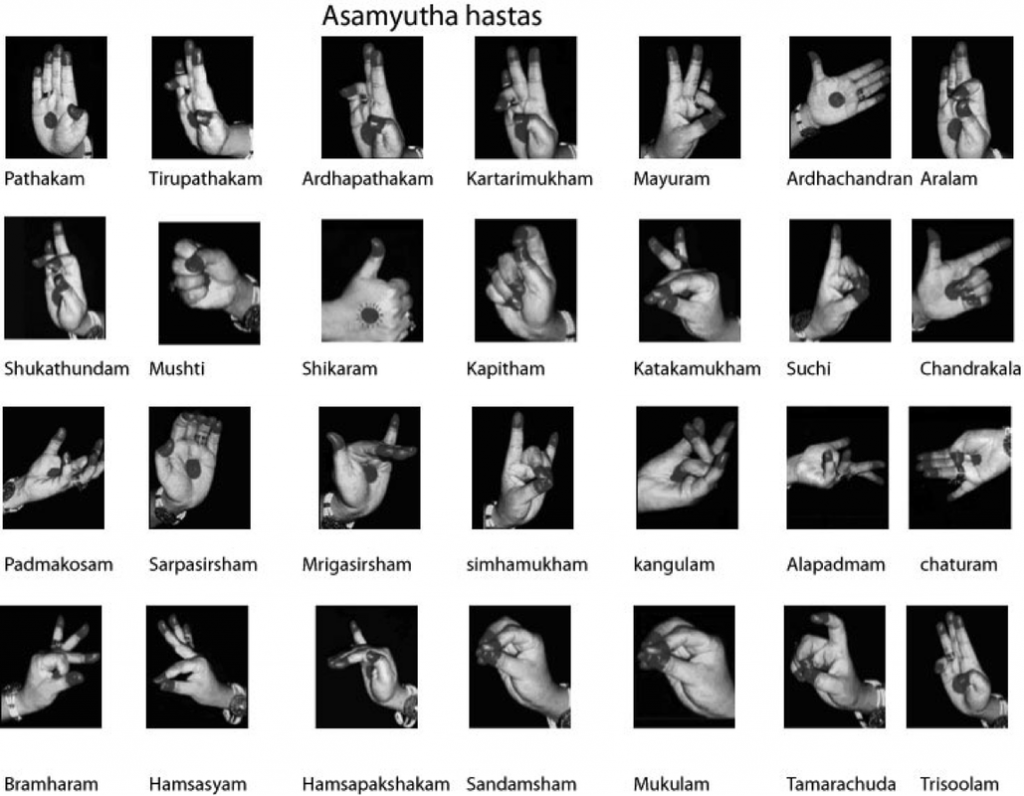
Asamyuta Hastas – Symbols for the single hand:
There are twenty-eight asamyuta mudras classified as:
Pataka, Tripataka, Ardha-pataka, Kartari-Mukha, Mayura, Ardha-chandra, Arala, Shukatundaka, Mushti, Shikhara, Kapittha, Kataka-mukha, Suchi, Chandrakala, Padmakosha, Sarpa-Shirsha, Mriga-shirsha, Simha-mukha, Langula, Sola-padma, Chatura, Bharamara, Hamsasya, Hamsapaksha, Samdamsa, Mukula, Tamrachuda and Trishula
Karana and Angarhara
According to Sarangadeva in the Sangita Ratnakar, a beautiful classical pose, formed by changing the hands and legs in dance, conditioned by the mood or flavour, is known as a karana. Bharata, in the Natya Shastra, merely defines a karana as a combined movement of the feet and the hands which, though momentarily static, is a dynamic series of movements which culminates in a specific pose.

By themselves, the karanas are beautiful aspects of dance, believed to have originated with Shiva-Nataraja’s Tandava. Pandits like Somanathkavi, Abhinavagupta and Sarangadeva suggested their use along with bhava so as to expand their utility into the realm of abhinaya. Over the years, gurus interpreted karanas with expressions in the Bhagavata Mela Natakam style, thereby incorporating these karanas into javalis and padams.
Karana
The hundred and eight karanas as described in the Natya Shastra:
- Pushpaputa: handful of flowers
- Vartita: Inverted
- Valitorukam: Turned thighs or thighs filded in
- Apaviddha: Violent shaking-off
Angahara
While Shiva performed the Tandava, several karanas were linked together as a garland of dance poses with the help of rechakas. These became the angaharas, garlands of dance poses for lord Hara. Each combination of angahara contains six, seven, eight or nine karanas. There are thirty-two angaharas, according to Bharata.
Later, learned experts in the field of dance created several additional angaharas in their own style. These were in different combinations of karanas and subsequently were different from those of Bharata. Sthirahasta: Lina, Nikuttitam, Urudvrutta, Swastika, Akshipta, Nitamba, Karihasta and Katichinna.
Paryasthaka: Puspaputa, Apavidaha, Vartita, Nikuttitam, Urudvrutta, Nitamba, Karihasta, and Katichinna.
Suchividdha: Vikshipta, Avarta, Nikuttitam, Urudvrutta, Akshipta, Uromandala, Karihasta and Katichinna.
Apaviddha: Apaviddha, Suchividdha, Uromandala and katichinna.
Navarasa
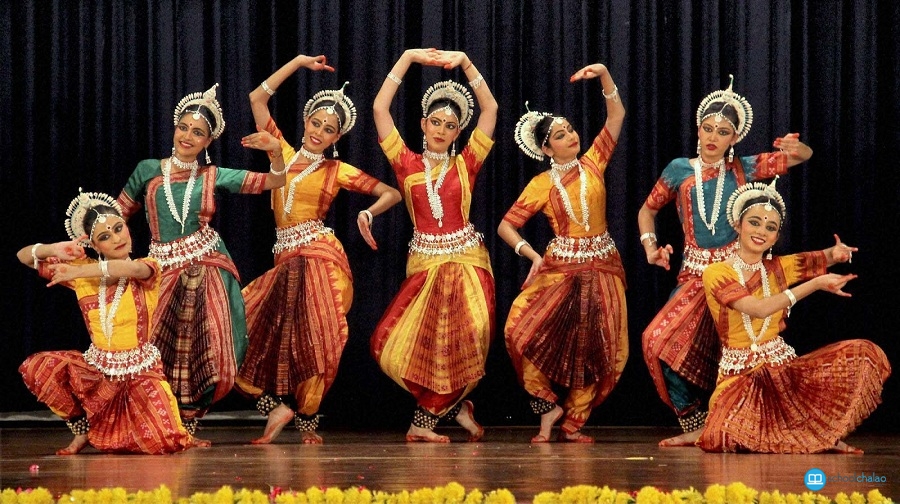
In the context of Kuchipudi dance, rasa is the quality that makes for understanding between the artist and the spectator. It can be translated in a wide sense as ‘relish’ or ‘flavour’ but perhaps ‘aesthetic experience’ gives a clearer idea of the real meaning. Rasa is a concentrated, knowledgeable identification of spectator with the spectacle, where, as Tolstoy put it, ‘one man consciously, by means of certain signs, hands on to others feelings he has lived through, and that other people are interested by these feelings and also experience them’.
Rasa in the Indian theory of aesthetics is the tasting of the flavour of a work of art. It is the quintessence of bhava or state of being which is divided again into the sthayibhavas (durable sates) brought forth by vibhavas (causes of emotion or determinants), anubhavas (indications or consequents), and sanchari or vyabhichari bhavas (transient or fleeting states).
The Seven Kinds of Ritual Dance
 According to early traditions, there were even kinds of dance that were the beginning of all dances, and which were combinations of karanas, charis, rechakas, etc. These were set in particular talas to particular shabdas. Each, according to Nandikeshwara, originated with the God or Goddess – Shudda Natya with Shiva, Deshini with Parvati, Peruni with Brahma, Prenkhani with Saraswati, Kundali with Vishnu, Dandika and Kalasha with Lakshmi. However, only the first two were accepted as divine by the Bhagavata Mela Natakam gurus and taken into the sampradaya. The rest were considered to have evolved from lokadharmi i.e., from the people themselves.
Music in Kuchipudi Dance
A raga (musical mode) with its unique and individual pattern is the soul of Indian music. Each raga has a special structure of fixed notes. It is the way in which a musician utilises this structural form that makes for the full expression of the different melodic types. Ancient authors gave the essential characteristics of ragas as the utilisation of special notes while avoiding some notes and rendering others with embellishments or graces (alankaras). Interestingly ragas were meant, according to their emotional appeal, to be sung only at certain times a day.
The ragas were also associated with visual images. For instance, the raga Bhairavi, the South Indian Mayamalavagaula is described as ” a beautiful sannyasi, his face smeared with white ashes. He wears a white scarf and around his neck is a garland of rubies. From his earrings hang pendants and on his forehead shines the crescent moon. Matted locks crown his head. He has the ekatara, one stringed instrument, in his hand and is seated upon a white bull. He is engaged in meditation on the banks of Ganges river”.