In 70 years, Sikhs have waged a secessionist uprising demanding independence in India’s Punjab, and have also felt insecure in overwhelmingly Muslim Pakistan as many have become victims of Taliban violence.
Radesh Singh’s grandfather was just 11 years old when he left his village in India’s Punjab to move to Peshawar, in the far northwest of Pakistan along the border with Afghanistan.
The year was 1901 — the British ruled the Indian subcontinent, Pakistan wasn’t even a glimmer in the eye of its founder, Mohammad Ali Jinnah, and Peshawar held the promise of work and adventure.
Singh’s grandfather would never return to his village, not even in 1947, when the Indian subcontinent was divided into majority Hindu India and Muslim Pakistan, generating one of the largest migrations in modern history and unleashing a brutality that left few untouched as mobs of Hindus and Muslims turned on each other.
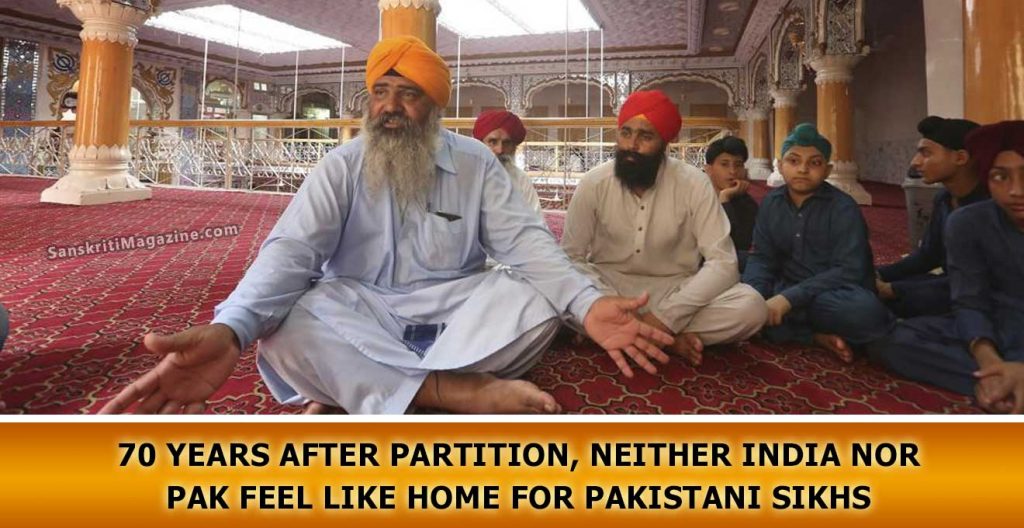
Singh’s family is neither Hindu nor Muslim but Sikh, a religious minority in both countries. In the 70 years since Partition, they have waged a secessionist uprising in India demanding outright independence for India’s Punjab state where they dominate. They have felt increasingly less at home on either side of the border, but particularly so in recent years in overwhelmingly Muslim Pakistan as they too have become victims of local Taliban violence.
Singh said poverty kept his grandfather in Peshawar, located at the foot of the famed Khyber Pass and dominated by fiercely independent ethnic Pashtun tribesmen. “It’s not easy to start over at zero when you have very little,” he said.
The hostility in the immediate aftermath of 1947 was brief in the northwest, said Singh. It was followed by decades of peace. The decision to stay in the new country now called Pakistan seemed like a good choice at the time. The Sikhs had lived peacefully for centuries alongside their Pashtun Muslim countrymen.
After all, said Singh, Sikhs had a glorious history in the northwest. For a time in the 18th century they oversaw a dynasty. Their capital was Pakistan’s eastern city of Lahore. It was a Sikh ruler, Ranjit Singh, who rebuilt Peshawar’s infamous Bala Hisar Fort, an imposing walled fortress that some historians say is as old as the city itself, which traces its origins back more than 2,000 years.
Today Sikhs are among Pakistan’s smallest minorities. They are easily identifiable because of their tightly wound and often colourful turbans, and because they share the surname Singh. The CIA Factbook estimates that 3.6% of Pakistan’s 180 million people are non-Muslims, including Sikhs, Christians and Hindus.
Until 1984, Singh said, Pakistan’s Hindus and Sikhs lived as one in northwest Pakistan. Their children married, they even worshipped together. But then India’s Prime Minister Indira Gandhi was assassinated by her Sikh bodyguards.
“They (Hindus) cut all relations with us. They said Pakistani Sikhs are like all Sikhs everywhere. No difference. They said, ‘From now on, we will be separate from you,’“ Singh recalled.
Today, Sikhs are battling with the Pakistan government for ownership of dozens of Sikh temples or gurdwaras; while it is slow going they have managed to reclaim some of the buildings. Many were abandoned in 1947 and taken over by Muslims who arrived from India. The Pakistan government, which took over the buildings after 1947, allowed the squatters to remain.
In a congested neighbourhood in Peshawar’s old city, Singh stepped through large steel gates that opened on to a sweeping courtyard. It no longer resembled a house of worship, but Singh said it was once a vibrant gurdwara attended by hundreds of Sikhs. Now two families call it home.
Two clotheslines crowded with clothes drying in the blistering midday sun stretched from one end of the courtyard to the other. A child’s plastic toy sat idle nearby.
Elsewhere in Peshawar, an armed guard, his rifle slung loosely by his side, stood guard at the city’s largest Sikh temple, an ornate marble building that dates back 250 years. Inside a half dozen Sikh men sat on plastic chairs.
It is a short, bureaucratic-looking man, a Muslim, who has the final say about who enters the gurdwara. He works for the government body that oversees properties vacated by people who fled to India in 1947.
After phone calls made, names recorded, passports handed over and more phone calls made, the doors to the gurdwara were opened. revealing a cavernous carpeted room and ornate pillars decorated with hundreds of tiny mirrors. In a small room at the far end of the upper story, two students read the Guru Granth Sahib, Sikhism’s holy book.
Singh, who heads a council representing the Sikhs in Pakistan, said that since his homeland began to turn toward radical Islam, particularly in the Pashtun heartland, young Sikhs have been looking to leave.
“They want to go to another country, not to India or Pakistan,” he said, but every country eyes them with suspicion. Even Indians, he said, see his Pakistani passport and question his intentions, suggesting he wants to agitate for Sikh secessionism, the battle that resulted in Indira Gandhi’s death and a dream still held by many Sikhs on both sides of the border.
For Singh, Pakistan’s slide into intolerance began in the late 1970s with the former Soviet Union’s invasion of neighbouring Afghanistan. Pakistan’s military dictator Zia-ul Haq set the country on the course of Islamic radicalisation as jihad became a rallying cry to defeat the communists in Afghanistan, he said.
Extremism worsened after the 2001 invasion of Afghanistan by a US-led coalition, he said. The tribal regions were gradually overtaken by Taliban and in 2013 several Sikhs were killed, their limbs severed. The brutality of the killings and the threats sent thousands fleeing Pakistan, said Singh.
He said today Pakistan’s intolerant use of blasphemy — a crime that carries an automatic death penalty — as a weapon against minorities and fellow Muslims alike.
“That is why we have a fear in our hearts, that this law can be used against us,” he said. The mere accusation of blasphemy can incite mobs to violence.
“In the last nearly 40 years we have been facing the boom, boom (mimicking the sound of explosions) in every city of Pakistan,” said Singh. “In a long time we have not heard any sweet sounds in our Peshawar, but still we love our city.”