~ By Shipraprasadini
In the recent molestation incident at Rampur, UP on 22nd May, 2017 a large group of 14 teenaged boys ranging from age as young as 14 to 16 cornered two young girls and subjected them to hours of horrifying and degrading sexual violence and intimidation. The perpetrators were so fearless and boisterous they even dared to film the entire incident and circulated the video. It subsequently went viral leading to large scale social protest. The police took swift action, filing ‘suo moto’ cognizance with most of the boys identified and arrested.
A second incident similar to above emerged, within days from Muzzafarnagar, Bihar leading to widespread consternation amongst the general public. In this video a girl in school uniform is shown trying to hide behind her male friend surrounded by a bunch of men who are seen teasing and tormenting the girl while physically trashing the boy trying to protect his friend. The case is being investigated though the perpetrators have not been identified thus far.
While the investigations are on our shores have till now not witnessed this kind of unprovoked savagery from men as young as 14. I as an ordinary citizen of the country am forced to ponder the inspiration for this bestial act which has an eerie parallel with similar mass sexual assault games or gang-rape games emerging from the Arab countries and recently from the European continent. In a world of internet and connected social media it would not be too far-fetched to conjecture that these boys have probably viewed videos of similar incidents from Egypt, Sweden, Germany and Europe and thus got influenced to brazen it out on our shores.
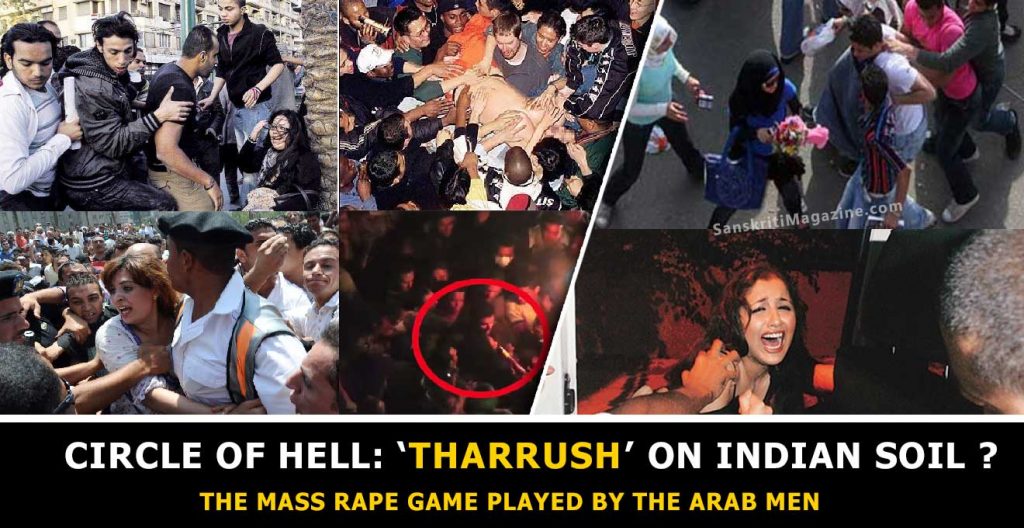
Organized mass sexual assault made its appearance in the modern times in 2005 in Egypt when hundreds of women were assaulted while protesting at ‘Egyptian Constitution Referendum’ by a group of agents also came to be known as ‘Black Wednesday’. ‘Taharrush Jinsi’ is the term used for sexual harassment in Egypt is (referenced: Wikipedia) and has its roots in medieval practices wherein a large gathering of Men circle a female victim, while the outer fringes work to deter potential witnesses and rescuers, the innermost circle will take turns to lift, carry, grope and subject the victim to all kinds of sexual violence and violations.
Coming back to our shores, last week, it would be truly interesting to know the source of their inspiration and fearlessness. With swift police action in case of Rampur incident and arrest of the perpetrators under SC/ST and Goonda act, It is heartening to note the administration is taking the occurrence of such incidents very seriously and also considering the application of the stricter National Security Act.
It would be prudent for the police and social organizations to take cognizance of this hitherto unknown method of mass molestation and mob behavior on the Indian continent so that they develop adequate laws and measures to arm law enforcers, young women and the general populace against this evil practice. Inputs can be taken from Anti Sexual Harassment brigades of Egypt and Europe to develop specialized modules and police teams with know-how of methods to be employed for self-defenses and for extricating oneself and friends when caught in similar situations.
Two similar incidents at close heels on Indian shore where most of the perpetrators in the first incident belong to Islamic faith makes one wonder about the degrading moral conscience of these young men towards women. Such attacks indicate a deep seated social antipathy and negative conditioning towards the female gender and their role in society. It has been observed that these attacks in modern times is an organized and vehement expression of misogynistic dominance where the purpose of the male is to intimidate and punish the woman who dared to step out in the streets. The idea is to send a social signal to restrict the movement of women outside their homes thereby depriving the women of their freedom to move, travel, work, upskill and partake in all modern activities which is available to the general populace.