Most religions have a constitution of their own, supposedly scripted by the Divine or a messenger of the Divine. As the constitution is of divine origin, it is not available to any sort of amendment. The result is that it lapses into archaic impracticality, or ossifies into dogma, leading to a history of conflict.
Constitutions, scriptures, or words of God — or whatever one may wish to call them — have brought peace and mayhem, spread love and spilled blood, but above all, have turned custodians of these documents into the ultimate authority. The outcome: authority becomes truth, rather than truth becoming the authority.
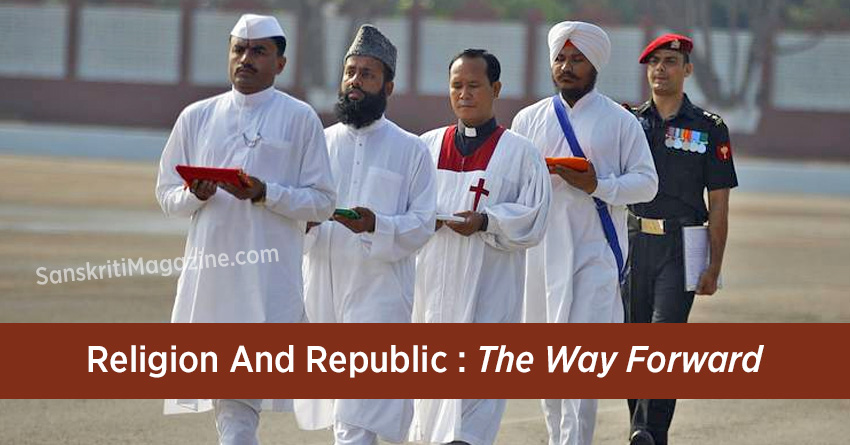
In this context, the culture of this subcontinent is unique because it is a kaleidoscope of spiritual practices and movements. A kaleidoscope needs to be carefully handled, so it stays dynamic and ever-confounding. Since being joyfully confused is the root of all seeking, the kaleidoscope defies conclusion, but stirs a profound sense of wonder and an intense spirit of quest. You look into a kaleidoscope not for certainty, but for lively exuberance. It is the false sense of certainty that leads to bigotry, and eventually to tyranny.
This kaleidoscope of cultural diversity where the sacred and the mundane are tossed into a mind-boggling mix is the distinctive hallmark of India.
It is, by design, a preventive for tyranny. Of course, some enterprising folk will always find a way to turn even creative chaos into bigotry.
The republic, on the other hand, is also a product of a constitution, but not God-given. It is a document that ‘we, the people’ decide to agree upon, a document that can be amended, as per the requirements and mindsets of the time. But the important thing is that it is an agreement, not an imposition. A republic is a congregation of people who have come to an agreement of their oneness, not their sameness. So, as a product of mutual agreement, a democratic constitution can only provoke debate, never a revolt.
Those who talk of overthrowing regimes in a democratic society are still feeding on the outdated romance of revolution, a hangover from a past when despots ruled with the power of sword or gun. Such an approach has no place in a society with a constitutionally elected government.
This does not mean passive acquiescence. Every citizen must be encouraged to think, question, challenge, and express freely and fearlessly. This is our inviolable right — the basis of a lively democracy. Our education system needs to foster a deeper, more mature understanding of democratic process, so we realise democracy spells the rule of institutions, not the caprice of individual whim.
Democracy is not perfect, but it does allow a constant process of course correction. Personally, I refuse to identify with the borders that divide humanity into political entities called nations. But a democratic nationhood seems to be the best instrument we have right now. Better a geographical boundary than that of race, religion or ethnicity. Until we achieve the utopian world of absolute unity, which is only achievable by raising human consciousness, a nation is, fortunately or unfortunately, sacrosanct.
When all of us are allowed to say and do what we want, we need to exercise that freedom with responsibility. Every citizen needs to understand the fundamentals of a republic. Being citizen of a nation means abiding by the constitution, not out of submission, but empowered choice, not out of indoctrination, but intelligence. A vibrant intelligence, capable of being interrogative and discerning, while remaining responsible and self-critical – these are the mechanics of a healthy republic.