IndianSanskriti
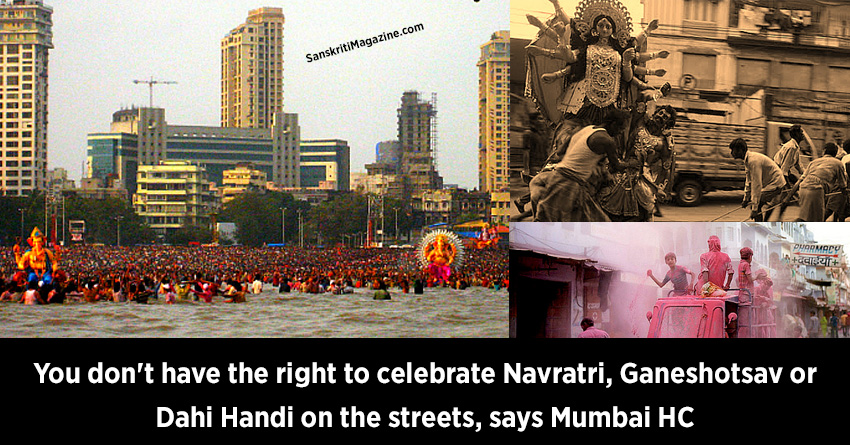
don't have the right to celebrate Navratri, Ganeshotsav or Dahi Handi on the streets, says Mumbai HC

You don’t have the right to celebrate Navratri, Ganeshotsav or Dahi Handi on the streets, says Mumbai HC

It may come as a relief to those frustrated with roadblocks caused in the name of religion. The Mumbai High Court, on Wednesday, has ruled that you don’t have the right to worship idols in public places while issuing stricter norms for temporary pandals for festivals like Dahi Handi, Navratri and Ganeshotsav that take over Mumbai’s roads and footpaths.

“No citizen has a fundamental right to worship God at a public place, unless that place is of particular significance for the religion concerned,” the division bench of justice Abhay Oka and justice Revati Mohite-Dere said, as reported by the HT.

So what are our rights when it comes to expressing religion?

During pandal season, citizens can walk on the roads, while temporary pandals on footpaths in good condition can be considered by municipal commissioners. To prevent illegal pandals, Mumbai High Court asked district collectors to put together teams to visit visit municipal areas a week before a festival to alert the civic chief. Since any matter of religion can get ugly, local police stations have been asked to protect civic staff making this visits.

The PIL that made it possible

All this happened after a PIL (public interest litigation) by a Dr Mahesh Bedekar, complaining about the rules and regulations were not followed while festivals such as Ganeshotsav, Navratri and Dahi Handi were being organised in the Thane. Bedekar, who runs a hospital in Thane, had filed an FIR on the menace caused by festivals such as Ganeshotsav, Navratri and Janmahotsav. He said no action by authorities, even if after citizens complained about the violations.

The PIL had previously led to the court preventing municipal commissioners from granting permissions to pandals and other religious structures if they obstructed traffic or footpath movement. The bench, comprising justice Abhay Oka and justice Revati Mohite-Dere, criticised the state government for “complete failure” to comply with the directions issued by the court earlier. It directed state chief secretary to furnish the names and designations of officers responsible for breach of its March 13 order for curbing noise pollution during festivals.

The bench was miffed that the State government had not complied with its directions, particularly for setting up of a complaints redressal mechanism. The court also noted that it was only after a lapse of two months that the order was communicated to the concerned departments. The bench also asked for ensuring that its guidelines regarding the Noise Pollution Rules (2000) and Supreme Court’s orders are implemented.
You may also like

Search the website

Like us on Facebook

Get daily updates via Email

Enter your email address:

Recent Posts

Yogini Ekadashi 2026 — The Yaksha Who Missed the Morning Flowers, and the Ekadashi That Undid His Curse

On Friday, July 10, 2026, the rare Krishna Paksha Ekadashi of Nija Ashadha arrives. The Padma Purana tells the story of Hemamali — the Yaksha gardener of Bhagavan Kubera in Alaka, whose single morning of distraction with his wife Vishalakshi cost him his form, his wife, and his celestial city. Cursed to wander the earth of Bharata as a leper for a long time, he was at last shown the way back by Sage Markandeya — a single sincere keeping of Yogini Ekadashi.

Jamai Shashthi 2026 — The Story of Maa Shashthi, the Cat, and the Wife Who Was Forgiven

Jamai Shashthi 2026 — The Story of Maa Shashthi, the Cat, and the Wife Who Was Forgiven

On Saturday, June 20, 2026, Bengali households across Bharata will welcome their married daughters and sons-in-law home for the legendary jamai-aador feast and perform the Shashthi Vrata. But behind the warmth lies a story most Bengalis know by heart and most non-Bengalis have never heard — the wife who stole the hilsa, blamed the cat, lost six sons to Maa Shashthi’s wrath, and was finally forgiven. The Vrat Katha, the vidhi, the mantras, and the deeper teaching.

Vat Purnima 2026 — The Wife Who Argued Yama Into Returning Her Husband’s Life

On Monday, June 29, 2026, women across Maharashtra, Gujarat, and southern Bharata will tie red thread around banyan trees and hear the story of Savitri — the wife who walked behind Yamaraja Himself when He came for her husband, and out-argued the Lord of Dharma into returning Satyavan’s life. The Mahabharata’s Pativrata Mahatmya Parva, the vrat vidhi, and why the banyan witnessed everything.

Nija Jyeshtha 2026 — The Real Jyeshtha Begins, and the Calendar Resumes

Nija Jyeshtha 2026 — The Real Jyeshtha Begins, and the Calendar Resumes

With Adhik Maas now closed on the Somvati Amavasya of June 15, the long-postponed festivals of Jyeshtha return — Vat Purnima (June 29, the Savitri-Yamaraja katha), Jamai Shashthi (June 20, the Bengali festival of Maa Shashthi), Sankashti Chaturthi (June 28), Yogini Ekadashi (July 10), and Devshayani Ekadashi (July 16, opening the four-month Chaturmas of Bhagavan Vishnu’s yoga-nidra). A guide to what the next four weeks hold and what the household that kept Purushottam Maas now carries forward.

The Closing of Purushottam Maas 2026 — Adhik Amavasya and the Sealing of the Month-Long Vrat

On Monday, June 15, 2026 — a rare Somvati Amavasya — the intercalary month that bears Bhagavan Vishnu’s own name comes to its close. The Acharyas teach that a vrat is not measured by its duration but by its closing. Here are the Padma Purana’s instructions for sealing the month-long Purushottam Maas vrat: the morning snan, the closing puja with the Vishnu Sahasranama, the day of dana, the Somvati Amavasya gift, and the final sarva-arpana — the offering of all merit at the feet of the Lord.

css.php