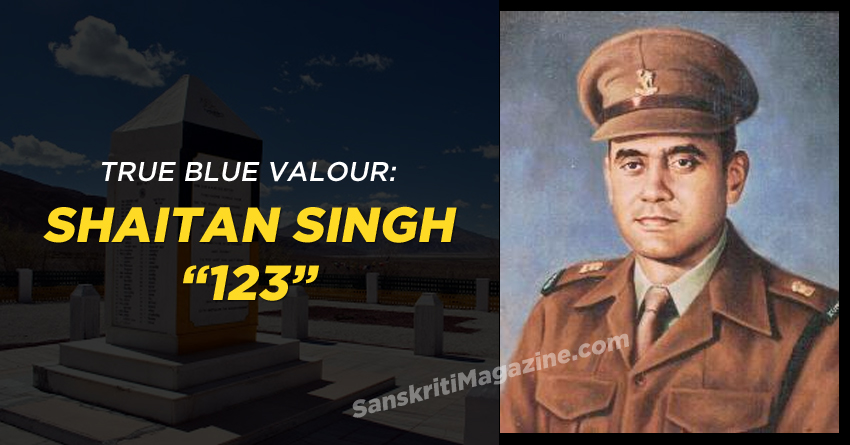
When the survivors of Rezang La told the commanders what had happened, they were not believed, but asked to clear their senses from battle shock. Then the survivor had to ask them to check the facts at the battle site to prove their details. It was Shaitan Singh, born on December 1, 1924 at Jodhpur in Rajasthan and his troops which had caused all this unbelievable mess. His father was Lt Col Hem Singh Bhati.
In the 1962 Sino-Indian War, The ‘C’ Company of the battalion, led by Singh, held this crucial position at Rezang La, a pass on the south-eastern approach to Chushul Valley in Ladakh, in the state of Jammu and Kashmir, at a height of 5,000 metres (16,404 feet). Ramchander Yadav was the Radio man of the company. The company area was defended by three platoon positions and the surrounding terrain isolated it from the rest of the battalion.
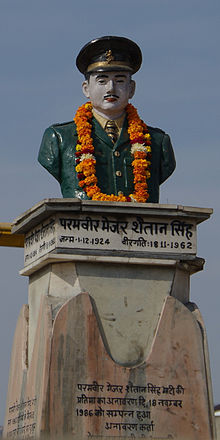 It was the end of a cold winter night with light snowfall. The icy winds howling through Rezang La were biting and benumbing. Apart from the thin air and cold, the location of Rezang La had a more serious drawback. It was unavailable to Indian artillery because of the terrain, which meant that they had to fight without the protective comfort of the cannons, big guns. During 1962, helicopters and such form of transportation were unthinkable in all locations. In the dim light of the morning, the Chinese were advancing through nullahs (gaps between heightened land mass) to attack No.7 and No.8 platoon positions.
The Indian Army troops fell on their prepared positions to face the Chinese offensive.
At 05:00 hours when the visibility improved, both platoons opened fire with rifles, light machine guns, grenades and mortars on the advancing Chinese. Indian artillery however, could not be used and the nullahs quickly littered with dead bodies. The survivors took position behind boulders and the dead bodies. The Chinese refused to retreat despite a failed first frontal attack and subjected the Indian positions to intense artillery and mortar fire with vengeance at about 05:40 hours.
Soon, about 350 Chinese troops commenced advance through the nullahs. This time, No.9 Platoon, which held fire till the enemy was within 90 metres opened up with all weapons in their possession. Within minutes, the nullahs were again full of dead bodies, this time mainly of the Chinese. This was the plan by Shaitan Singh to give the enemy a surprise.
Unsuccessful in frontal attack, the enemy then approximately 400 strong attacked from the rear of the company position. They simultaneously opened intense medium machine gun fire on No.8 Platoon, an attack for which the Indian soldiers were well prepared. Shaitan Singh had made arrangements so that nobody could climb up from behind and attack, containing the enemy at the barbed wire fencing of the post.
The Chinese then resorted to heavy artillery and mortar shelling and an assault group of 120 Chinese also charged No.7 Platoon position from the rear. However, Indian Army 3-inch mortar killed many of them.
When the last 20 surviving Chinese charged the post, Havildar Surja Ram sent message, it is the time they will fight hand to hand. Out of ammunition and weaponry, about a dozen Kumaoni’s rushed out of their trenches to fight the armed Chinese with their bare hands and bayonet knives. Meanwhile, the Chinese brought up fresh reinforcements and the encirclement of No.7 Platoon was sadly complete. The platoon, however, fought valiantly till there were no survivors. No.8 Platoon also fought bravely to the last round.
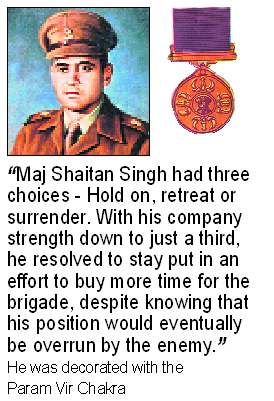
Singh displayed exemplary leadership and courage in the battle of Rezang La. By all accounts, he led his troops most admirably against an immense foe. Unmindful of his personal safety he moved from one platoon post to another and encouraged his men to fight. While moving among the posts he was seriously wounded, by a sniping Chinese MMG but he continued to fight alongside with his men. He ordered his radio man, Ramchander Yadav to be alive, to go to the base and tell them what happened and how the Indians had fought .
While he was being evacuated by two of his comrades, the Chinese brought heavy machine gun fire on them. Singh sensed danger to their lives and ordered them to leave him there. Company Havaldar Harphool Singh asked Ramchander Yadav to not let the Chinese get their hands on Major saab’s body.
Yadav described the remaining as:
“So I opened the sling of the rifle and tied Major saab to myself with the belt, joining our bodies together at the waist. And then, slowly, I started to roll.
There was very little life left in him. After about 10 yards, there was gravelly ground and I started rolling down faster. I rolled for 400 yards, and then there was a nullah, after that boulders again. After rolling for 400 yards, I stopped near a boulder to catch my breath. I was thinking that the Company headquarters are below, so I should try to somehow get a couple of people from there to help me so I can take saab down. But when it was 8.15pm by his watch, I noticed that the Major saab was no longer alive. Because Major saab’s watch ran by his pulse, and when the pulse stopped, the watch stopped. I took off the Majors gloves, and slid his body between boulders to hide it, so that it remained safe until someone could return to fetch it”.
Ramchander Yadav explained how some of his colleagues fought hand to hand when they were out of ammunition, when company 7 was out of ammunition they ran forward with bayonets and attacked the incoming enemy. What they did to the Chinese earned them their respect.
 “Sometimes the bayonets would not work, the Chinese were wearing thick parkas (heavy protective clothing) and the bayonets could not penetrate them. I saw our men, stabbing repeatedly with their bayonets, and the blade would not go through. Then they fought with bare hands. One Havildar Singh Ram just grabbed them by their necks and smashed their heads together and against rocks. He was a wrestler… Bahut tagda pehelwaan tha. He could catch people like me by the scruff of our necks and say, c’mon, heat the milk. I was his boxer. Before the Chinese left, they sank a bayonet on the ground near his head, and put a helmet on top. They gave him izzat, samman, (respect) they kept a note there. I have seen that note”. Such was the respect even among soldiers, described Yadav.
In this action, 109 Kumaonis out of a total of 123 were killed. Of the 14 survivors, 9 were severely injured. The Chinese suffered more than a thousand causalities.
Major’s body, his gloves with his blood were found hidden in the rocks where Ramchander Yadav hid them. Every Jawan in the Company died facing the enemy with a bullet would on their chest and no wounds on their backs. Nursing Assistant Dharam Pal, who bandaged 32 wounded soldiers, died while bandaging his comrades on the battlefield. A Jawan died holding the light machine gun with bullets in his chest but the gun never fell from his hand; he remained clasping the machine gun even after death. Another Jawan died in the process of throwing a grenade, still holding it yet the Chinese could not pull it out of his hand upon death. Many others remained in crouching positions, with bayonets in their hands and bullets in their chests – all dead… the cold weather and ice froze their bodies, preserving their last moment on earth as a grim reminder of the selfless sacrifice to their motherland.
Maj. Gen. Ian Cardozo, a Vir Chakra winner, writes in his Param Vir Chakra – Our heroes in Battle:
“When Rezang La was later checked, dead Jawans were found in the trenches still holding on to their weapons, frozen .. every single man of this company was found dead in his trench with several bullet or splinter wounds. The 2-inch mortar man died with a bomb still in his hand. The medical orderly had a syringe and bandage in his hands when the Chinese bullet hit him… Of the thousand mortar bombs with the defenders all but seven had been fired and the rest were ready to be fired when the (mortar) section was overrun”.
A memorial in Rewari where most of the Ahir soldiers of the regiment came from, states that 1700 Chinese soldiers were killed in battle that day. There is another memorial in Ladakh built by all staff.
Because of the fight these brave men put up and stopped the momentum of the advancing Chinese Army with their lives, the Chinese had to rethink about the war and Ladakh remained a part of India.
Major Singh’s body was retrieved and flown to Jodhpur where he was cremated with full military honours. He was awarded Param Vir Chakra, the highest wartime gallantry medal, posthumously, for his leadership and devotion to duty.
Today as our Jawans continue to face the enemy and brave the treacherous conditions at the borders, let us not forget the countless sacrifices of unsung heroes that have strengthened the unified India so that people like you and I can live in a democratic country… there they have stood guard for us as we sleep in our cozy beds at night.
The battle of Rezang La is a great feat of leadership, courage and unswerving determination in the annals of Military History. Appropriately the plaque at the memorial of Rezang La says:
“How can a man die better
than facing fearful odds
For the ashes of his fathers
and the temple of his Gods”
~ Prasoon Kumar