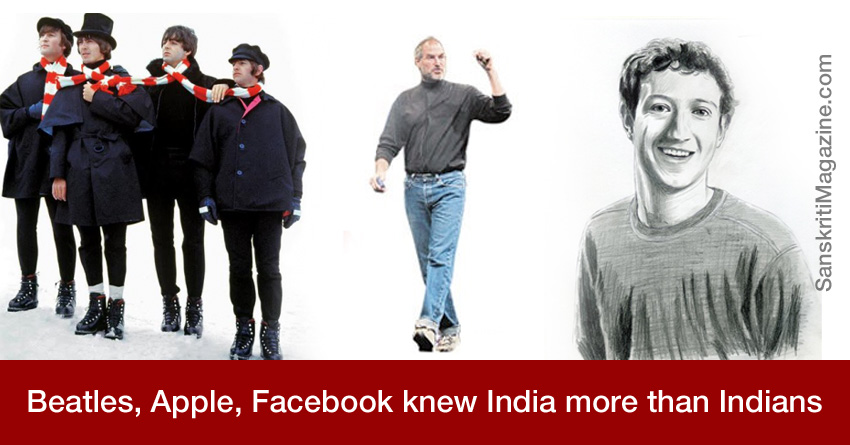
Facebook’s Chairman Mark Zuckerberg had dropped a bombshell during PM Modi’s visit to his Facebook’s office in California. It’s all about the Facebook connection with India. Well, initially it was never a bed of roses for what is now a household name across the world. This world-famous ‘social networking service company’ had its own share of bad times. Revealing for the first time in the recent meeting at the Facebook office upbeat Zuckerberg told PM Narendra Modi that Steve Jobs, the founder Chairman of Apple, had advised him to visit a certain temple in India for blessings.
The revelation may have caused heartburn to many. More so in India where so-called secular and snooty folks have long acquired a proclivity to look down upon their own culture, religion and values while being appreciative of any bizarre customs and styles of the West. Yes, heeding to the advice of his mentor Steve Jobs the depressed Mark had visited the temple and toured around India for nearly a month.
Well, the American techno-wizard Steve Jobs had himself spent over six months in India in 1974. He was here in quest of the higher meaning of life and spiritual solace. As understood, from early age Steve was quite haunted by a good deal of unanswered questions. Of course, his encounter with a book “Be Here Now” by Richard Alpert, a Harvard Professor, had opened up a gateway to the spiritualism of the East.
This book had also introduced him to a mystic Yogi ‘Neem Karoli Baba’. That later inspired Steve to set out the journey for the East. As soon as Steve and his friend Daniel Kottke arrived India they directly went to meet the Guru in Kainchi Dham Ashram in Nainital. But to their disappointment they found the Baba had already passed away some months earlier. Nevertheless, the urge to dive deeper into the spiritualism did not die away. They shaved their heads and put on Indian clothes and undertook an extensive meditation and yogic practices.
The most significance impact that had made upon Steve’s life was a book “Autobiography of a Yogi” by Paramhansa Yogananda. It is on record that that he would read this book too frequently, at least once every year until his death, 2011. This book had given him the practical insight into what exactly this world is about and how a layman can prepare himself to realize the Supreme knowledge. The firsthand account of a Yogi with empirical approaches to know oneself this book by Yogananda is a smash hit manual now among the seekers of the Eastern spiritualism.
Yes, by dint of hard work, intuition and innovation Steve stood out as one of the most successful techno-tycoons of the modern time. As much known, Jobs was hardly possessed by the luxury of riches and materialistic vanity. He just regarded his entrepreneurship as a tool to awaken his dormant potentialities. The chairman of Salesforce.com and famous philanthropist Marc Benioff says with conviction — “If you want to understand Steve, it’s a good idea to dig into ‘Autobiography of a Yogi’.” It is this book which Steve’s family had given to all the guests as a last gift at his memorial service.
Here we can’t afford to ignore the Beatles’ fascination for INDIA as well. The band members that were basking in the opulence of materialistic riches and glory visited India (Rishikesh) in search of inner peace. They met with Sri Maharshi Mahesh Yogi and learnt from him Transcendental meditation (TM) who laid bare methods to feel true bliss within. Sri Maharshi is a big name in the West having a huge following that includes celebrities like Oprah Winfrey, David Lynch, Russell Brand, Hugh Jackman, Jennifer Aniston, Modern physicist Dr. John Hagelin, to name a few. The Beatles’ Paul McCartney and Ringo Starr often assists a Hollywood Director/actor David Lynch to organize the Transcendental meditation under ‘David Lynch Foundation’ across USA and the European countries. George Harrison later took refuge in Bhakti Yoga. The founder of ISKCON Sirla Prabhupada showed him the pathway to the Supreme Consciousness.
It is quite known that the Beatles’ visit to India brought about a major shift in the perception of the western world about this ancient country and her wisdom. Many hold it as true that the Beatles are partly credited for the massive acceptance of Yoga in the West.
What basically pulls the rational westerners to India is less known to Indians themselves. It’s shamefully paradoxical. From early 19th Century the philosophical literary treasure troves and Yoga of India found more admirers in the foreign lands than at home. Indeed, the philosophy of the “laws of Karma” and the presence of all-power-divinity within every being and everywhere — which any human being can realize irrespective of one’s caste, creed, nationality and color, has intensely stirred the greatest of the great minds of the West. The ancient texts hold out a whole bunch of keys to unlock oneself and know his/her relationship with the Supreme Being which in fact seems very seasonable to the West.
Further, the complex studies of world-view by Modern scientists are gradually arriving at the same conclusion what the ancient sages of India expounded over five thousands year back that ‘creation and creator are ONE’. Interconnection, inter-relation and interdependence among every individual particle/object, living or non-living, in the infinite universe — which is the fundamental tenets of the Eastern philosophy, provided a new light of wisdom to the the modern physicists like Schrödinger, Heisenberg, Julius Oppenheimer, Brain David Josephson, David Bohm, John Stewart Bell et al. Well, Indian’s contribution to the western academia is immeasurable — though deliberately undermined or less discussed in India itself.
It’s very worthwhile to recall a famous proclamation by our western master whom we hold in the highest esteem. TS Eliot, one of the most celebrated poet of 20th century, asserts:
“Indian philosophers’ subtleties make most of the great European philosophers look like schoolboys.”
~ Salil Gewali, Shillong