India is surrounded by water from three sides – the Bay of Bengal to its east, the Arabian Sea to the west and the vast Indian Ocean to the south. Therefore, the naval force of the Indian military must be strong enough to tackle sea intrusions and attacks on the shore. To do this, the Government of India is putting much priority to strengthen the Indian Navy.
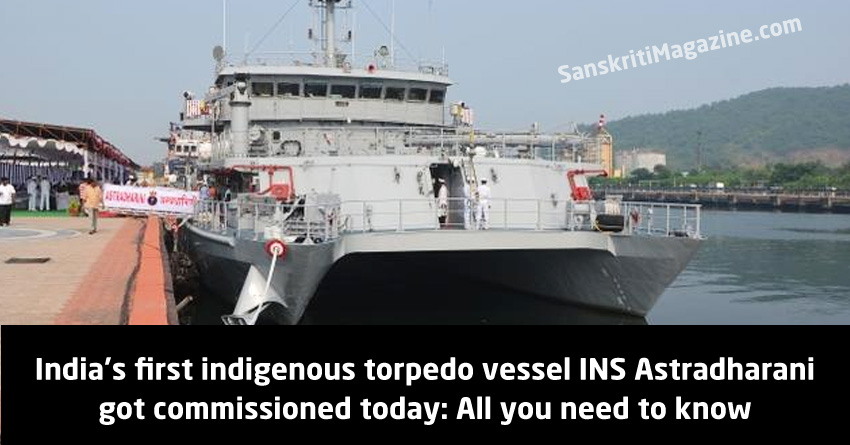
The Indian Navy is increasing its tally of aircraft carriers and destroyer vessels. INS Astradharani is the latest addition to the Indian Navy fleet. India’s first completely indigenous torpedo launch and recovery vessel (TRV), INS Astradharani, has been commissioned into the naval force in Visakhapatnam in Andhra Pradesh. The INS Astradharani was built under the joint efforts of Naval Science and Technological Laboratory of the Defence Research and Development Organisation (DRDO), Shoft Shipyard and IIT Kharagpur. The vessel comes as a replacement of INS Astravahini that was built by Goa Shipyard Limited and P.S. and Company for the Indian Navy. It was decommissioned last July.
Some key features of the INS Astradharani:
Length: 50 metre
Speed: 15 knots (28 kilometre per hour)
Crew capacity: 2 officers and 27 sailors. It can also carry 13 additional crew in case of emergency
Firepower: Underwater weapons including torpedoes and sea-surface mines
Special feature: The vessel is designed with Catamaran Hull configuration that comes with two parallel hulls to reduce power consumption
The Indian Navy is prioritising the making of indigenous vessels under Prime Minister Modi’s call of Make in India. The inclusion of an advanced TRV like INS Astradharani certainly adds to the self-reliance of India’s offshore defence mechanism.
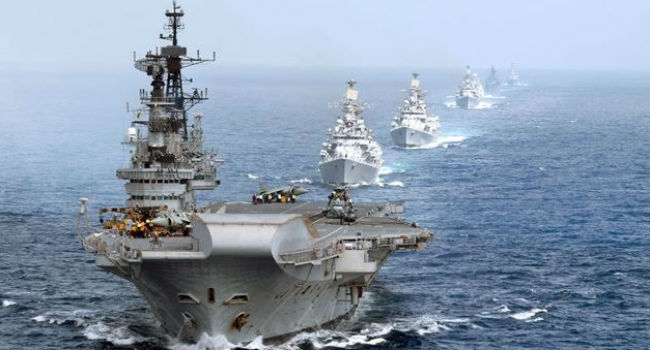
Here are 7 facts about the Indian Navy you would take pride in:
1. Indian Navy is not a newborn child. The first tidal wave port that helps naval fleet go offshore is believed to have been built at Lothal in Gujarat in 2300 BC!
2. The Navy has a special task force of marine commandos named MARCOS alias ‘Magarmach’
3. The Indian Navy has a dedicated satellite for navigation named GSAT-7
4. The Navy also embarks on humanitarian missions such as disaster management in and outside India
5. The first military operation conducted by the Indian Navy was against the Portuguese in 1961 during the liberation of Goa
6. The Indian Navy possesses the fastest cruise missile in the world called BrahMos. It travels at a speed of Mach 2.8 to Mach 3.0 (Mach 1= 1,234 kilometres per hour)
7. The Indian Navy also has the biggest naval academy in Asia. The Indian Naval Academy in Ezhimala, Kerala, has an area span of around 2,450 acres and enrolls up to 1,200 cadets every year.