SCROLL DOWN FOR VIDEO
September 1970 is known as the Black September in Arab history and sometimes is referred to as the “era of regrettable events.”
It was a month when Hashemite King Hussein of Jordan moved to quash the autonomy of Palestinian organizations and restore his monarchy’s rule over the country. The violence resulted in the deaths of tens of thousands of people, the vast majority Palestinian. Armed conflict lasted until July 1971 with the expulsion of the PLO and thousands of Palestinian fighters to Lebanon.
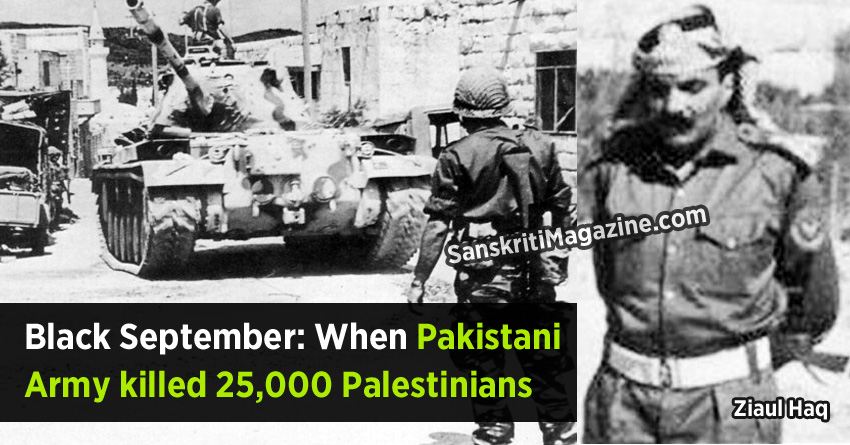
On September 15, King Hussein declared martial law. The next day, Jordanian tanks (the 60th Armored Brigade) attacked the headquarters of Palestinian organizations in Amman; the army also attacked camps in Irbid, Salt, Sweileh,Baq’aa, Wehdat and Zarqa. Then the head of Pakistani training mission to Jordan, Brigadier Muhammad Zia-ul-Haq (later Chief of Army Staff and President of Pakistan), took command of the 2nd division. In addition, the Iraqi army in Jordan after 1967 war serving as a reserve forces supported the Jordanian army.
The armored troops were inefficient in narrow city streets and thus the Jordanian army conducted house to house sweeps for Palestinian fighters and got immersed in heavy urban warfare with the inexperienced and undisciplined Palestinian fighters.
Amman experienced the heaviest fighting in the Black September uprising.
The American backed Jordanian army shelled the PLO headquarters in Amman and battled with Palestinian guerillas in the narrow streets of the capital. Syrian tanks rolled across the Yarmouk River into northern Jordan and began shelling Amman and other northern urban areas. Outdated missiles fired by the PLO struck Amman for more than a week. Jordanian infantry pushed the Palestinian Fedayeen out of Amman after weeks of bitter fighting.
Zia remained posted in Jordan from 1967 till 1970, where he was involved in training and leading Jordon’s military. He is still highly respected in Jordan for his role in the Black September operations in support of King Hussein, where he commanded Jordan’s 2nd division. Zia’s troops were heavily involved in street-to-street urban fighting and are credited with killing scores of Palestinians. Black September was a great example of how the Arab nations despise the Palestinians, and their support of them only goes as far as to encourage and help the Palestinians to kill Jews.
This in itself is very strange as the most promising comparison between the Islamic Republic of Pakistan and the Jewish State of Israel came from Gen. Zia ul-Haq. Lacking a political constituency, he skillfully exploited Islam to legitimize and consolidate his military dictatorship. Presenting himself as a simple, pious and devoted Muslim, he institutionalized religious radicalism in Pakistan. In so doing, he found Israel to be his strange ally.
Toward the end of 1981, he remarked:
“Pakistan is like Israel, an ideological state. Take out the Judaism from Israel and it will fall like a house of cards. Take Islam out of Pakistan and make it a secular state; it would collapse.”
He likewise surprised many observers in March 1986, when he called on the PLO to recognize the Jewish state. He was actively involved both in the 1970 Black September massacre of the Palestinians in Jordan as well as in Egypt’s re-entry into the Islamic fold more than a decade later.
The intensity of bloodletting by Zia ul Haq and King Hussain was such that one of the founder fathers of Israel Moshe Dayan said:
“King Hussein (with help from Zia-ul-Haq of the Pakistani army) sent in his Bedouin army on 27 September to clear out the Palestinian bases in Jordan. A massacre of innumerable proportions ensued. Moshe Dayan noted that Hussein “killed more Palestinians in eleven days than Israel could kill in twenty years.” Dayan is right in spirit, but it is hardly the case that anyone can match the Sharonism in its brutality.”
The butcher was awarded Jordan’s highest honour for the services rendered.
Upon his return to Pakistan, this Brigadier’s name was suggested for Court Martial due to his role in Palestine and the massacre of its people. But for some unknown reason, the then Chief of Army Staff General removed his name from the list which was then sent to President Zulfiqar Ali Bhutto. This resulted in his promotion to the rank of Major General and later again to the ranks of Lt. General by “special attention”.
He was later made Chief of Army Staff ahead of seven other senior officers within just 6 years after Black September. It was this man who then overthrew the elected government of Zulfiqar Ali Bhutto and later hanged him to “make him an example for the Free World.”
So much for the Palestinian cause that is very much touted by the Muslims of Pakistan today.