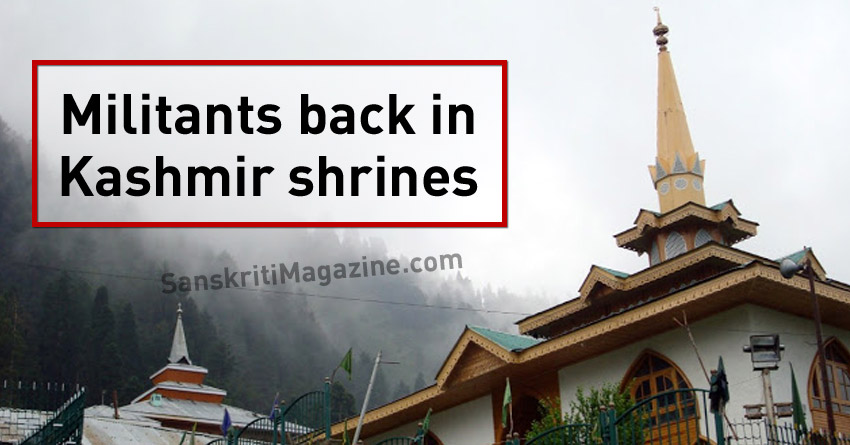
The most disturbing fact revealed by Naveed Mohammad, the terrorist who was captured alive while trying to escape after having mounted a deadly terror attack on Border Security Force (BSF) convoy on Wednesday, is that he and his three accomplices along with their weapons had stayed at the famous Baba Reshi shrine atop a hillock in the Tangmarg area in Baramullah district. The shrine, visited by men and women of all faiths, is guarded round the clock by security forces.
It is puzzling that the Kashmir shrine was used as a hiding place by Naveed, just 5th standard pass, and his three accomplices Abu Ukash (a Pashto-speaking militant), Abu Mohammad (a local Kashmiri militant) and Momin Khan, who was shot dead by the BSF on the day of the attack. The two who are on the loose are in the Pulwama-Kulgam area of south Kashmir.
Militants have not used shrines in Kashmir for the first time – they had done so in 1993 and 1996 when the Hazratbal shrine in Srinagar was occupied by them. The shrine of Charar-e-Sharief in Budgam district was under the control of Pakistani militants, including Mast Gul of Peshawar, in 1995.
These four terrorists, according to Naveed of Faisalabad in Pakistan Punjab, had come from Fazza opposite the Noori post of India by cutting fence and reached the Baba Reshi shrine, which is frequented by scores of people daily. From there they were taken to Kulgam to meet the Lashkar-e-Toiba chief in Kashmir, Abu Qasim. All four had received training in three stages, with the last one at Manshera. That was days before May 3, when they started their journey from Muzaffarabad in Pakistan-occupied Kashmir to this side of the Line of Control (LoC).
Two days before the attack on August 3, Abu Qasim asked Naveed and Momin, “Are you ready for the action”. They replied: “Yes”. This action had to be done in Jammu. They were sent to Nursoo Nullah in a truck. Trucks are not checked at Jawahar Tunnel while small vehicles are. The tunnel connects the two regions —- the Valley and Jammu.
Interrogators and investigators are frustrated by the fact that none of the sources of the security forces and intelligence agencies gave even the slightest clue about the use of the shrine by the terrorists. That meant that the over ground network of the terror groups is intact and flourishing. This could mean a lot of trouble because security forces entering shrines or mosques — a phenomenon in the early part of this century — is a highly sensitive issue.
“We are worried on two counts: one, that the shrines were being used by militants and, two, that our sources have not been able to inform us about this revived phenomenon,” a senior police officer told The Tribune on condition of anonymity. This, when translated in the situational terms, means that the terror groups have so much terrorised the people that no one dares to speak about them. The local support is growing for them and that is what could cause a serious situation in the coming weeks and if any hard measures are adopted, things could get further complicated, according to the police.
“This situation needs to be handled carefully by the men who know the sensitivities of the people and also understand the imperatives of national security,” the police officer said. “Any image or impression that there would be extraordinary use of force or the use of the brutal methods of the past would backfire” is being said in informed circles.
~Arun Joshi, Tribune News Service