In the 19th century, the prevailing belief among the historians of science was that Mathematics and Astronomy in the Indian subcontinent had gone into hibernation after Bhaskaracharya in the 12th century. The credit for demonstrating that this was not so must surely go to Charles M Whish, Esq., a civil servant in the East-India Company. In 1832 he brought to the attention of the historians the magnificent achievements of the Kerala School which flourished from the 14th to 17th century. (Whish’s paper, On the Hindu Quadrature of the circle, has been reproduced in a modern introduction to ancient Indian mathematics, T S Bhanumurthy, Wiley Eastern, as an appendix.) Among the major figures of this school are Madhava (1350-1410) of Sangamagrama, Paramesvara (1360-1455), Nilakantha Somayaji (1444-1545) and Jyesthadeva (c.1500-1600) whose significant contributions to mathematics include infinite series expansions of trigonometric functions and very accurate approximations to pi.
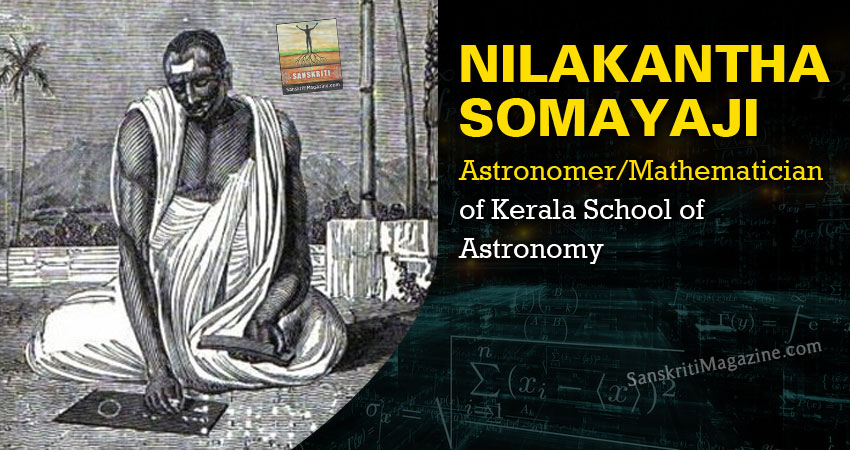
The most comprehensive work of the Kerala School available to us is the Tantrasangraha of Nilakantha Somayaji along with commentaries on it by some of his followers. Fortunately the biographical details of Nilakantha are well recorded. He was born on Wednesday, June 14, 1444, and was a resident of Trkkantiyur (Sanskritised into Sri -Kundapura ), near Tirur, Ponnai taluk, South Malabar. His teachers were Ravi with whom he studied Vedanta, and Damodara, son of Paramesvara, who initiated him into Astronomy and the underlying mathematical principles. That Nilakantha lived upto a ripe old age, even to become a centenarian, is attested by a contemporary reference made to him in a Malayalam work on astrology Prasnasara composed in 1542-43.
Nilakantha’s writings substantiate his knowledge of several branches of Indian philosophy and culture. It is said that he could refer to a Mimamsa authority to establish his view-point in a debate and with equal felicity apply a grammatical dictum to the same purpose.
The Tantrasamgraha is his major astronomy treatise written in 1501. It consists of 432 Sanskrit verses divided into 8 chapters, and it covers various aspects of Indian astronomy. It is based on the epicyclic and eccentric models of planetary motion. The first two chapters deal with the motions and longitudes of the planets. The third chapter Treatise on shadow deals with various problems related with the sun’s position on the celestial sphere, including the relationships of its expressions in the three systems of coordinates, namely ecliptic, equatorial and horizontal coordinates.
The fourth and fifth chapters are Treatise on the lunar eclipse and on the solar eclipse and these two chapters treat various aspects of the eclipses of the sun and the moon. The sixth chapter is on vyatipata and deals with the complete deviation of the longitudes of the sun and the moon. The seventh chapter on visibility computation discusses the rising and setting of the moon and planets. The final chapter on elevation of the lunar cusps examines the size of the part of the moon which is illuminated by the sun and gives a graphical representation of it.
The Tantrasamgraha is very important in terms of the mathematics Nilakantha uses. In particular he uses results discovered by Madhava and it is an important source of the remarkable mathematical results which he discovered. However, Nilakantha does not just use Madhava’s results; he extends them and improves them. An anonymous commentary entitled Tantrasangraha-vakhya appeared and, somewhat later in about 1550, Jyesthadeva published a commentary entitled Yuktibhasa that contained proofs of the earlier results by Madhava and Nilakantha. This is quite unusual for an Indian text in giving mathematical proofs.
The series π/4 = 1 – 1/3 + 1/5 – 1/7 + … is a special case of the series representation for arctan, namely
tan-1x = x – x3/3 + x5/5 – x7/7 + …
It is well known that one simply puts x = 1 to obtain the series for π/4. The author of [4] reports on the appearance of these series in the work of Leibniz and James Gregory from the 1670s. The contributions of the two European mathematicians to this series are well known but in [4] the results on this series in the work of Madhava nearly three hundred years earlier as presented by Nilakantha in the Tantrasamgraha is also discussed.
Nilakantha derived the series expansion
tan-1x = x – x3/3 + x5/5 – x7/7 + …
by obtaining an approximate expression for an arc of the circumference of a circle and then considering the limit. An interesting feature of his work was his introduction of several additional series for π/4 that converged more rapidly than
π/4 = 1 – 1/3 + 1/5 – 1/7+ … .
The author of [4] provides a reconstruction of how he may have arrived at these results based on the assumption that he possessed a certain continued fraction representation for the tail series
1/(n+2) – 1/(n+4) + 1/(n+6) – 1/(n+8) + …. .
The Tantrasamgraha is not the only work of Nilakantha of which we have the text. He also wrote Golasara which is written in fifty-six Sanskrit verses and shows how mathematical computations are used to calculate astronomical data. The Siddhanta Darpana is written in thirty-two Sanskrit verses and describes a planetary model. The Candracchayaganita is written in thirty-one Sanskrit verses and explains the computational methods used to calculate the moon’s zenith distance.
The head of the Nambudiri caste in Nilakantha’s time was Netranarayana and he became Nilakantha’s patron for another of his major works, namely the Aryabhatiyabhasya which is a commentary on the Aryabhatiya of Aryabhata I. In this work Nilakantha refers to two eclipses which he observed, the first on 6 March 1467 and the second on 28 July 1501 at Anantaksetra. Nilakantha also refers in the Aryabhatiyabhasya to other works which he wrote such as the Grahanirnaya on eclipses which have not survived.
~ J.J. O’Connor and E F Robertson, University of St. Andrews, Scotland with references from Indic Studies, USA