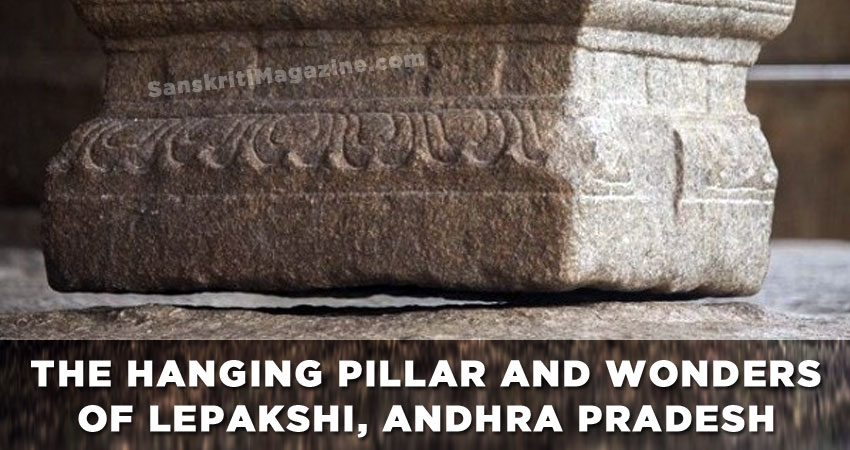
Time has not withered the magnificent sculptures and murals of the village of Lepakshi, also known for its silk weaving, located in Andhra Pradesh…
Wonders, they say, never cease. India is a land of ceaseless wonders, often waiting to be discovered by the world.
Lepakshi is one such wonder. Located 110 kilometres from Bangalore, about 10 kilometres from the nearest railhead of Hindupur, Lepakshi is located in the state of Andhra Pradesh. The very scenic drive from Bangalore, redolent with sunflowerand marigold-filled fields, can be very cool and pleasant. Lepakshi is a tiny town known for its silk weaving. The priceless Veerabhadra temple sits atop a small tortoise-shaped hill. Inside lies a magnificent trove of sculpture and mural art, about five centuries old.
Lepakshi was founded in the 16th century, possibly 1538, during the reign of the Vijayanagar king, Aliiya Rama Raya. An almost finished saga in stone was created by Virupanna and his brother Viranna, governors of the Penukonda region, under Vjayanagar rule. It was a popular temple, and visiting devotees and pilgrims could find shelter at the temple itself, along the rock pavilions. Stone rings were set into the rocky roof to suspend curtains, creating spacious cubicles for pilgrims.
Virupanna had the Lepakshi temple built – a vast financial outlay. He drew freely from the royal treasury, eager to create and complete his vision of beauty. Jealous enemies at court convinced the king that Virupanna was bent on outshining the king. The enraged king ordered Virupanna to be blinded. Virupanna however decided he had created and seen all the beauty he could probably ever see. Preempting the king’s order, he gouged his own eyes out, and dashed them across a rock face in the temple, leaving two long bloodstains, which are still visible.
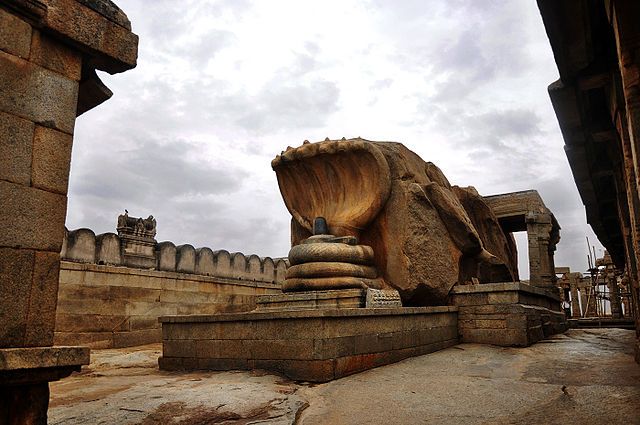
An outstanding huge Ganesha greets one at the entrance. A turn leads to Nagalingeswara – this piece is breathtaking. A huge sculpture of the holy coiled and hooded naga featuring a small lingam is placed right opposite the Potu rooms, or the kitchen. The coiled part has a large visible crack. The beauty of this sculpture took the fancy of the cook, who was stirring the huge cauldron of rice. According to legend, his evil eye caused the rock to crack.
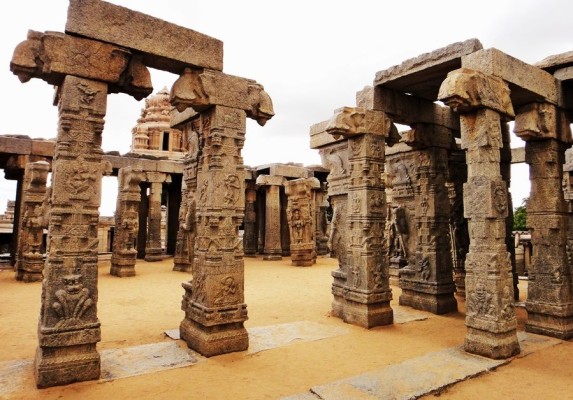
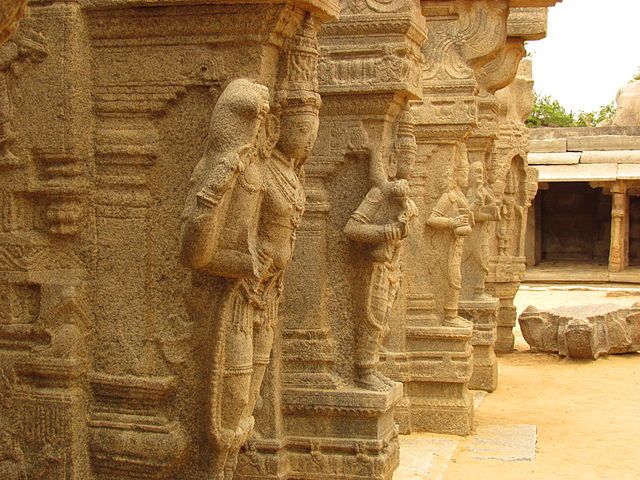
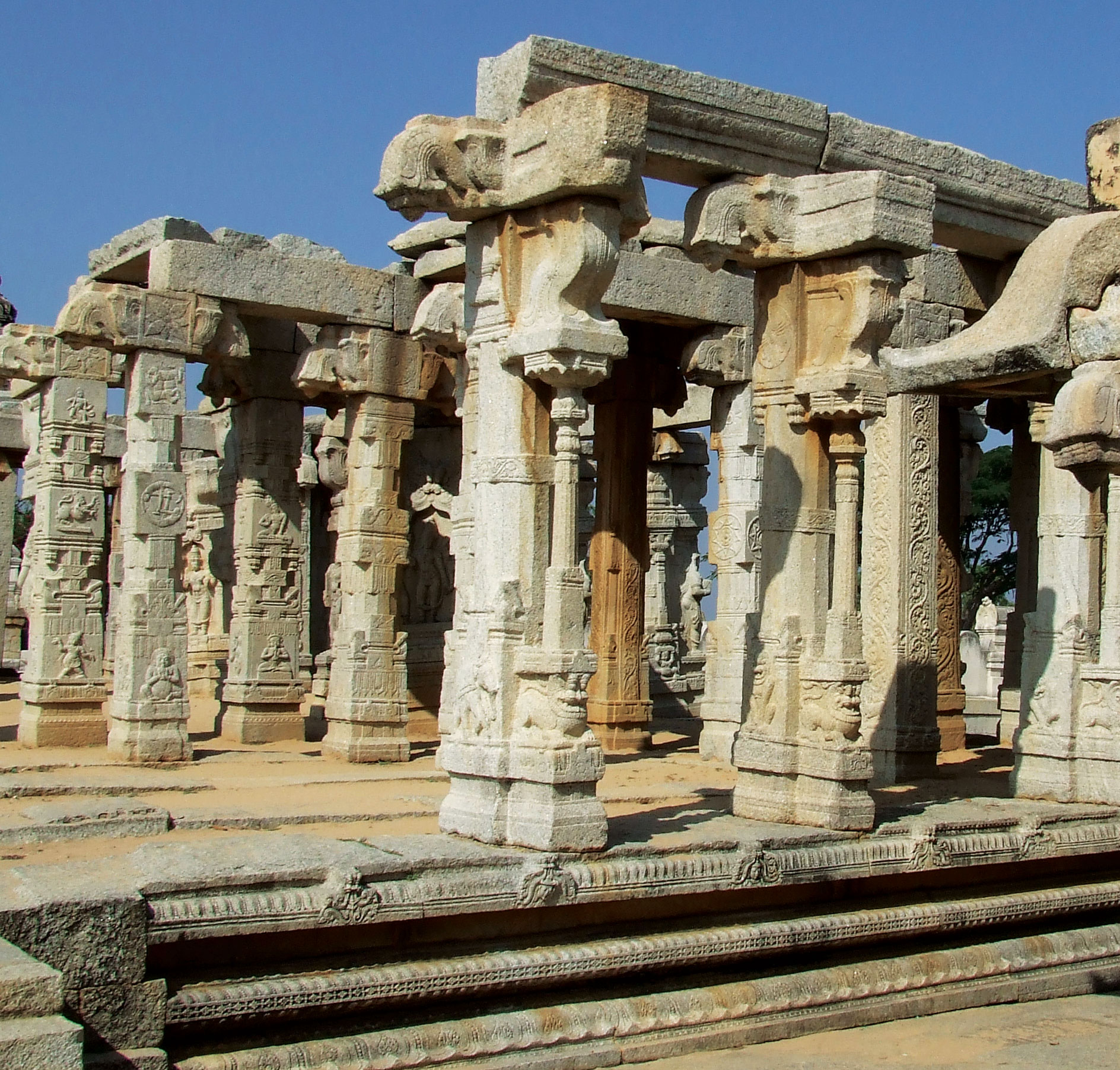
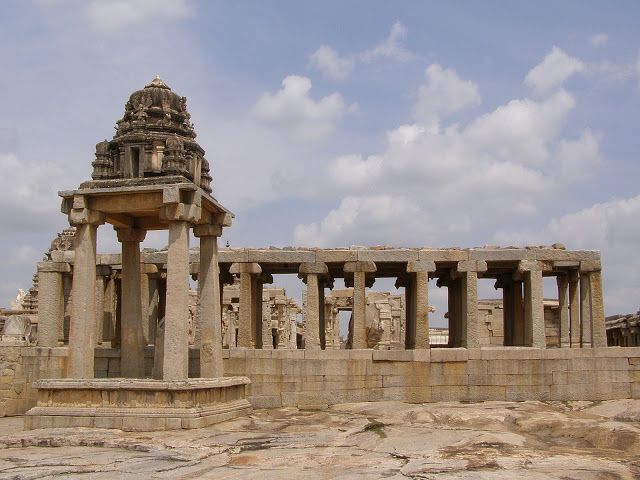
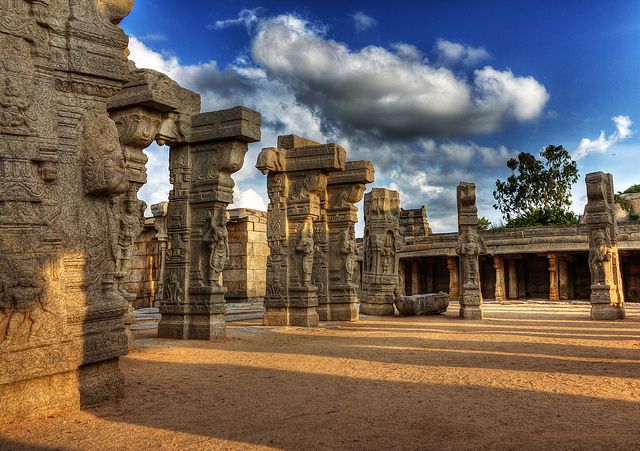
The marriage hall, open to the sky, stands unfinished: a poem in stone. Figures of Shiva and Parvati, Himavanta and Menaka Devi, parents of Parvati, waiting to greet Shiva, sages, gods, celestial dancers and musicians, gymnasts, beauteous maidens – it’s a festive atmosphere befitting the divine wedding.
Through an old arch, Bahmani in style, we pass into the Dance Hall, or Natya Mandiram. Here are carved pillars showing Shiva, Rambha, and Nandhi in dance poses.
The deity Veerabhadra (Shiva) stands resplendent, as does Parvati, in the sanctum. Mini shrines surround the sanctum with lingams; they were said to be set up by and worshipped by Hanuman and Rama. Lepakshi is the place where Jatayu fell, mortally wounded by Ravana. Rama commanded the dying bird to rise. “Lepakshi,” he said and the valiant bird rose to guide Rama on his quest to find the kidnapped Sita. A big footprint in the rock is said to be Sita’s. A hidden spring constantly keeps it filled with water.
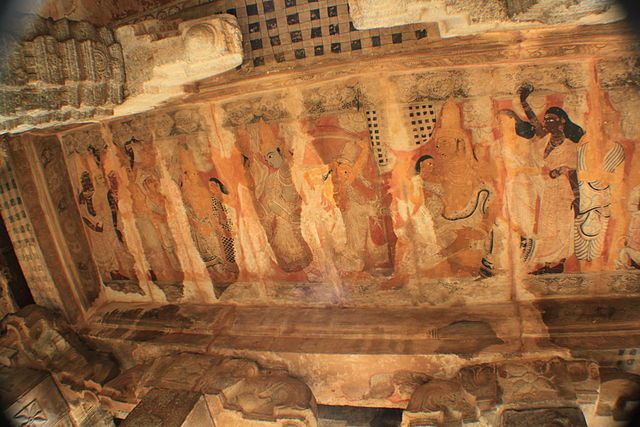
Outside the Dance Hall are small craters, looking like flying saucers, from outer space. Local guides fancifully call these eating plates. Logic easily counters this opinion. These craters must have been used to pound precious stones, and grind flowers, leaves and roots to get required colours – a giant palette for the fantastic murals painted on the rock ceiling of the dance hall and main shrine. Sages, maidens, Parvati, gods at the wedding venue, the divine couple in procession, maidens bedecked and bejewelled in stunning clothes and ornaments, fantastic hair styles – it’s all too mind-boggling for words. The builders Virupanna and his brother are also finely depicted.
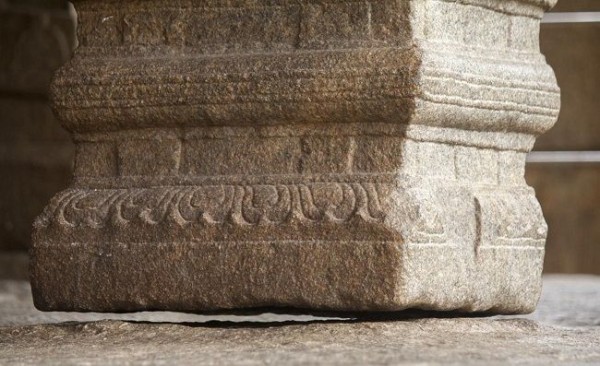
Asia’s largest mural is here – that of Veerabhadra – in front of the sanctum. A huge pillar bears the sculptures of Vastu Purusha and Padmini, the epitome of male and female perfection. The faces are chiselled according to tradition – the distance between the nose and the lips, the size of the forehead, the length of the nose, the ears, the length and shape of the fingers, the size of the breasts and waist.
Vijayanagar was known for promoting silk weaving, even as far as ancient Kanchipuram. Sari designs are sculpted on the stone pillars of Lepakshi. These designs hold good even today, as do some of the motifs in the murals. The nearby town of Dharmavaram is also famed for its silk saris.
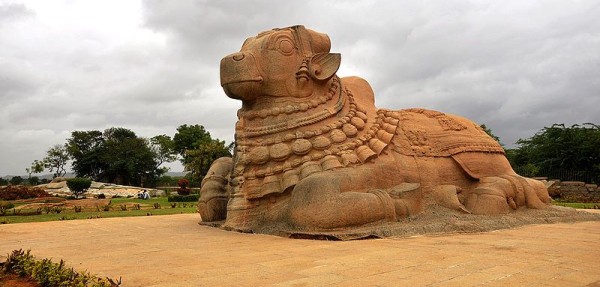
The military might and wrath of the Bahmanis resulted in the vandalising of the Lepakshi sculptures, as everywhere else. Was it the invasion, drought, famine or just insane jealousy that interrupted the completion of the open air pavilion? Time has not yet told the story. Perhaps the largest ever Nandi, here in Lepakshi, is the sole witness to it all, guarding the precious cache of murals and the gods.
The serene beauty of Lepakshi is known to all the locals, a few art lovers and many foreign visitors. Fortunately, Lepakshi is fairly close to Puttaparthi, the magnetic holy town of Sai Baba, visited by hordes. The diligent artloving foreigner is drawn to Lepakshi while on a visit to Puttapathi.
Local guides speak a variety of Indian languages and passable English. Lepakshi as such is too small a town, though a travellers’ bungalow is kept well maintained for all tourists. Hindupur provides decent lodgings, as do certain highway motels. Nandi Hills can be a good diversion to the tourist, on the drive back – either for a stay at the hilltop or just to admire the lovely bull temple at the base, splendorous with its carvings.
The murals of Lepakshi are the result of superhuman effort testing the ingenuity of the painters. The ravages of time have thus far been defeated by supreme ancient skills, a continuing wonder.
~ Incredible India