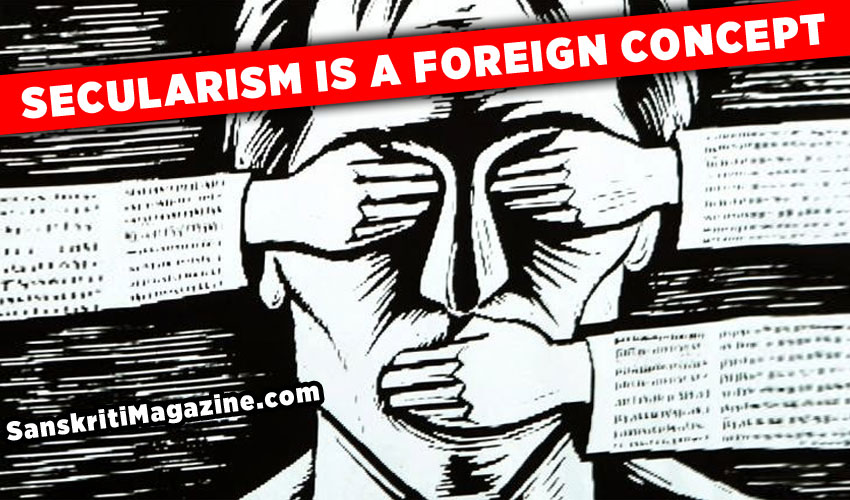
The concept of secularism was imported into India by the British. It was a strategic tool to suppress and deny India’s quest for independence by repeatedly asking the Indian National Congress that was predominantly Hindu, to address the concerns of the minorities, says Sanjeev Nayyar
Every leader claims to be secular. No one is asking, however, what is the meaning of the word secular?
This article seeks to provoke thought by giving the origin of the word secular and benchmarks, briefly, it with other countries worldwide.
The founders of the Constitution deemed it appropriate to use the concept of secularism without spelling out its meaning. The word ‘secular’ was made part of the preamble of the Indian Constitution during the Emergency (1975-77). However, the word was left undefined.
During the Emergency, former Prime Minister Indira Gandhi made the word ‘secular’ part of the preamble of the Constitution but did not define it. When the Janata Party came to power in 1977 an attempt was made to define ‘secular republic’ to mean a ‘republic’ in which there is equal respect for all religions’. The Janata government had a majority in the Lok Sabha but was in a minority in the Rajya Sabha where it was voted down by the Congress.
‘In Sanatan Dharma the need for turning secular never arose’
The Supreme Court judgment on the Ayodhya Acquisition Act, 1993, has some thoughts on the subject, excerpts. Former Chief Justice A M Ahmadi said: “Notwithstanding the fact that the words socialist and secular were added in the preamble of the Constitution in 1976 by the 42nd amendment, the concept of secularism was very much embedded in our constitutional philosophy. The term ‘secular’ has advisedly not been defined presumably because it is a very elastic term not capable of a precise definition and perhaps best left undefined. By this amendment what was implicit was made explicit”.
Secularism has come to mean that the government has a right to take over, manage Hindu temples and in some cases donations made in temples go to the state treasury but this is not applicable to Muslim and Christian places of worship! Or appoint non-Hindus to oversee sacred shrines and events like the Kumbh Mela!
Next question: is the word secular native to India?
The concept of secularism originated in Europe where the church, controlled education/ property etc, became so powerful that even the king felt oppressed. So secularism meant separation of the church and state with intent to curb the influence and power of the church.
The situation in India was different. Sanatan Dharma or Hinduism, as it is erroneously called, was neither governed by a monolith organisation like the church nor did it own property and control the state. Thus, the need for turning secular never arose.
The concept of an all powerful central organisation, like the church, goes against the very grain of Sanatan Dharma.
Thus, as a concept secularism is as alien to India as a three-piece suit is to Lalu Prasad Yadav and Dravida Munnetra Kazhagam chief M Karunanidhi.
Oh: but then how did secularism enter India?
‘The word secular does not exist in the Muslim world’
The concept of secularism imported into India by the British. It was a strategic tool to suppress and deny India’s quest for independence by repeatedly asking the Indian National Congress that was predominantly Hindu, to address the concerns of the minorities (Muslims).
Ok: but how does secularism operate in other parts of the world?
When Barack Obama took oath of office (first term) as President of the United States of America, he kept one hand on the Holy Bible.
Can you visualise the furore if A B Vaypayee had taken oath as prime minister keeping his hand on the Bhagavad Gita? All of Macaulay’s children and the secularists would have taken to the streets and asked him to apologise for insulting the Indian Constitution.
In England the queen is head of state and the church.
Since being head of state is the equivalent of the India President it is like saying that President Pranab Mukherjee is head of the Vishwa Hindu Parishad.
Christians in Germany and some other European nations pay a tax on their income to the church. This is akin to Hindus paying a tax to the Shankaracharya or the sadhu akhadas, the sant samaj!
Yet the secular credentials of these countries are never questioned! This, however, does not prevent them from giving India sermons on secularism.
The word secular does not exist in the Muslim world. The condition of non-Muslims in those countries is well known and does not merit comment.
Moreover, there would be discrimination even if you are Muslim but belong to a sect i.e. a minority in that country for e.g. Shias and Ahmediyas in Pakistan or Saudi Arabia. Secularism enters the Muslim discourse in countries where they are in a minority.
‘Sanatan Dharama is about Vishwadharma’
What these countries and secularists forget that long before secularism entered popular discourse, the followers ofdharma (read as Hindus, Buddhists, Jains and Sikhs; the Indian Constitution includes all Indic dharmic traditions as Hindus for the purpose of personal law) gave refuge to those who were persecuted in other countries. For e.g. Parsis, Jews and a body of Christian immigrants from Persia and Mesopotamia, who presumably fled from a severe persecution by Sapor II which began in 343 AD in Persia.
Further the Christian and Muslim worlds fail to realise that Sanatan Dharama is about Vishwadharma, the essential unity of creation, the oneness principle, and the compassionate universe! And is unlike Christianity/Islam where there is one prophet, only one way.
NaMo’s use of the word burkha has made this dress become newspaper headlines. It would be interesting to know what Dr Balasaheb Ambedkar had to say about burkha. Excerpts from the book ‘Thoughts on Pakistan’ written in 1941:
“Purdah is responsible for social segregation of Hindus from Muslims, which is the bane of public life in India. This argument may fear farfetched and one is inclined to attribute this segregation to the unsociability of the Hindus rather than to purdah among the Muslims. But the Hindus are right when they say that it is not possible to establish social contact between Hindus and Muslims because such contact can only mean contact between women from one side and men from the other.”
“Purdah is found amongst a section of the Hindus in certain parts of the country. But the point of distinction is that among the Muslims, purdah has religious sanctity which it has not with the Hindus”.