IndianSanskriti
Nav Ratna or Nine Gems in Astrology

Nav Ratna or Nine Gems in Astrology

Gems are found in almost all parts of the word and are liked by all people irrespective of cast and creed. Gem stones are useful for our prosperity, health and fortunes as per the traditions in many religions. In Ayurveda gem stones are also used in medicines as bhasmas to cure many diseases. From experiments it has been proven that the gems has some effects on the human beings. Wearing a correct gem is helpful to attain good health, wealth, happiness and success. There are many gem stones in the world and they are categorizes in two categories one is Precious Gems and Semi Precious. There are nine precious gems which are called Nav Ratnas. These are very powerful gems which reflects the strengths of nine planets and have many great benefits on the humans if worn correctly.

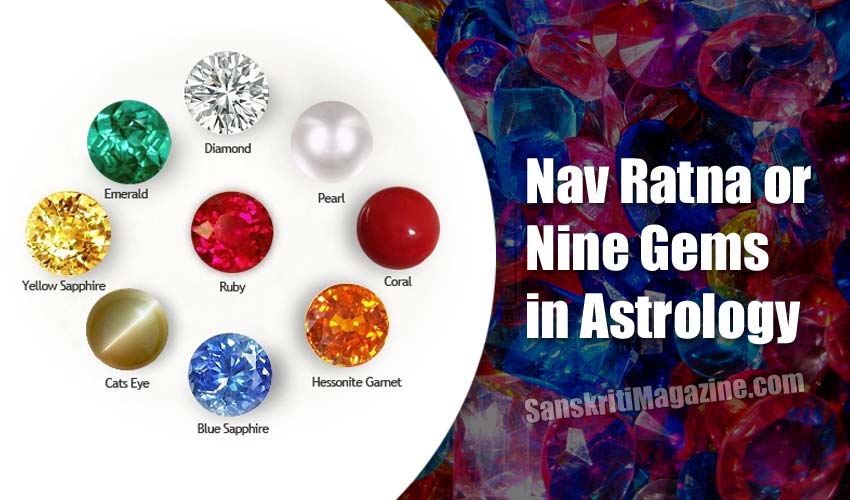
The nine precious gems or Nav Ratans are Ruby, Diamond, Emerald, Yello Sapphire, Blue Sapphire, Gomeda, Pearl, Cat’s Eye and Coral. One should always wear a gem in a fashion that it touches the body. The cosmic rays of the planet related to the gem absorbed by the body through the gem and gives desired benefits. It is believed that all the negative energy of a planet is neutralized by the positive energy of the related gem and hence one can prevent him or her from the negative impact of the planet. Following are the brief qualities of these Nav Ratans:

Ruby: Hindi name Manik. The basic color of ruby is red. But it is also found in rose, black, yellow and sky blue colors. The planet of ruby is Sun. Ruby is having wave length of 70000. It is mined from the mother earth.

Diamond: Hindi name Heera. The diamond is found in white, yellow, red, blue and black colors. It is related with planet Venus. Its wave length is 60000. It is a very precious stone and is very popular among rich people. It is mined from the earth.

Emerald: Hindi name Panna. The color of emerald is green. The emerald of peacock color, parrot color and grass color have the best qualities. The emerald is related with the planet Mercury. Its wave length is 75000.

Blue Sapphire: Hindi name Neelam. As per its name it is found in dark blue, blue, and light blue colors. This gem stone is related with planet Saturn. Its wave length is 79000. This is also found below the earth surface.

Cat’s Eye: Hindi Name Lehsunia. The color of this stone is yellowish or blackish yellow. This also has a visible shining band inside which moves when the stone is turned. It resembles as cat’s eye. Cat’s eye is related with the planet Ketu and is having a wavelength of 70000. It is also found in the earth surface.

Pearl: Hindi name Moti. The basic color of this gem is white but it is also found in yellow, red or black colors. It is found in the sea. Its wave length is 70000 and it is related with planet moon.

Red Coral: Hindi name Moonga. This precious gem is found in orange red color. White corals are also available. It is related with planet Mars and its wave length is 65000. It is found in the sea.

Yellow Sapphire: Hindi name Pukhraj.The color ODF yellow sapphire is light yellow. It is related with the planet Jupiter and it is having wave length of 50000. It is found in the earth surface.

Hessonite: Hindi name Gomed. The color of this precious stone is honey color. This is related with planet rahu. It is having wave length of 70000. It is also found below the earth surface.

Gems should be fixed in the ring in such a way that they should touch the finger so the positive rays can pass through gem to our body. Gems are worn as per the birth chart as well as the current chart. The right quality and size are very important in providing the good benefits. Also gems should be worn in the right finger and hand. The right hand is called solar hand and the left hand is called moon hand. It is believed that the gems related to high energy stars like Sun, Saturn, Mars, Rahu and Ketu should be worn on left hand i.e. moon hand to balance the energy and the other gems related to moon, Mercury, Venus and Jupiter should be worn on right hand. All the fingers are also related with certain planets so one has to choose right finger also. The details of all the precious gems are available in separate articles.
~By : Vinod Jindal

You may also like

Search the website

Like us on Facebook

Get daily updates via Email

Enter your email address:

Recent Posts

Jamai Shashthi 2026 — The Story of Maa Shashthi, the Cat, and the Wife Who Was Forgiven

Jamai Shashthi 2026 — The Story of Maa Shashthi, the Cat, and the Wife Who Was Forgiven

On Saturday, June 20, 2026, Bengali households across Bharata will welcome their married daughters and sons-in-law home for the legendary jamai-aador feast and perform the Shashthi Vrata. But behind the warmth lies a story most Bengalis know by heart and most non-Bengalis have never heard — the wife who stole the hilsa, blamed the cat, lost six sons to Maa Shashthi’s wrath, and was finally forgiven. The Vrat Katha, the vidhi, the mantras, and the deeper teaching.

Vat Purnima 2026 — The Wife Who Argued Yama Into Returning Her Husband’s Life

On Monday, June 29, 2026, women across Maharashtra, Gujarat, and southern Bharata will tie red thread around banyan trees and hear the story of Savitri — the wife who walked behind Yamaraja Himself when He came for her husband, and out-argued the Lord of Dharma into returning Satyavan’s life. The Mahabharata’s Pativrata Mahatmya Parva, the vrat vidhi, and why the banyan witnessed everything.

Nija Jyeshtha 2026 — The Real Jyeshtha Begins, and the Calendar Resumes

Nija Jyeshtha 2026 — The Real Jyeshtha Begins, and the Calendar Resumes

With Adhik Maas now closed on the Somvati Amavasya of June 15, the long-postponed festivals of Jyeshtha return — Vat Purnima (June 29, the Savitri-Yamaraja katha), Jamai Shashthi (June 20, the Bengali festival of Maa Shashthi), Sankashti Chaturthi (June 28), Yogini Ekadashi (July 10), and Devshayani Ekadashi (July 16, opening the four-month Chaturmas of Bhagavan Vishnu’s yoga-nidra). A guide to what the next four weeks hold and what the household that kept Purushottam Maas now carries forward.

The Closing of Purushottam Maas 2026 — Adhik Amavasya and the Sealing of the Month-Long Vrat

On Monday, June 15, 2026 — a rare Somvati Amavasya — the intercalary month that bears Bhagavan Vishnu’s own name comes to its close. The Acharyas teach that a vrat is not measured by its duration but by its closing. Here are the Padma Purana’s instructions for sealing the month-long Purushottam Maas vrat: the morning snan, the closing puja with the Vishnu Sahasranama, the day of dana, the Somvati Amavasya gift, and the final sarva-arpana — the offering of all merit at the feet of the Lord.

Parama Ekadashi 2026 — The Other Rare Ekadashi of Purushottam Maas, and the Poor Brahmin Who Kept It

Two weeks ago, Vaishnavas across Bharata kept Padmini Ekadashi — the rare Shukla Paksha Ekadashi of Adhik Maas. Padmini has a twin. On Thursday, June 11, 2026, the Krishna Paksha Ekadashi of the same intercalary month appears: Parama — the Supreme Ekadashi. The Padma Purana names it the rarer and more secret of the two, and reserves it for those whose poverty or sorrow has refused to lift in spite of every other vrat already kept. The story of Sumedha and Pavitra of Kampilya, the rishi Kaundinya, the prince sent by Bhagavan Brahma — and the vidhi for the day.

css.php