Our values are our principles, our guides. Values are our codes of internal conduct, the principles upon which we run our lives and make our decisions. Our first values are given to us by our parents, and these are added to by those values given to us by our peers, our teachers, the wider community. Our moral values are often sourced from our faith systems. It is from these that we select the principles which rule our lives and our behaviours.Our values often include universal principles such as truthfulness, honesty, fairness, justice, honour, etcetera, etcetera. These principles are often essential for our personal and social survival. Putting things back to front, we can often work out what values are present when we analyse either ourselves or others, for behaviour reveals choices, and choices are based on our values. We always choose what is best for us, and best for others. We do this when we are being selfless, putting the good of all first, ahead of our own wishes and desires. This is how social values come into existence and are known.
Our brains are hard-wired to seek the Truth. No matter what blueprints are laid down by our families, education and work, we are seekers of ultimate truth. What words we put on this varies in time and place, culture and society, but we are all seekers of peace and truth. In saying this, we are not saying we are seekers of pleasure and comfort; we are not creatures who seek to reduce others or life to units of rest, pleasure or satisfaction. Ultimate universal concepts drive our lives to discover and embody those concepts within ourselves.
Human Values
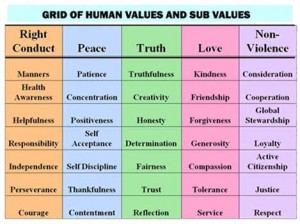 What are Human Values? Human Values are those universal concepts, drivers of action which are found in all cultures, all societies, all times and in all places where human beings eke out their lives.
The five human values, which can be found in all cultures, all societies and in all religions, are Truth, Right Conduct, Love, Peace and Non-Violence. These values are eternal; they are eternal essences, which elevate human life to its highest expression, its highest capacity. Click the image below to view full size in a new window.Human values have an inherent energy and dynamism. Human values do not follow the laws of physical science. They cannot be depleted. Normally, when we spend energy our resources we become drained of energy to the extent of our expenditure. But human values multiply as they are applied, used, expressed and acted out.
Human values do not follow the inverse square law. They do not undergo diminution with time and space. A good action performed today remains a good action forever.
There is an overlap between behaviour and values; behaviour is always based on choices; choices are based on values; i.e., guides to action and behaviour. Values are dynamic and fluid; they are not discrete units, they are multi layered, multi-contextual, multi-faceted. The do not have rigid boundaries and apply across all compartments of behaviour, choice and motivation. Values are also linked to emotion; emotion is simply the energy, the outward going momentum of the mind expressed as feeling and action.
So before we go analysing behaviour and attributing motives and choices, we know that action and behaviour are based on thoughts, which express wants and desires. Values are a dynamic force that operate on the ego, mind and will, enabling connectivity to intellect, conscience, discrimination; values empower the reflection between the impermanent and permanent aspects of action and behaviour, reality and desire, want and choice. Thus, human values have an inherent dynamism which carries the human being forward through all the domains of the person to the exercise and application of knowledge, skill, balance, insight and identity.
So we may conclude that human values are eternal essences empowering, driving, charging and informing human activity which sustain and uplift both the individual and the society.
~ Chris Parnell