Ten by ten, the sepoys were called forth. Their names having been taken down in succession, they were pinioned, linked together, and marched to execution; a firing party being in readiness…” Amritsar deputy commissioner Frederick Henry Cooper’s description of the brutal mass slaughter of 282 unarmed “native” soldiers in Punjab’s Ajnala town on August 1, 1857, is a chillingly cold-blooded account that was designed, as the very act he ruthlessly presided over, to smother what India now regards as its first war of Independence.
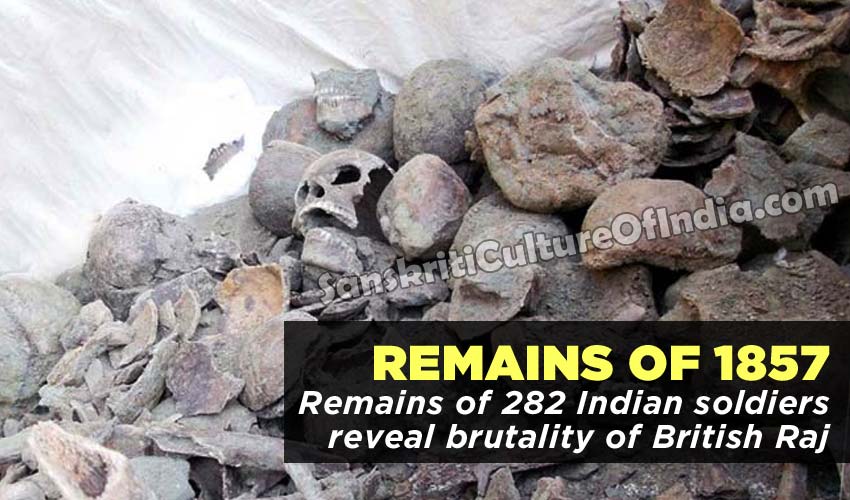
More than a century-and-a-half later, over three days from February 28 to March 2, the people in Ajnala exhumed the mortal remains of India’s first freedom fighters, uncovering hard evidence of the tyranny that unfolded under the British Raj-systematic, premeditated mass murder, much like at Jallianwala Bagh on April 13, 1919.
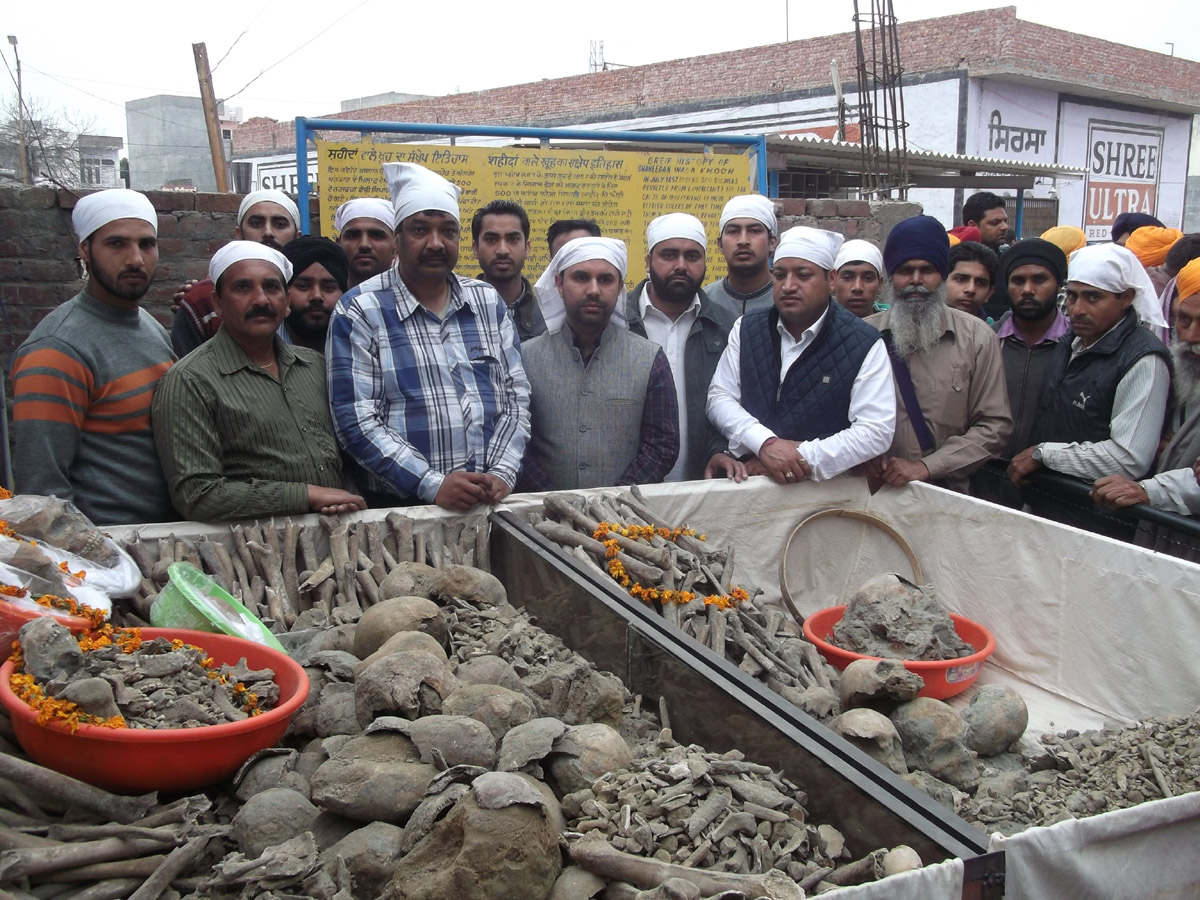 Pursued doggedly by Surinder Kochhar, 42, an Amritsar-based history enthusiast committed to exploring “ignored monuments” in Indian and Pakistani Punjab, nearly 30,000 residents volunteered and took turns at carefully excavating the Kalianwala Khoo (black peoples’ well), a long-forgotten, centuries-old, brick-lined well in the township now fringing the present day expanse of Amritsar city.
What they uncovered is unprecedented: Skeletal remnants-90 intact skulls, elements of nearly 200 jaws and thousands of other precariously preserved bone fragments-of the 282 brave men Cooper had interred here. These were soldiers of the East India Company’s 26th NI (Native Infantry) who had broken free to escape confinement at the Mian Mir Cantonment outside Lahore on July 31, 1857.
“They just had to be in there (the well),” says Kochhar, who fought a lonely five-year battle, desperately trying to cobble support for his conviction that the martyrs were buried there.
“There was ample evidence,” he says, pointing to the detailed, albeit cold and almost self-congratulatory description of the massacre, including the chosen burial site in Cooper’s 1858 book, The Crisis in the Punjab-From May 10 until the fall of Delhi. Much of the deputy commissioner’s chilling testimony, Kochhar says, is also available in the British House of Commons archives. The Kalianwala Khoo also finds mention in all four editions of the Amritsar District Gazetteer published between 1883 and 1947.
Cooper records 237 soldiers, all “purbeeahs (men from eastern Uttar Pradesh and Bihar),” shot in batches of 10 by the firing party, gloatingly portrayed as “eager Sikh levies (young conscripts)”. Another 45 were allowed to literally suffocate, most of them dying inside a stiflingly hot and humid bastion adjacent to the Ajnala police station. Forty-one other men, who had initially managed to evade arrest by the British posse, “suffered death by being blown from the canon’s mouth” at Lahore. Frederick Cooper and his act of butchery in Ajnala drew wide condemnation in Britain. Northampton MP Charles Giplin’s blistering House of Commons speech on March 14, 1859, described the executions as “truly a cannibal affair”. There has, however, never been any official censure or even the hint of remorse at the brutality perpetrated in the name of the British Crown.
Despite the volume of documentary evidence that Kochhar collected, no one in authority was willing to cooperate with him. According to him, even qualified experts were reticent.”The main problem was that no well was visible at the site indicated in Cooper’s book and other documents,” says Kochhar, who believed the burial site was under Gurdwara Shaheedganj, a shrine built around 1947.
But confronted by the disconcerting prospect that the place of worship may in fact be sitting over the graves of martyrs, in December 2012, the shrine management, headed by Amarjit Singh Sarkaria, agreed to undertake an exploratory dig supervised by the historian. “At less than 10 feet below the surface, we struck the curved wall of the well made from old Nanakshahi bricks,” he recalls. With public contributions, a Rs.80-lakh loan and blessings from the Akal Takht Jathedar Giani Gurbachan Singh, the shrine was moved to a new location this January, making way for the momentous dig.
“Bole so nihal, Sat Sri Akal!” An anguished rendering of the Sikh war cry rang through the crowd on the discovery of the first remains on February 28 morning-a near complete skeleton with one arm raised, eight feet below the surface. “He must have still been alive and trying to crawl his way out from the heap of bodies,” Kochhar says describing the remains of seven more soldiers around where the standing man’s feet would have been.
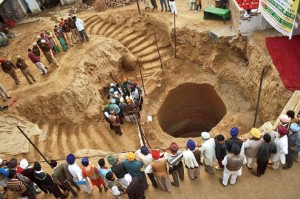 The scale of the tragedy, more than apparent in the mounting body count two days later, left Ajnala’s residents in tears. Though satisfied that he has been able to unearth the truth of the massacre, Kochhar laments that forensic details may have been lost forever because he was forced to rely on untrained villagers to do the digging. “No one was willing to support us,” Kochhar says, recalling how Navjot Randhawa, Punjab’s director, archives and archaeology, did not show up for the dig.
The historian and the Gurdwara Shaheedganj management had dispatched over 180 registered letters to almost everyone in authority-Prime Minister Manmohan Singh, state chief ministers and the Army chief. “Not one of them responded,” he says.
The remains of the 26th NI alongside other artefacts including 70 one rupee gold coins minted by the East India Company, gallantry medals and pieces of personal jewellery, now kept in the gurdwara, await the decision of a five-member committee constituted by the Punjab government after the recovery. This amid numerous calls for DNA analyses, an examination of British archival records to identify the soldiers and a memorial.
Over 48 hours between July 31 and August 1, 1857, each of the 500 Indians in the 700-strong 26th NI was hunted down and “destroyed”. Buried and forgotten over 150 years ago, the horrors unearthed in Ajnala have even now curiously failed to elicit response from India’s political leaders.
Barring Punjab Chief Minister Parkash Singh Badal’s offer of financing the construction of a cenotaph, and former chief minister Amarinder Singh’s demand of posthumous military honours for the soldiers, the silence has been decidedly deafening amid the growing din of the elections.
~ Asit Jolly