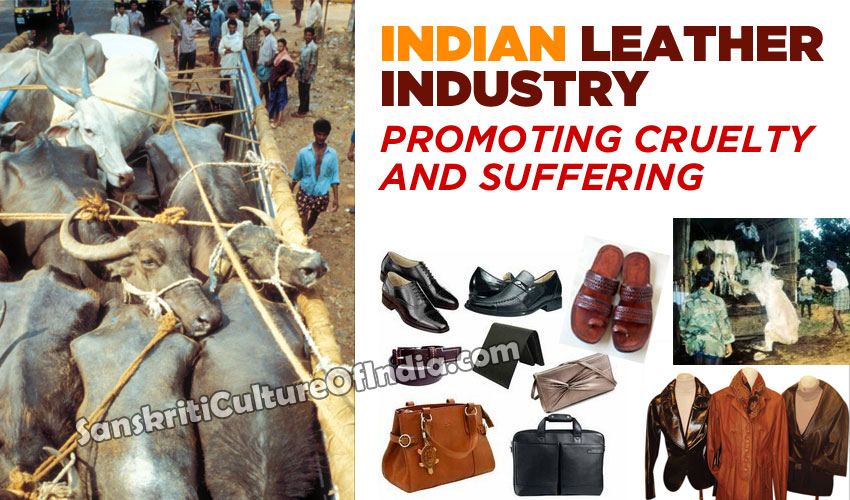
Cattle crammed into trucks, calves hurled on their backs and other serious animal welfare abuses happen daily in India. Despite ambitious legislation, animal welfare is a concept the leather industry are yet to embrace.
Twilight is long gone and complete darkness engulfs Highway 181 in the humid Indian state of Tamil Nadu. Light from the speeding cars and trucks in the throng of traffic is the single source of illumination. The cattle truck belonging to 56-year-old Saravanan is the only vehicle not moving on this rural stretch of road. He watches as two colleagues struggle to change the flat left-rear tyre. Some of the 21 buffaloes crammed together in the truck follow the work disinterestedly. ’I know it is illegal to have 21 cattle [on the truck], but I load as many as possible,’ says Saravanan. ‘I need the money. I don’t know what the legal limit is.’ The limit is six cattle on a truck his size according to government regulations.
From the roof of the driver’s cab I get a closer look at the well-fed animals, standing bottom-to-shoulder in no apparent order with no space at all between them. One is lying down, while another one is having trouble keeping its head above the rest of the big bodies. Packed together like anchovies in a tin, there is no need to tie the animals, although some are bound with a rope through their noses. ’I buy on cattle markets and drive to slaughterhouses in Kerala, which is around 300 kilometres from here,’ continues Saravanan. ‘Other cattle trucks have to travel 800 kilometres from markets to slaughterhouses. My animals get food and water before we leave. Sometimes they collapse during transport but they will live. They need to live until we reach the slaughterhouse’, he adds.
He drives during the hours of darkness to avoid attention from police and animal welfare NGOs that are known for stopping cattle trucks and filing animal abuse cases in court. With good reason it seems. Earlier I spotted trucks carrying 25 cows on the same highway. Another truck driver, Paulraja from Punjipuliampatti, has just won such a case against what he calls a group of ’Hindu-nationalists’. ’They filed a case about overloading of my truck but I won. I have had no income the whole week while my truck and cattle were confiscated by the police,’ he says frustrated. He was transporting 15 cows and calves on his medium-sized truck with a truck bed measuring around 1.5 by 2.5 metres. According to Government regulations, this allows him to carry only two cattle, not 15. According to his lawyer Noorul Ameen he won the case, because only two were cows, the rest were calves and calves are not included in the regulations. Yet the regulations do mention calves as a type of cattle.
Big business
Beef is not big business in India because of the Hindu belief that cows are sacred creatures not to be killed or eaten. Still, millions of cows are slaughtered each year, mostly by non-Hindus. India is one of the top five producers of hides globally, with production hitting 400,000 tonnes in 2009. And the reason hides are big business is because of the leather industry. From local markets cattle are transported long distances to slaughterhouses in Indian states such Kerala and West Bengal where demand for beef is high thanks to large Muslim and Christian populations. In Kerala, 1.2 million cows are slaughtered annually, of which two thirds are killed illegally, according to the State Animal Husbandry Department of Kerala. After slaughter, the hides are transported to leather industry clusters in other states, such as Tamil Nadu. ’If you cross the highway and wait, you will see trucks with hides driving in the opposite direction back to Tamil Nadu,’ says truck driver Saravanan. Now on his way to Kerala with the 21 buffalos, he gestures into the dark to the other side of the road.
The following videos may not be suitable for everyone, viewer discretion is advised:
With no tradition of cattle ranching and few slaughterhouses compared to the worlds top producer of hides, Brazil, the wide-spread but small-scale network of cattle farmers and slaughterhouses in India makes it a challenge for leather companies to trace the hides back through the supply chain. Kerala alone has 4,904 slaughterhouses according to the Government of Kerala. None of the tanneries has taken up the challenge, it seems. Not even the more progressive ones, such as Farida Prime Tannery – one of the biggest tanneries in India and supplier to some of the worlds biggest shoe brands. ’It is difficult to trace cattle hides back to the slaughterhouse, as India is full of them. It would be easier with the establishment of bigger slaughterhouses, this could make it possible to trace the hides,’ says Director Israr A. Mecca of Farida Prime Tannery. Farida Prime Tannery mostly sources buffalo hides from India.
’Not one slaughterhouse fulfilled the legal requirements’
At the Coimbatore Corporation Beef Slaughterhouse, I peek inside to watch the slaughter of a handful of cattle. It’s not a pretty sight but it’s not cruelly done either. According to Dr. Chinny Krishna who is Vice Chairman in the Animal Welfare Board of India, a governmental body part of the Federal Ministry of Environment of Forests, the main problems in cattle welfare are the transportation and slaughter conditions. ’Cattle crammed in too little space, collapsing and worse on cattle trucks and mistreatment in slaughterhouses is extremely widespread,’ he says. ‘Based on directives from the Supreme Court of India, several dozen slaughter houses in the states of Tamil Nadu, Karnataka and Kerala were inspected between 2006 and 2009. Not one fulfilled the legal requirements. I can guarantee that not one vehicle transporting animals for slaughter follows the Transportation Rules,’ he says, adding: ’During your visit, did you find even one that did so?’ I have to say no.
Some industry initiatives are in place in order to improve animal welfare. The Council for Leather Exports (CLE) has helped the local authorities in Coimbatore to start a project to reform slaughterhouses in the city and the animal market in nearby Pollachi. The project should improve practice in markets, lorries and slaughterhouses. But the project has been criticised by some NGOs as not dedicated enough. PETA India, a branch of the international animal welfare NGO, was part of the CLE project for several years but has now withdrawn. ’Over the duration of the project, it became evident that the CLE intended to do only the bare minimum that they felt was required to give the misleading appearance of progress, which was nowhere near enough to genuinely alleviate the suffering of any animals in Coimbatore or anywhere else in India,’ says Poorva Joshipura, Chief Functionary of PETA India. According to lawyer Noorul Ameen who represented truck driver Paulraja, the problem is the widening gap between the economic and the animal welfare perspectives.
’It is impossible for drivers to earn a profit with only six cows in a big truck or two cows in a medium-sized one,’ he says. ‘At the moment regulation is too strongly slanted towards the animal welfare perspective.’ Vice Chairman in the Animal Welfare Board of India, Dr. S. Chinny Krishna, disagrees. ’India has probably the best rules in the world for animal protection,’ he says. However, implementation is virtually zero.’
~ Peter Bengtsen, DanWatch
Saravanan is a pseudonym. The identity of the driver is known to DanWatch. DanWatch is an independent media and research centre doing investigative journalism about the global impact of corporations on people and the planet