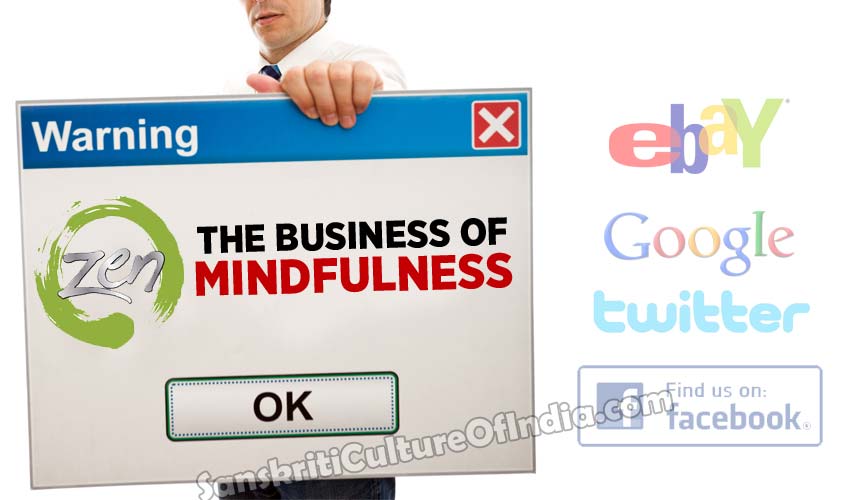
In his 1905 book, “The Protestant Ethic and the Spirit of Capitalism”, Max Weber credited the Protestant ethic with giving rise to capitalism. Now it sometimes seems as if it is the Buddhist ethic that is keeping capitalism going. The Protestants stressed rational calculation and self-restraint. The Buddhists stress the importance of “mindfulness”—taking time out from the hurly-burly of daily activities to relax and meditate. In today’s corporate world you are more likely to hear about mindfulness than self-restraint.
Google offers an internal course called “search inside yourself” that has proved so popular that the company has created entry-level versions such as “neural self-hacking” and “managing your energy”. The search giant has also built a labyrinth for walking meditation. EBay has meditation rooms equipped with pillows and flowers. Twitter and Facebook are doing all they can to stay ahead in the mindfulness race. Evan Williams, one of Twitter’s founders, has introduced regular.
The fashion is not confined to Silicon Valley
The mindfulness movement can be found in every corner of the corporate world. Rupert Murdoch has a well-developed bullshit detector. But earlier this year he tweeted about his interest in transcendental meditation (which he said “everyone recommends”). Ray Dalio of Bridgewater Associates and Bill Gross of PIMCO are two of the biggest names in the money-management business, and both are regular meditators. Mr Dalio says it has had more impact on his success than anything else.
What got the mindfulness wagon rolling was the 1960s counter-culture, which injected a shot of bohemianism into the bloodstream of capitalism: witness the rise of companies such as Virgin, Ben & Jerry’s and Apple, whose co-founder, Steve Jobs, had visited India on a meditation break as a young man, and who often talked about how Zen had influenced the design of his products. But three things are making the wheels roll ever faster.
The most obvious is omni-connectivity. The constant pinging of electronic devices is driving many people to the end of their tether. Electronic devices not only overload the senses and invade leisure time. They feed on themselves: the more people tweet the more they are rewarded with followers and retweets. Mindfulness provides a good excuse to unplug and chill out—or “disconnect to connect”, as mindfulness advocates put it. A second reason is the rat race. The single-minded pursuit of material success has produced an epidemic of corporate scandals and a widespread feeling of angst. Mindfulness emphasises that there is more to success than material prosperity. The third is that selling mindfulness has become a business in its own right.
The movement has a growing, and strikingly eclectic, cohort of gurus. Chade-Meng Tan of Google, who glories in the job title of “jolly good fellow”, is the inspiration behind “search inside yourself”. Soren Gordhamer, a yoga and meditation instructor, and an enthusiastic tweeter, founded Wisdom 2.0, a popular series of mindfulness conferences. Bill George, a former boss of Medtronic, a medical-equipment company, and a board member at Goldman Sachs, is introducing mindfulness at Harvard Business School in an attempt to develop leaders who are “self-aware and self-compassionate”.
Many other business schools are embracing mindfulness. Jeremy Hunter of the Drucker management school at Claremont university teaches it to his students, as does Ben Bryant at Switzerland’s IMD. Donde Plowman of the University of Nebraska-Lincoln’s business school has even tried to quantify the mindfulness of management schools themselves. The flow of wisdom is not one-way: Keisuke Matsumoto, a Japanese Buddhist monk, took an MBA at the Indian School of Business in Hyderabad and is now applying its lessons to revitalise temples back home.
As for its exploitation as a business, Arianna Huffington runs a mindfulness conference, a “GPS for the soul” app and a mindfulness corner of her Huffington Post. Chip Wilson, the boss of lululemon, a seller of yoga gear, has set up a website, whil.com, that urges people to turn off their brains for 60 seconds by visualising a dot. (“Power down, power up, and power forward.”)
A walk in the countryside
Does all this mindfulness do any good? There is a body of evidence that suggests that some of its techniques can provide significant psychological and physiological benefits. The Duke University School of Medicine has produced research that shows that, in America, an hour of yoga a week reduces stress levels in employees by a third and cuts health-care costs by an average of $2,000 a year. Cynics might point to the evidence that a walk in the countryside has similar benefits. They might also worry that Aetna, an insurer which wants to sell yoga and other mindfulness techniques as part of its health plans, is sponsoring some of the research that supports them. But it seems not unreasonable to suppose that, in a world of constant stress and distraction, simply sitting still and relaxing for a while might do you some good.
The biggest problem with mindfulness is that it is becoming part of the self-help movement—and hence part of the disease that it is supposed to cure. Gurus talk about “the competitive advantage of meditation”. Pupils come to see it as a way to get ahead in life. And the point of the whole exercise is lost. What has parading around in pricey lululemon outfits got to do with the Buddhist ethic of non-attachment to material goods? And what has staring at a computer-generated dot got to do with the ancient art of meditation? Western capitalism seems to be doing rather more to change eastern religion than eastern religion is doing to change Western capitalism.