.
Please click on images to view in full. Photo courtesy Global Crop Diversity Trust

Endangered species such humpback whales and rhinoceros often grab the headlines, but plant life is under threat too. Fruits and vegetables that humans have been growing for millennia are dying out as we speak. One study found that out of more than 8,000 crop varieties grown in the US in 1903, only 600 remained by 1983. What will happen in the event of a global nuclear war, an asteroid strike or even catastrophic climate change? Will there by enough species left to restart a civilization? The solution ? A bank vault of seeds.
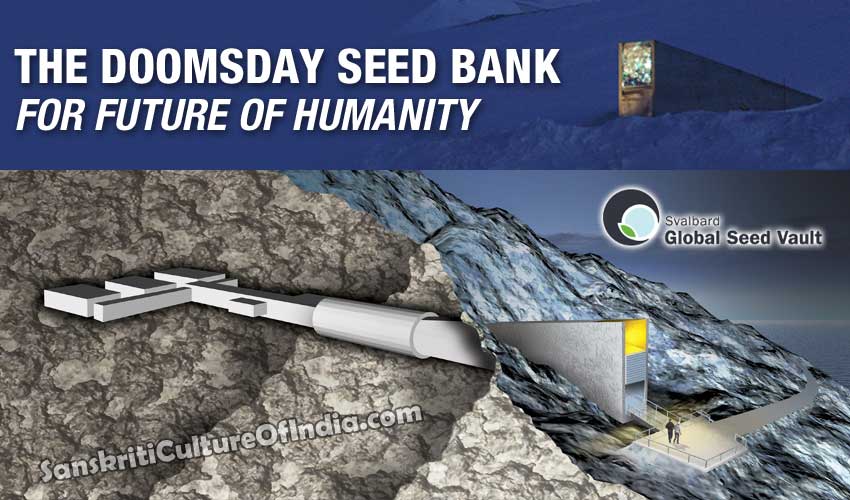
Deep inside a mountain on the freezing remote Norwegian island archipelago of Svalbard, halfway between mainland Norway and the North Pole, is the Svalbard Global Seed Vault. A fail-safe, state-of-the-art seed storage facility, built to stand the test of time and all possible natural or man-made disasters. The purpose of the vault is to store frozen duplicates (back ups) of all seed samples from the world’s crop collections, making the vault the ultimate insurance policy for the world’s food supply.
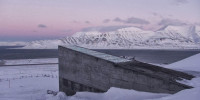
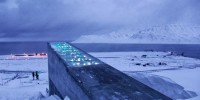
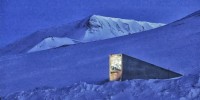
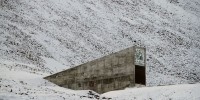
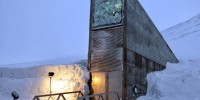
Often called the “Doomsday” Seed Vault, the Svalbard Seed Vault is the world’s insurance policy against botanical disasters, so that food production can be restarted anywhere on the planet following a regional or global catastrophe. The vault is reached via an access tunnel about 330 feet (100 meters) long, with an entrance portal on its outside.
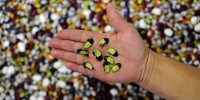
The vault was opened in 2008, and within the first year, around 400,000 seed samples were in storage. Samples came in from Ireland, the U.S., Canada, Switzerland, Colombia, Mexico and Syria. As of March 2013, the number of distinct samples rose to 770,000.
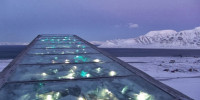
The entrance portal is the only visible part of the facility and is in the form of a long, narrow concrete “fin”, and made with brushed steel. An artistic decoration on the outer roof surface and on the upper part of the front will partly reflect the polar light and partly give off a muted, glowing light.
The location takes into account all known scenarios for rising sea level caused by possible global climate changes. The facility has also been located so deep inside the mountain that any changes to Svalbard’s climate will not affect the efficacy of the permafrost, and thus keep the seeds safe.
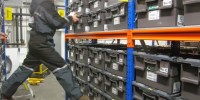
The facility consists of three separate underground chambers. Each chamber has the capacity to store 1.5 million different seed samples. The Seed Vault functions like a safety deposit box in a bank. The bank owns the building and the depositor owns the contents of his or her box.
In the case of the Seed Vault, Norway owns the facility, having entirely funded it’s $9 million construction. As far as the seeds go each depositing genebank from nations around the world owns the seeds they send to the Seed Vault for safekeeping. As an extra layer of security, the Svalbard Global Seed Vault stores a backup of these valuable seed collections.
The responsibility for testing material and for any subsequent regeneration and multiplication remains with the genebanks sending their seeds to Svalbard. No one has access to anyone else’s seeds.
The Vault is managed in partnership between the Global Crop Diversity Trust, the Nordic Genetic Resource Center (NordGen) and the Government of Norway.