It is only when a person is in greatest danger that he begins to shout and call for help: “Help! Help! Help! Save me! Save me! If you do not save me, I am lost!” In that state of dire extremity, he looks for someone to come and rescue him. He calls aloud and is prepared to do anything, because he wants to save himself,” Whatever you say, I will do.” When one’s resources are completely at an end and one realizes one’s absolutely helpless state, then, like a man drowning, knowing he can no longer rely upon himself or save himself, one reaches up and calls out for help from the outside.
In this way, perhaps certain heavy sorrows, extremely dire situations, catastrophes or calamities become the turning point of one’s life. From a feeling of self-sufficiency, from a basic egoistical arrogance of feeling that one is capable of doing everything in this world, one comes into a sudden realisation that here is something which one cannot face.
As long as the jivatma is in a state of, as they say “hypervitaminosis I”. an oversupply of the vitamin “I”, ahamkara (egoism), the jivatma is lost, because ahamkara is the first product of avidya orajnana. It contains the essence of individuality. And this individuality is a state of alienation from one’s eternal oneness, one’s unity with the Divine Reality. And this state of alienation from our divine Source, our divine cosmic Origin, which deprives us completely of the awareness of our essential svarupa as amsas(parts) of the supreme paramatman, is the root cause of all the tapatrayas (sufferings or afflictions) ofsamsara and prapancha (worldly life).
If you wish to commence your liberation from total bondage in this net of ahamkara and mamakara (I-ness and mine-ness), attachment, selfishness and an identification with these inner principles of a separate, finite, little ego-personality, then the first thing needful is to realise and recognise the insufficiency of this little ego-principle, which up till that moment was to you the centre of your universe, the most important and precious thing in the world, the dearest thing, for which, to protect its interest, you have been prepared to fight with anyone.
When this ego-principle is recognised in its true colours, that it, as a matter of fact, constitutes your real problem, that it is the factor that holds you in thraldom, in bondage, then you realise that if you rely upon it, you will ultimately be left in the lurch. When that realisation begins to dawn and you start looking up for a higher Being, a higher Power to take you out of this predicament which has been brought about by giving over-importance to the ego, then commences your liberation.
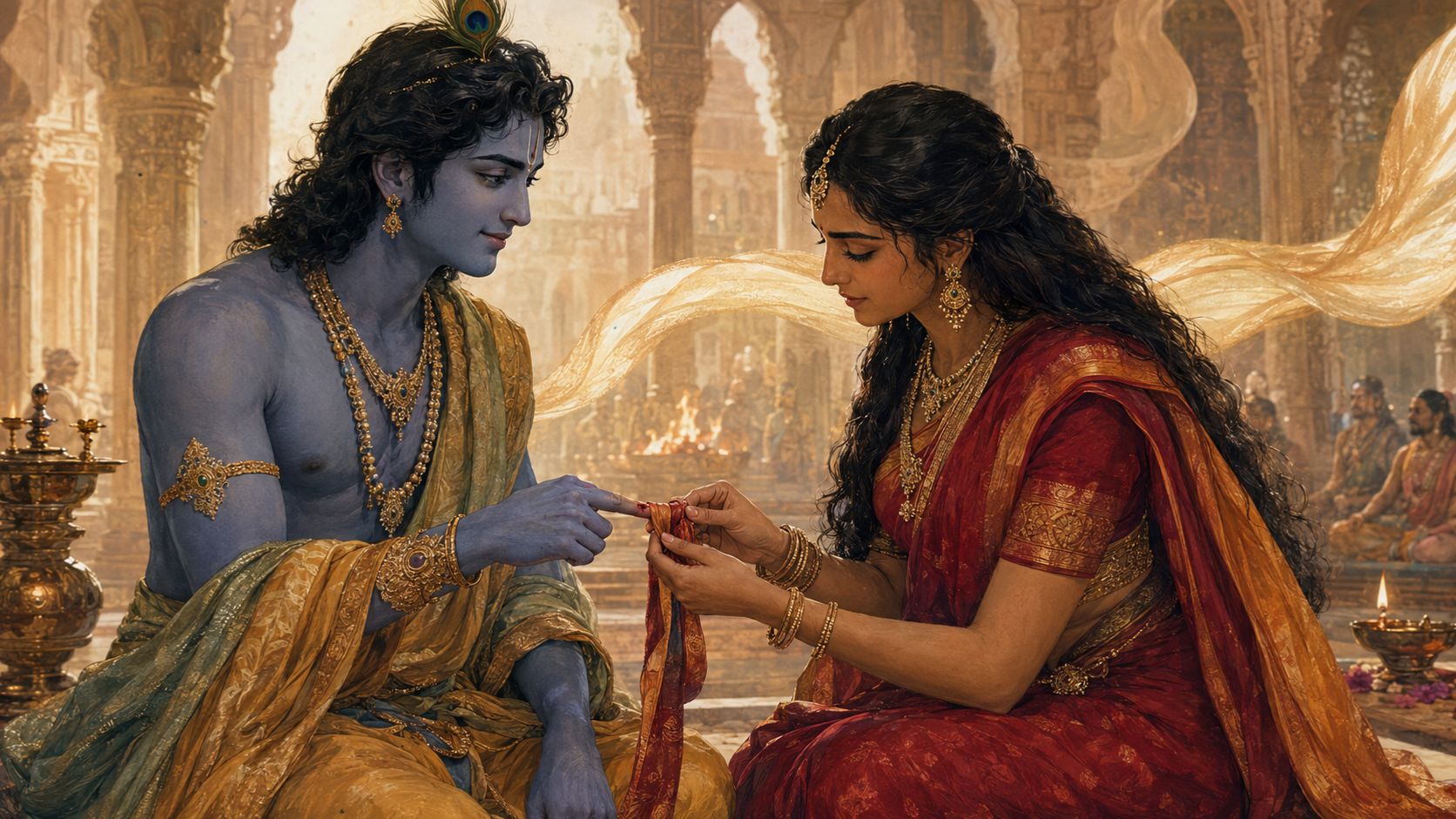
Thus the all-knowing Lord-of all existence, anantakoti brahmanda nayaka prabhu bhagavan (God, the Lord and the Ruler of millions and billions of universes), Who is the inner prompter, sarvantaryami, in order to give the highest wisdom teachings for all mankind, brings about this conflict situation and puts Arjuna into a fix, like Hamlet, not knowing what to do.
Arjuna actually does know what he has to do; he has come fully prepared for it. But suddenly, when the attachments of the sentimental and emotional aspect of his personality begin to invade his consciousness and begin to overcome him, overwhelm him, then he finds himself in a terrible fix. Suddenly there is this clash between the clear thinking intelligence, the rational aspect of Arjuna, and the overwhelming and very powerful emotional and sentimental aspect of Arjuna.
And the sentimental aspect of Arjuna is now trying to undo everything. And in this state of fix, not able to decide what to do, this normally clear thinking young prince, who had come with no doubts about what he had to do that day, cries aloud for help. They say: “Man’s extremity is God’s opportunity”.
Geeta Saar
The Bhagvad Gita (“Song of God”) is the essence of the Vedas and Upanishads. It is a universal scripture applicable to people of all temperaments, for all times. It is a book with sublime thoughts and practical instructions on Yoga, Devotion, Vedanta and Action. The Bhagvad Gita has influenced many great thinkers over the years.
क्यों व्यर्थ की चिंता करते हो? किससे व्यर्थ डरते हो? कौन तुम्हें मार सक्ता है? आत्मा ना पैदा होती है, न मरती है।
Why do you worry without cause? Whom do you fear without reason? Who can kill you? The soul is neither born, nor does it die.
जो हुआ, वह अच्छा , जो हो रहा है, वह अच्छा हो रहा है, जो होगा, वह भी अच्छा ही होगा। तुम भूत का पश्चातापन करो। भविष्य की चिन्ता न करो। वर्तमान चल रहा है।
Whatever happened, happened for the good; whatever is happening, is happening for the good; whatever will happen, will also happen for the good only. You need not have any regrets for the past. You need not worry for the future. The present is happening…
तुम्हारा क्या गया, जो तुम रोते हो? तुम क्या लाए थे, जो तुमने खो दिया? तुमने क्या पैदा किया था, जो नाश होगया? न तुम कुछ लेकर आए, जो लिया यहीं से लिया। जो दिया, यहीं पर दिया। जो लिया, इसी (भगवान) सेलिया। जो दिया, इसी को दिया।
What did you lose that you cry about? What did you bring with you, which you think you have lost? What did you produce, which you think got destroyed? You did not bring anything – whatever you have, you received from here. Whatever you have given, you have given only here. Whatever you took, you took from God. Whatever you gave, you gave to him.
खाली हाथ आए और खाली हाथ चले। जो आज तुम्हारा है, कल और किसी का था, परसों किसी और का होगा।तुम इसे अपना समझ कर मग्न हो रहे हो। बस यही प्रसन्नता तुम्हारे दु:खों का कारण है।
You came empty handed, you will leave empty handed. What is yours today, belonged to someone else yesterday, and will belong to someone else the day after tomorrow. You are mistakenly enjoying the thought that this is yours. It is this false happiness that is the cause of your sorrows.
परिवर्तन संसार का नियम है। जिसे तुम मृत्यु समझते हो, वही तो जीवन है। एक क्षण में तुम करोड़ों के स्वामीबन जाते हो, दूसरे ही क्षण में तुम दरिद्र हो जाते हो। मेरा-तेरा, छोटा-बड़ा, अपना-पराया, मन से मिटा दो, फिर सबतुम्हारा है, तुम सबके हो।
Change is the law of the universe. What you think of as death, is indeed life. In one instance you can be a millionaire, and in the other instance you can be steeped in poverty. Yours and mine, big and small – erase these ideas from your mind. Then everything is yours and you belong to everyone.
न यह शरीर तुम्हारा है, न तुम शरीर के हो। यह अग्नि, जल, वायु, पृथ्वी, आकाश से बना है और इसी में मिलजायेगा। परन्तु आत्मा स्थिर है – फिर तुम क्या हो?
This body is not yours, neither are you of the body. The body is made of fire, water, air, earth and ether, and will disappear into these elements. But the soul is permanent – so who are you?
तुम अपने आपको भगवान के अर्पित करो। यही सबसे उत्तम सहारा है। जो इसके सहारे को जानता है वह भय,चिन्ता, शोक से सर्वदा मुक्त है।
Dedicate your being to God. He is the one to be ultimately relied upon. Those who know of his support are forever free from fear, worry and sorrow.
जो कुछ भी तू करता है, उसे भगवान के अर्पण करता चल। ऐसा करने से सदा जीवन-मुक्त का आनंद अनुभवकरेगा।
Whatever you do, do it as a dedication to God. This will bring you the tremendous experience of joy and life-freedom forever.
~ by Swami Sivananda