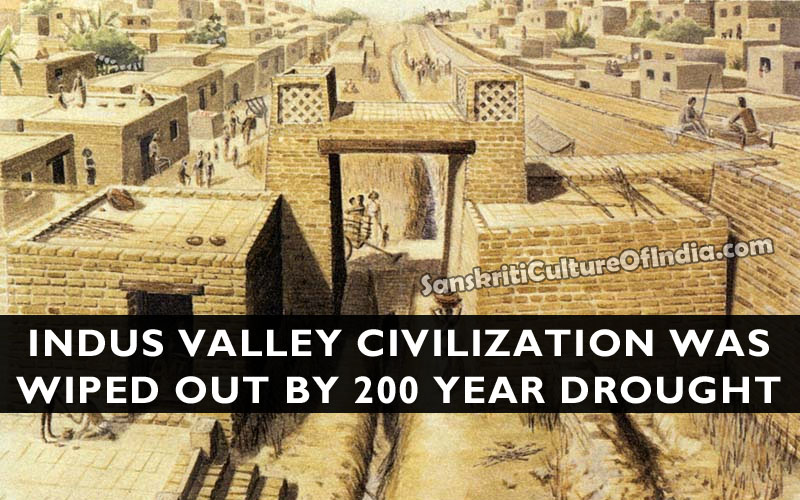
In a ground-breaking discovery led by an Indian-origin palaeoclimatologist, researchers have found that a 200-year-long monster drought nearly 4,200 years ago doomed the Indus Valley civilisation in present Pakistan and northwest India.
Based on isotope data from the sediment of an ancient lake, the researchers suggest that the monsoon cycle, which is vital to the livelihood of all of South Asia, essentially stopped there for as long as two centuries to wipe out the Indus Valley civilisation — also knows as the Harappan civilisation.
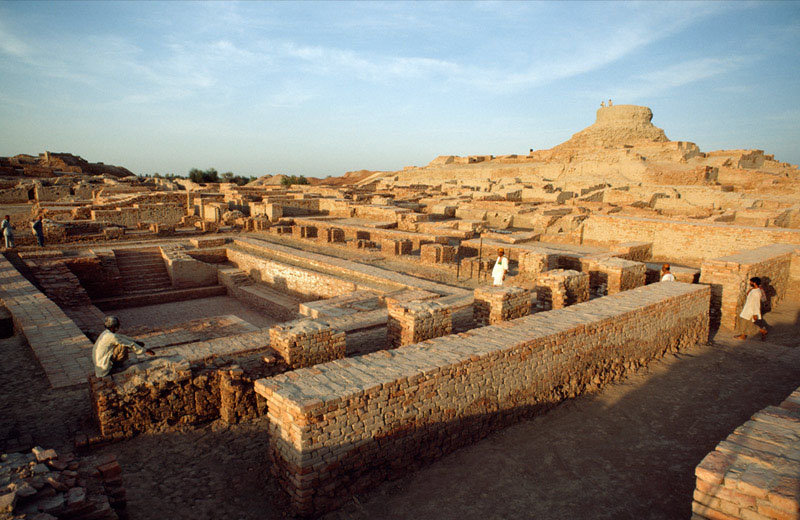 “The Indus Valley was characterised by large, well-planned cities with advanced municipal sanitation systems and a script that has never been deciphered.
But the Harappans seemed to slowly lose their urban cohesion, and their cities were gradually abandoned,” explained Yama Dixit, a palaeoclimatologist at University of Cambridge.
The team examined sediments from Kotla Dahar — an ancient lake near the northeastern edge of the Indus Valley area in Haryana — that still seasonally floods.
The team assigned ages to sediment layers using radiocarbon dating of organic matter.
 In various layers, they collected the preserved shells of tiny lake snails which are made of a form of calcium carbonate called aragonite.
The team also looked at the oxygen in the argonite molecules, counting the ratio of the rare oxygen-18 isotope to the more prevalent oxygen-16.
Kotla Dahar is a closed basin, filled only by rain and runoff and without outlets. During drought, oxygen-16, which is lighter than oxygen-18, evaporates faster so that the remaining water in the lake and, consequently, the snails’ shells, become enriched with oxygen-18.
The team’s reconstruction showed a spike in the relative amount of oxygen-18 between 4,200 and 4,000 years ago.
The data, published in the journal Geology1, suggests that the regular summer monsoons stopped for some 200 years.
According to Anil Gupta, director of the Wadia Institute of Himalayan Geology in Dehradun, this work fills a gap in the geographic record of ancient droughts.
But large questions still remain.
“What drove this climate change 4,200 years ago? We do not see major changes in the North Atlantic or in the solar activity at that time,” he said.