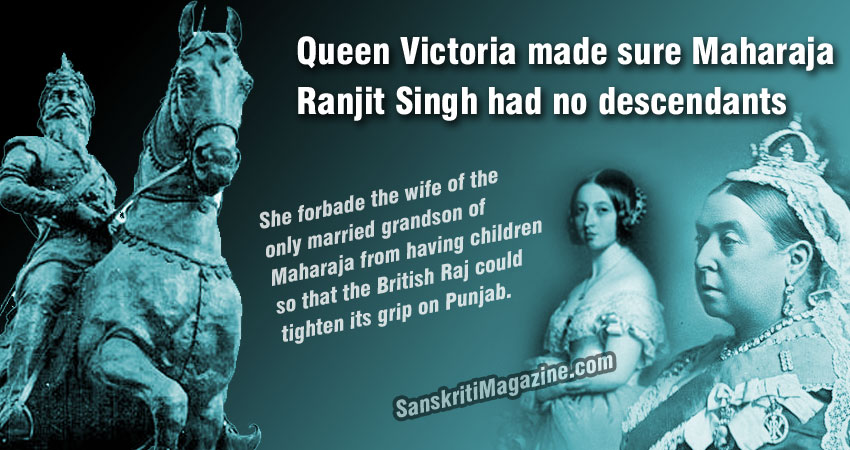
An Indian-origin writer has made the startling claim that Queen Victoria forbade the wife of the only married grandson of Maharaja Ranjit Singh from having children so that the British Raj could tighten its grip on Punjab.
Peter Bance, a specialist in the history of Sikhs in Britain, writes about the reported instruction by Queen Victoria in his book, “Sovereign, Squire & Rebel”, a biography of Duleep Singh, son of Maharaja Ranjit Singh.
Equally remarkable is the claim he makes that Queen Victoria may have been motivated by the desire to ensure that Britain’s hold over the massive and profitable Sikh kingdom remained unchallenged by any future Sikh royal descendant.
The Sikh kingdom, among the fiercest opponents of the British Raj, is today among the few – if not the only one – of the erstwhile major Indian kingdoms without any direct royal descendants.
Duleep Singh had six children from his first marriage and two from his second. All eight, including four who were married, died without issue, a fact that the writer says fanned his curiosity.
In his book, the London-based Bance says Queen Victoria gave the instruction to Lady Anne Alice Blanche -the aristocratic English wife of Duleep Singh’s eldest son Prince Victor Albert Jay – in the summer of 1898. Lady Anne was the youngest daughter of the 9th Earl of Coventry.
The reported instruction came 12 years after the British army physically stopped a disgruntled and rebellious Duleep Singh from returning to India from England, where he had been taken as a 12-year-old boy-king after being converted to Christianity.
Like his father, Prince Victor too had tried to visit India in 1898 – if only to spend his honeymoon with Lady Anne, who had taken the name of Princess Victor Duleep Singh – but they too were stopped by the British in Colombo.
On their return, they attended a ball thrown by Queen Victoria at Buckingham Palace July 8, 1898, where invitees included Prince Victor’s sister Princess Sophia, younger brother Prince Frederick and several other royals visiting from India.
“The ball was soon followed by a request from Queen Victoria for a private audience with Princess Victor at Buckingham Palace, where she received the most distressing and chilling of orders,” says the book.
“She was told by the Queen that she must not have any children with the Prince and that she must live abroad with her husband. Princess Victor followed that command faithfully all her life.”
Bance, a Sikh, obtained the startling piece of information from a close “Coventry family source” of Lady Anne, who died in 1956.
“This person, who told me not to mention his name, asked Lady Anne once, ‘why didn’t you have any children?’ and that was when Lady Anne spoke about Queen Victoria’s instructions.
“Of course Lady Anne, being an aristocrat herself, went by those instructions.”
Bance said the main reason why Queen Victoria would have given such a harsh command was the nascent Indian nationalism that had showed in Duleep Singh – otherwise a thorough ‘English’ country gent – throughout the late 1880s.
Mounting expenses for the upkeep of the family would have been an additional factor.
“There is no doubt that the family was always a thorn on the side of the British establishment,” said Bance, who has being researching the life of Duleep Singh since 1996.
“They (any descendants) would be constantly staking a claim to the Punjab throne.”
After the failed bid to visit India, Maharaja Duleep Singh told a British journalist in 1888: “In less than three years – in less than two perhaps – I and my 250,000,000 (250 million, 25 crore) fellow-countrymen will have driven them (the British) out of India.”
Duleep Singh, who had a legitimate claim to a kingdom whose powerful Sikh army very nearly overran the British in 1849, also boasted that 90 percent of Indian princes as well as the Russian government were behind his plan to oust the British.
Although Queen Victoria was very fond of Duleep Singh, he had been increasingly distressed by the failure of British authorities to honour financial and other pledges made to him.
In later years, some of Duleep Singh’s children, particularly his youngest daughter from his first marriage, Princess Bamba, were to show strong feelings for India.
The book goes on to refer to a second startling claim about an alleged British plot to stem the royal Sikh bloodline.
It says Princess Bamba had told members of the Fakir family, who were former ministers in her father’s court, that when they were children their English cooks would put “substances” into their food so as to make them infertile.
“The story seemed a bit far-fetched, but nonetheless not one of the Duleep Singh children had any issue,” says the book. “But this is really what struck me as being very odd – a man with a big family, eight children, and no grandchildren,”
~ Dipankar De Sarkar