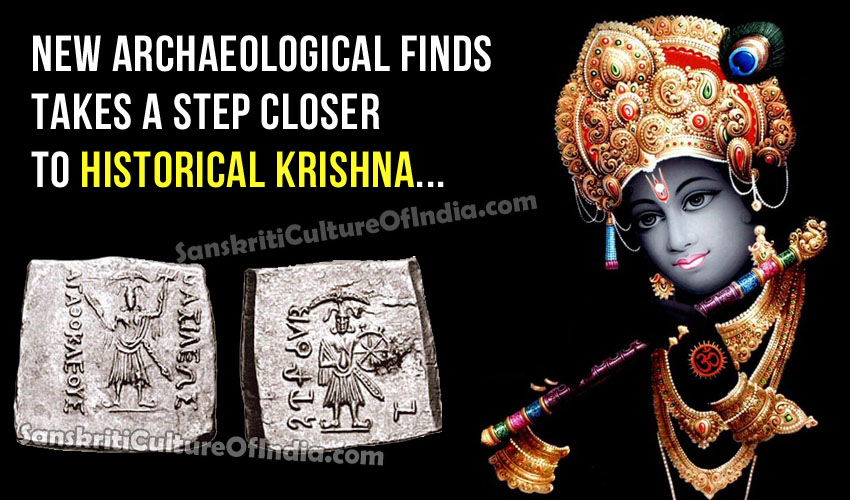
The conch and the Sudarshana Chakra are unmistakable. Although the figures do not match popular images of Krishna sporting a peacock feather, archaeologists are convinced that the coins are of Krishna, revered as an avatar of Vishnu.
“These square coins, dating back to 180 BC, with Krishna on one side and Balram on the other, were unearthed recently in Al Khanoun in Afghanistan and are the earliest proof that Krishna was venerated as a god, and that the worship had spread beyond the Mathura region,” says T K V Rajan, archaeologist and founder-director, Indian Science Monitor, who is holding a five-day exhibition, In search of Lord Krishna,’ in the city from Saturday.
Having done extensive research in Brindavan, Rajan is convinced that a lot of the spiritual history of ancient India lies buried. “Close to 10,000 Greeks, who came in the wake of Alexander the Great, were Krishna’s devotees. There is an inscription by Heliodorus, the Greek ambassador at Takshila , which reads Deva, deva, Vasudeva. Krishna is my god and I have installed this Garuda Pillar at Bes Nagar (now in Bihar),'” says Rajan.
According to him the Archaeological Survey of India (ASI) has unearthed many sites that throw fresh light on the era of Krishna. “ASI is expected to release the full findings next year. Many of the unearthed artifact have a close resemblance to materials of what is believed to be the Harappan civilisation. The findings may show that Krishna’s life was the dividing line between India’s spiritual history and the society’s gradual shift towards a materialistic one,” says Rajan.
Interestingly, a lot of what has been uncovered closely resemble the narration in the texts of Mahabharatha and the Bhagavatham,” he adds. Both the spiritual works are revered by the Hindus as their holy books.
It has been over five years since the discoveries were made at Tholavira near Dwaraka, close to Kutch. Much progress has been made due to the application of thermoluminous study (TL) in ascertaining the age of artifact. “It is possible to get the diffusion of atomic particles in the clay pottery unearthed and arrive at an accurate date,” points out Rajan. Tholavira itself is believed to be the capital city as detailed in the opening chapters of Bhagavatham. Rajan points to an image of a plough, made of wood, which is mentioned in the Bhagavatham.
The findings could lay a trail to understanding Krishna’s life (said to be 5,000 years ago) and times, as a historical fact, says Rajan. The exhibition will be open till December 31 at Sri Parvathy Gallery, Eldams Road.
~ Bhama Devi Ravi