IndianSanskriti

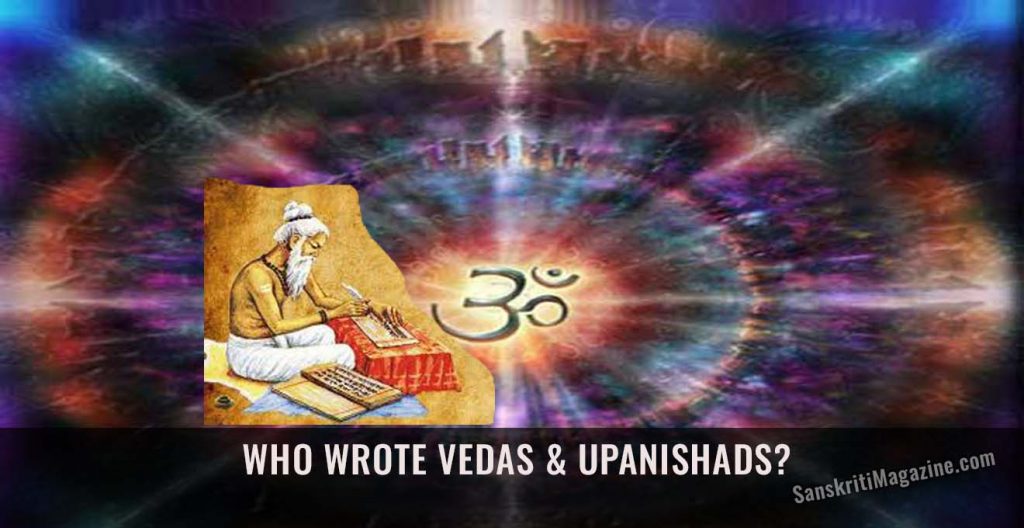
Who wrote the Vedas and Upanishads?

Vedas and Upanishads that form the key foundational scriptures of the Sanatana Dharma don’t have authors name mentioned anywhere.

In the modern society, where the people are driven by accumulating more and more of “I” and “Mine” in terms of Wealth, Name & Fame etc., this principle seems to be counter intuitive.

Sanatana Dharma consider the Vedas to be apauruṣeya, which means “not of a man, superhuman” and “impersonal, authorless”

Now that makes us wonder what the Rishis context was not to leave their names as authors!!

Vedas and Upanishads are not created through the human logical thought process.  Those few beings who raised themselves to vibrate in the very frequency of the Cosmos, the very frequency of the Brahman, Universe, they disappeared into that.

When their “I” disappeared into the cosmic vibration, whatever truths they received, whatever truths oozed out and expressed through them, they got recorded as Vedas and Upanishads. Those rishis understood clearly  that the revelations came from a space where no “I” existed.  That is why they very clearly decided not to own those truths even by claiming authorship.

This core characteristic makes Upanishads as a very authentic scripture. When the Rishis expressed it, the only context to express was articulate the truths (satya) for humanity and there was absolutely no trace of vested interest or greed mixed in that. There is no discussion of “For Profit” or “Non-Profit” ideas- Just they did not record their names!!

When Rishis were vibrating with the cosmic frequency, they were overwhelmed by the greatness of the truth. They realized that truth is too big than their identity.  They were standing on the truth, not the truth on them. This is one the key reasons that the very subtle authentic truths are expressed in Vedas and Upanishads.

This context of Integrity and authenticity to the ultimate truths is central to the Sanatana Dharma value system and one of the key reasons as to why the Vedas and Upanishads has a strong relevance even in the current society.


References


https://en.wikipedia.org/wiki/Vedas

http://www.nithyananda.org/video/upanishads-first-books-ever-written

You may also like

Search the website

Like us on Facebook

Get daily updates via Email

Enter your email address:

Recent Posts

Purushottam Maas — The Month No Deity Would Claim, and the Lord Who Made It Supreme

Every month of the Hindu calendar has a lord — except the rare thirteenth, the Adhika Maas, born an orphan and shunned as the “impure month.” The Puranas tell how this rejected month went in grief to Bhagavan Vishnu, who claimed it, gave it His own name — Purushottam — and made it the most fruitful month of all. The origin story, the teaching, and what it means for Purushottam Maas 2026 (May 17 – June 14).

Padmini Ekadashi 2026 — The Ekadashi Even the Devas Descend to Keep

Padmini Ekadashi 2026 — The Ekadashi Even the Devas Descend to Keep

The rarest Ekadashi of the entire Hindu calendar is three days away. The Padma Purana preserves a conversation between Bhagavan Krishna and Yudhishthira about a single Ekadashi the great Rishis spend lifetimes waiting for — Padmini. The Vrat Katha of Queen Padmini of Mahishmati, the lotus teaching, and why May 27, 2026 is the morning Vaishnavas across Bharata are preparing for.

Varada Chaturthi 2026 — The Rare Ganesha Day of Purushottam Maas

Varada Chaturthi 2026 — The Rare Ganesha Day of Purushottam Maas

Once every 2.5–3 years — when the rare 13th month of Adhika Maas opens — a thirteenth Vinayaka Chaturthi appears. The Mudgala Purana calls it Varada Chaturthi, the “boon-giving” Chaturthi, and holds it as the most fruit-bearing Ganesha day of the entire calendar. Today, Wednesday May 20, 2026, is that day.

Padmini Ekadashi 2026 — The Rare Ekadashi That Comes Only in Purushottam Maas

Padmini Ekadashi 2026 — The Rare Ekadashi That Comes Only in Purushottam Maas

Padmini Ekadashi 2026 falls on Wednesday, May 27 — the Shukla Paksha Ekadashi of Adhika Maas, the rarest Ekadashi in the entire Hindu calendar (it appears only every 2.5–3 years). The Padma Purana conversation between Bhagavan Krishna and Yudhishthira, the Vrat Katha of Queen Padmini, complete vrat vidhi with jagrana, mantras, and the lotus symbolism that gives the Ekadashi its name.

Ganga Dussehra 2026 — The Day Maa Ganga Came Down to Bhagiratha

Ganga Dussehra falls on Monday, May 25, 2026 — commemorating the day Maa Ganga descended from Vaikuntha to the earth through the millennia-long tapasya of King Bhagiratha. The full account from the Valmiki Ramayana, snan vidhi, dana traditions, mantras, and the teaching of sustained sincerity.

css.php