IndianSanskriti
Goddess Kalaratri


Navratri Series – Day 7: Goddess Kalaratri – The Fierce Protector

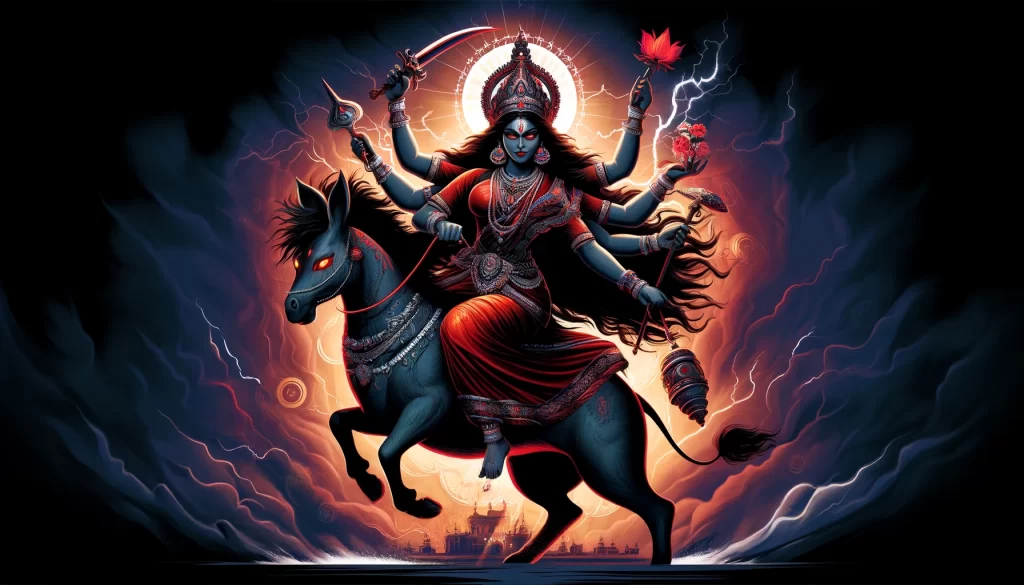
As we progress to Day 7 of Navratri, we honor Goddess Kalaratri, the seventh form of Goddess Durga. Known for her formidable appearance and fierce power, she is revered as the protector against all evils and misfortunes.

Who is Goddess Kalaratri? Goddess Kalaratri is depicted with a dark complexion, disheveled hair, and a fearless posture riding a donkey. She has four hands, with two holding a thunderbolt and a weapon, and the other two bestowing blessings. Her appearance symbolizes death of darkness and the dawn of knowledge.

Symbolism and Significance Worshipping Goddess Kalaratri destroys ignorance and removes darkness from the lives of her devotees. She is considered the most powerful and fierce form of Goddess Durga, embodying the destruction of negativity and protection from evil spirits.

The Story of Kalaratri Goddess Kalaratri’s legend involves her battle with the demons Sumbha and Nisumbha, whom she defeated to protect the universe. Her name and form are associated with the night of absolute darkness, yet she enlightens the paths of her devotees.

Cultural Practices and Rituals Devotees often perform the “Kalaratri Puja” with great devotion, dressing in red as a symbol of energy and passion. The day is particularly significant for spiritual seekers as it is believed to bring relief from adverse planetary influences.

Contemporary Reflections In today’s context, Goddess Kalaratri teaches us about the power of transformation and courage. She inspires individuals to face challenges head-on and to embrace the changes that lead towards growth and enlightenment.

Call to Action Join us tomorrow for Day 8 as we explore the mysteries of Goddess Mahagauri. Dive deeper into the spiritual journey of Navratri with insightful articles and reflections at Sanskriti Magazine.

You may also like

Search the website

Like us on Facebook

Get daily updates via Email

Enter your email address:

Recent Posts

Yogini Ekadashi 2026 — The Yaksha Who Missed the Morning Flowers, and the Ekadashi That Undid His Curse

On Friday, July 10, 2026, the rare Krishna Paksha Ekadashi of Nija Ashadha arrives. The Padma Purana tells the story of Hemamali — the Yaksha gardener of Bhagavan Kubera in Alaka, whose single morning of distraction with his wife Vishalakshi cost him his form, his wife, and his celestial city. Cursed to wander the earth of Bharata as a leper for a long time, he was at last shown the way back by Sage Markandeya — a single sincere keeping of Yogini Ekadashi.

Jamai Shashthi 2026 — The Story of Maa Shashthi, the Cat, and the Wife Who Was Forgiven

Jamai Shashthi 2026 — The Story of Maa Shashthi, the Cat, and the Wife Who Was Forgiven

On Saturday, June 20, 2026, Bengali households across Bharata will welcome their married daughters and sons-in-law home for the legendary jamai-aador feast and perform the Shashthi Vrata. But behind the warmth lies a story most Bengalis know by heart and most non-Bengalis have never heard — the wife who stole the hilsa, blamed the cat, lost six sons to Maa Shashthi’s wrath, and was finally forgiven. The Vrat Katha, the vidhi, the mantras, and the deeper teaching.

Vat Purnima 2026 — The Wife Who Argued Yama Into Returning Her Husband’s Life

On Monday, June 29, 2026, women across Maharashtra, Gujarat, and southern Bharata will tie red thread around banyan trees and hear the story of Savitri — the wife who walked behind Yamaraja Himself when He came for her husband, and out-argued the Lord of Dharma into returning Satyavan’s life. The Mahabharata’s Pativrata Mahatmya Parva, the vrat vidhi, and why the banyan witnessed everything.

Nija Jyeshtha 2026 — The Real Jyeshtha Begins, and the Calendar Resumes

Nija Jyeshtha 2026 — The Real Jyeshtha Begins, and the Calendar Resumes

With Adhik Maas now closed on the Somvati Amavasya of June 15, the long-postponed festivals of Jyeshtha return — Vat Purnima (June 29, the Savitri-Yamaraja katha), Jamai Shashthi (June 20, the Bengali festival of Maa Shashthi), Sankashti Chaturthi (June 28), Yogini Ekadashi (July 10), and Devshayani Ekadashi (July 16, opening the four-month Chaturmas of Bhagavan Vishnu’s yoga-nidra). A guide to what the next four weeks hold and what the household that kept Purushottam Maas now carries forward.

The Closing of Purushottam Maas 2026 — Adhik Amavasya and the Sealing of the Month-Long Vrat

On Monday, June 15, 2026 — a rare Somvati Amavasya — the intercalary month that bears Bhagavan Vishnu’s own name comes to its close. The Acharyas teach that a vrat is not measured by its duration but by its closing. Here are the Padma Purana’s instructions for sealing the month-long Purushottam Maas vrat: the morning snan, the closing puja with the Vishnu Sahasranama, the day of dana, the Somvati Amavasya gift, and the final sarva-arpana — the offering of all merit at the feet of the Lord.

css.php