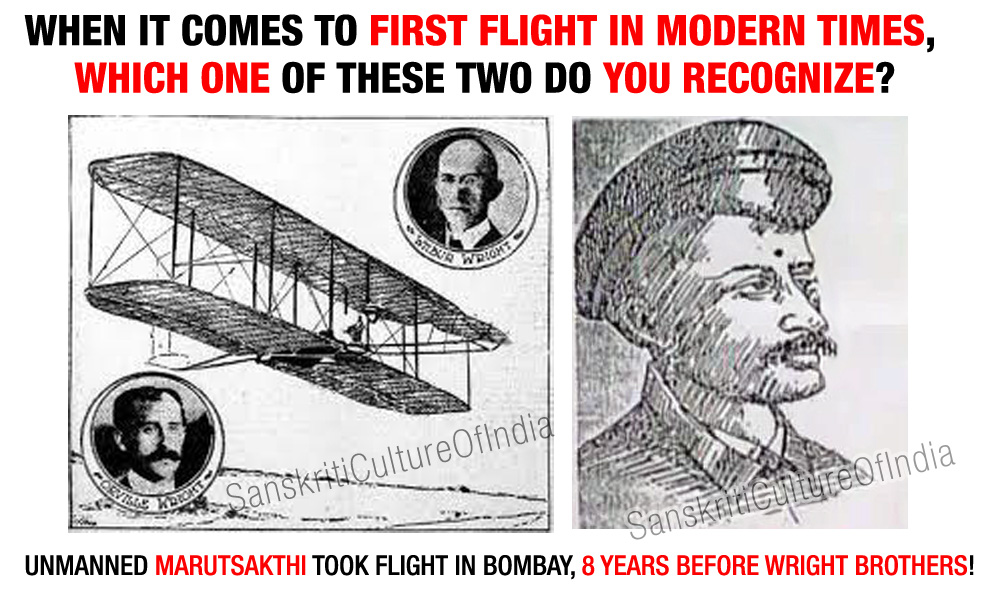
Orville Wright demonstrated on December 17th 1903 that it was possible for a ‘manned heavier than air machine to fly’. But, in 1895, eight years earlier, the Sanskrit scholar Shivkar Bapuji Talpade had designed a basic aircraft called Marutsakthi (meaning Power of Air) based on Vedic technology and had it take off unmanned before a large audience in the Chowpathy beach of Bombay. The importance of the Wright brothers lies in the fact, that it was a manned flight for a distance of 120 feet and Orville Wright became the first man to fly. But Talpade’s unmanned aircraft flew to a height of 1500 feet before crashing down and the historian Evan Koshtka, has described Talpade as the ‘first creator of an aircraft’.
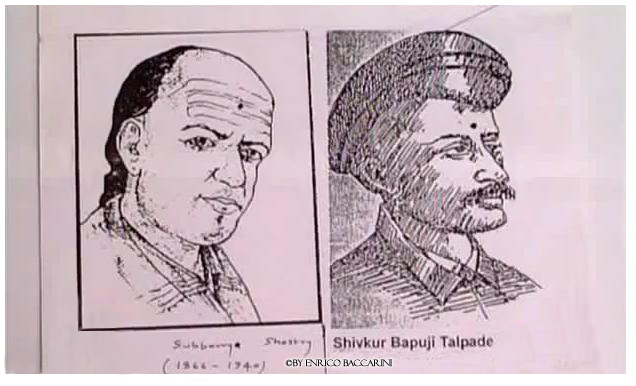 As the world observes the one hundredth anniversary of the first manned flight, it is interesting to consider the saga of India’s 19th century first aircraft inventor for his design was entirely based on the rich treasury of India’s Vedas. Shivkar Bapuji Talpade was born in 1864 in the locality of Chirabazar at Dukkarwadi in Bombay.
He was a scholar of Sanskrit and from his young age was attracted by the Vaimanika Sastra (Aeronautical Science) expounded by the great Indian sage Maharishi Bhardwaja. One western scholar of Indology Stephen-Knapp has put in simple words or rather has tried to explain what Talpade did and succeeded!
According to Knapp, the Vaimanika Shastra describes in detail, the construction of what is called, the mercury vortex engine the forerunner of the ion engines being made today by NASA. Knapp adds that additional information on the mercury engines can be found in the ancient Vedic text called Samaranga Sutradhara. This text also devotes 230 verses, to the use of these machines in peace and war. The Indologist William Clarendon, who has written down a detailed description of the mercury vortex engine in his translation of Samaranga Sutradhara quotes thus ‘Inside the circular air frame, place the mercury-engine with its solar mercury boiler at the aircraft center. By means of the power latent in the heated mercury which sets the driving whirlwind in motion a man sitting inside may travel a great distance in a most marvellous manner. Four strong mercury containers must be built into the interior structure. When these have been heated by fire through solar or other sources the vimana (aircraft) develops thunder-power through the mercury.
 NASA (National Aeronau-tical and Space Administra-tion) world’s richest/ most powerful scientific organisation is trying to create an ion engine that is a device that uses a stream of high velocity electrified particles instead of a blast of hot gases like in present day modern jet engines. Surprisingly according to the bi-monthly Ancient Skies published in USA, the aircraft engines being developed for future use by NASA by some strange coincidence also uses mercury bombardment units powered by Solar cells! Interestingly, the impulse is generated in seven stages. The mercury propellant is first vapourised fed into the thruster discharge chamber ionised converted into plasma by a combination with electrons broke down electrically and then accelerated through small openings in a screen to pass out of the engine at velocities between 1200 to 3000 kilometres per minute! But so far NASA has been able to produce an experimental basis only a one pound of thrust by its scientists a power derivation virtually useless. But 108 years ago Talpade was able to use his knowledge of Vaimanika Shastra to produce sufficient thrust to lift his aircraft 1500 feet into the air!
According to Indian scholar Acharya, ‘Vaimanika Shastra deals about aeronautics including the design of aircraft the way they can be used for transportation and other applications in detail. The knowledge of aeronautics is described in Sanskrit in 100 sections, eight chapters, 500 principles and 3000 slokas including 32 techniques to fly an aircraft. In fact, depending on the classifications of eras or Yugas in modern Kaliyuga aircraft used are called Krithakavimana flown by the power of engines by absorbing solar energies!’ It is feared that only portions of Bharadwaja’s masterpiece Vaimanika Shas-tra survive today.
The question that comes to one’s mind is, what happened to this wonderful encyclopaedia of aeronautical knowledge accumulated by the Indian savants of yore, and why was it not used? But in those days, such knowledge was the preserve of sages, who would not allow it to be misused, just like the knowledge of atomic bombs is being used by terrorists today!
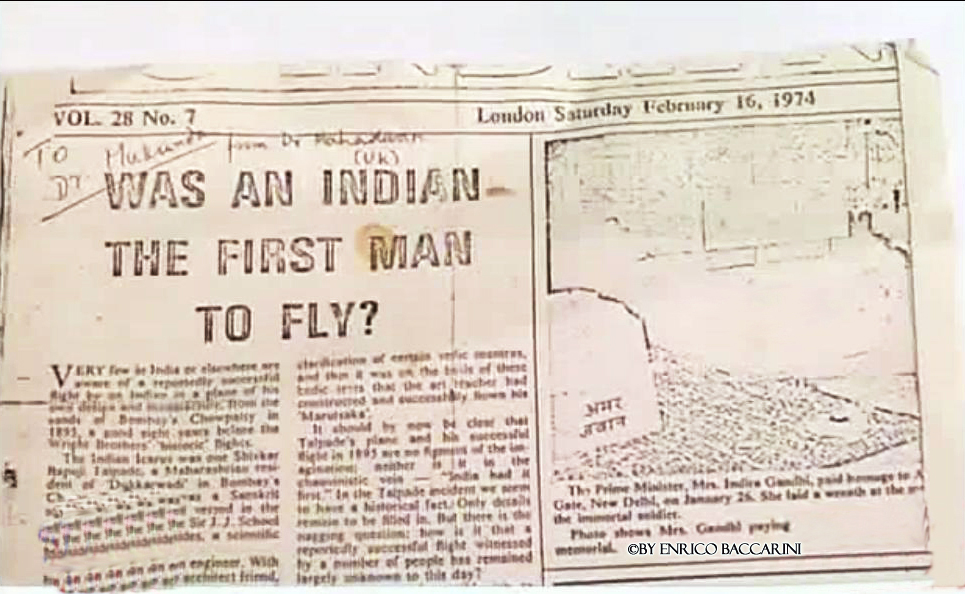
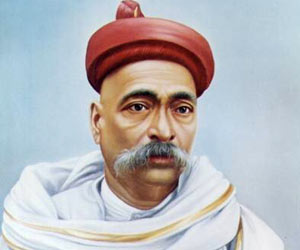 According to scholar Ratnakar Mahajan who wrote a brochure on Talpade. ‘Being a Sanskrit scholar interested in aeronautics, Talpade studied and consulted a number of Vedic treatises like Brihad Vaimanika Shastra of Maharishi Bharadwaja Vimanachandrika of Acharya Narayan Muni Viman yantra of Maharish Shownik Yantra Kalp by Maharishi Garg Muni Viman Bindu of Acharya Vachaspati and Vimana Gyanarka Prakashika of Maharishi Dhundiraj’. This gave him confidence that he can build an aircraft with mercury engines. One essential factor in the creation of these Vedic aircraft was the timing of the Suns Rays or Solar energy (as being now utilised by NASA) when they were most effective to activate the mercury ions of the engine. Happily for Talpade Maharaja Sayaji Rao Gaekwad of Baroda a great supporter of the Sciences in India, was willing to help him and Talpade went ahead with his aircraft construction with mercury engines. One day in 1895 (unfortunately the actual date is not mentioned in the Kesari newspaper of Pune which covered the event) before an curious scholarly audience headed by the famous Indian judge/ nationalist/ Mahadeva Govin-da Ranade and H H Sayaji Rao Gaekwad Talpade had the good fortune to see his unmanned aircraft named as ‘Marutsakthi’ take off, fly to a height of 1500 feet and then fall down to earth. Bal Gangadhara Tilak the editor of Kesari Pune had put in an editorial . It was also reported by two other English newspapers, a terse account. Eminent Indian judge Mahadeva Govin-da Ranade and King of Baroda H H Sayaji Rao Gaekwad witnessed the flight.
But this success of an Indian scientist was not liked by the Imperial rulers. Warned by the British Government the Maharaja of Baroda stopped helping Talpade. It is said that the remains of the Marutsakthi were sold to ‘foreign parties’ by the relatives of Talpade in order to salvage whatever they can out of their loans to him. Talpade’s wife died at this critical juncture and he was not in a mental frame to continue with his researches. But his efforts to make known the greatness of Vedic Shastras was recognised by Indian scholars, who gave him the title of Vidya Prakash Pra-deep.
Talpade passed away in 1916 un-honoured, in his own country.
As the world rightly honours the Wright Brothers for their achievements, we should think of Talpade, who utilised the ancient knowledge of Sanskrit texts, to fly an aircraft, eight years before his foreign counterparts.