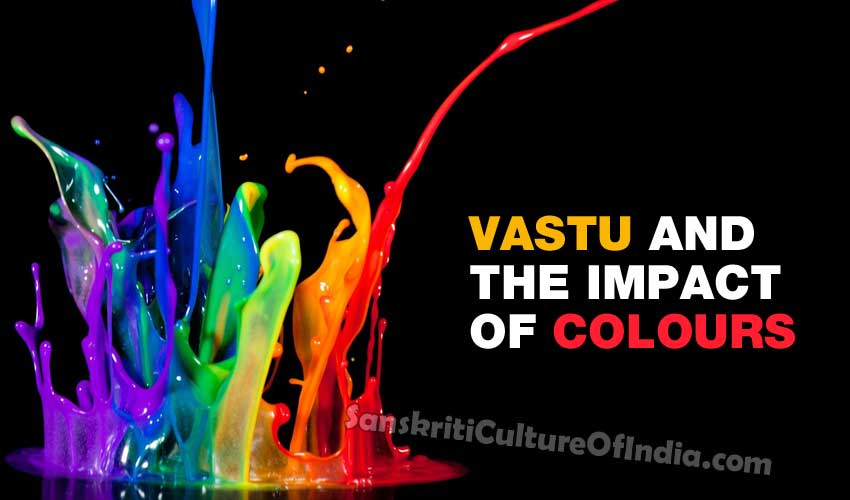
Colours affect various domains of our life – world, food, clothing, the living place, transportation, education and recreation. Colour also can harmonize and balance our energy and thus improve our life and destiny. Out of the balance and harmonizing of positive and negative forces arises energy – the most essential feature of life and human energy is greatly affected by colour. Colours play a vital role in influencing vastu shastra to a greater extent.
Let us take a look at how colours influence vastu, which bring balance to our minds and bodies and stimulate our energy that is a colourful change which gives zest:
Colors are most powerful in influencing the human mind and body. It is also the least expensive, easiest and quickest to use, to change and to create a decorating scheme. In Vedic periods, all colors were taken out from vegetables and flowers, which were more permanent in shade, soothing to eye and natural tint. At an early period in human history the symbolic use of colors was made. During early period Heart, which was the seat of life and the blood was identified with life and consciousness and was colored red. Yellows were possibly the color of fire and white that of the day. Vaastu Shastra provides vital guidelines as to how to decorate our homes etc. in decent manner to derive maximum delight with dignity and décor.
According to some Vaastukars, the color schemes should conform to the raashi (constellation / zodiac sign) of the owner to bring good luck and happiness.
Zodiac sign and their suggested colours:
Aries: Coral Red
Taurus: Milky white
Gemini: Green
Cancer: Rose red,pearl
Leo: Ruby red, dim white
Virgo: Emerald green
Libra: Cement color, milky white
Scorpio: Pink, coral red
Sagittarius: Golden yellow
Capricon: Dim red
Aquarius: Pink, blue
Pisces: Yellow, pure white
If a room has poor daylight, it should be painted in light color and if a room gets good amount of natural light throughout the day, it can be painted in some deep color. If a room has only a North window, which admits cold light, we should not use blue on the walls. If a room gets much direct sunlight, it is not advisable to paint the walls yellow or peach. It is nearly better to have ceilings white and the ceiling temperature should be less than the human body temperature. Some scholars suggest different color to the direction the building faces. They are really the colors of the planets governing these directions.
Direction and their suggested colours:
East: (Sun) Shining White
West: (Saturn) Blue
North: (Mercury) All Greens
South: (Mars) Pink,Coral Red
North-East: (Jupiter) Golden Red
South-West: (Rahu) All Greens
South-East: (Venus) Silver White
North-West: (Moon) White
Color contrast in value is perhaps the most important factor in a composition or a design. Maximum contrast is obtained by the use of colors of extremely strong chromes. A strong yellow on a black field is an excellent example of maximum visibility. A bright strong yellowish red would be considered as a powerful color. The color of an object depends upon the light it emits or sends back to an eye. Opposite contrast colors are quickly changed when it mixed as for black which makes colors both brighter and lighter in looks. Surrounding an intense color with a Grey increase the apparent colorfulness of the intense color making. It appears even brighter or brilliant. Surrounded by yellow, a Grey color may appear slightly blue. Surrounded by red, it may appear slightly green and surrounding by Grey with a bright color on other hand may influence the eye to discern in the greying of the complementary of the bright colors.
A sensible good blending can create a forceful creation. A particular color can activate or can control human glands by different bodily functions. Such as for good appetizer or to give excitement for the low blood pressure patient, a light limited soothing color atmosphere is recommended. Similarly Blue color is to stop overeating habits. For a high blood pressure patient, a light limited soothing color atmosphere is recommended. For quicker healing, green color is used in hospitals. For a good healthy, tasty food, golden yellow or tinted brown color is recommended.
Colors effect our body and mind very much. The purest and most thoughtful minds are those, which love, colors the most. The cool colors are blue sea or mainly blue in cast. The warm colors are red or mainly blue in cast. The warm colors are red and yellow in cast. Red make you feel happy while man can work best when surrounded by blue, but too strong blue or red cause depression. People often feel cold in blue room and warm in a red room. It is the color that makes them feel that way.
Vastu and suggested colours for Home:
Bedroom: Pink , Light Green, Light Blue
Living Room: Yellow, Green, Blue, Beige And Tan
Kitchen: White, Orange, Yellow, Rose Pink, Red And Chocolate
Bathroom: White, Mixture Of White And Black, Gray Colors, Pink And Other Pastel Colors
Dining Room: Green, Pink And Blue