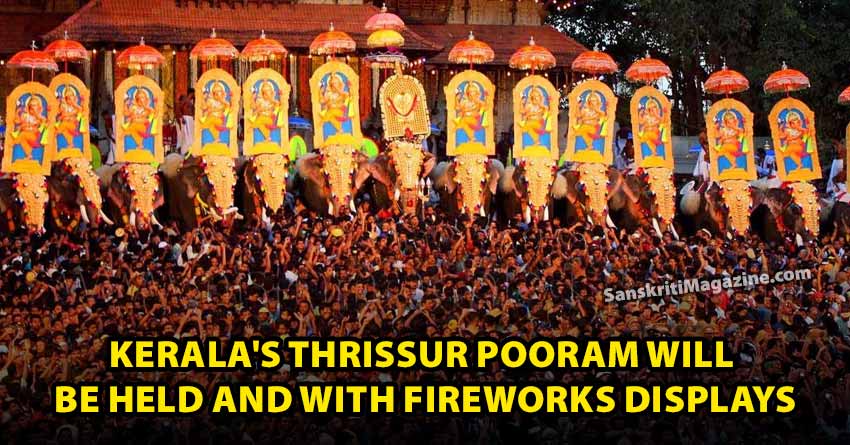
NEW DELHI: Despite the Puttingal Devi temple tragedy that caused 114 deaths, the Kerala High Court and the state’s chief minister on Thursday gave their assent to the use of fireworks during the state’s biggest festival, the upcoming Thrissur Pooram that will be held August 17-18.
In addition, the focus of the court and the state government continued to be on sound-emitting fireworks, rather than on dangerous fireworks displays.
The Puttingal temple tragedy occurred when sparks from fireworks fell on a store room where even more firecrackers were kept. No permission had been given to hold the display.
The Kerala high court on Thursday allowed the use of sound-emitting firecrackers after dusk during the Thrissur Pooram, a mere two days after it banned sound-making fireworks in all places of worship in the state, between sunset and sunrise.
Kerala chief minister Oommen Chandy, too, said on Thursday that fireworks displays will not be banned in the state.
Not just fireworks, the tragedy’s victims – the injured and the families of the dead – also got a mention from the Kerala Chief Minister, on Thursday.
“It’s now become a reality that those who have suffered injuries will take a long time to get back to normal life and to come to their support, the Kerala government will set up a separate fund for it. We call upon all to contribute generously to the fund,” Chief Minister Chandy told reporters here after the all-party meeting.
Other Keralites will have some relief from the fireworks, though, as the High Court said the noise level of the fireworks has to be kept below 125 decibels, as specified in the Explosives Rules Act and the Environment Protection Act.
Without specifying how they plan to enforce it, the CM, too, said displays will be allowed “but with strict controls and checks”.
Chandy said that the general consensus at an all-party meeting on Thursday was that bringing a blanket ban on events associated with religious institutions was not a practical one.
“At the moment, there are already rules and regulations on how to go about such events. The meeting wanted that from now on, the enforcing of the law should be taken up with utmost seriousness and rules will not be given the go-by,” said Chandy.
The Kerala court said that it instituted the ban on Tuesday, not having realized that a 2007 Supreme Court (SC) order allowed the use of firecrackers – even at night – during religious customs such as temple festivals.
Therefore, the Thrissur Pooram can be carried out as has been customarily done, as stated in the SC’s order of March 26, 2007, the bench held.
“The Thrissur Pooram is part of the state’s culture and a showpiece event and it just cannot be banned, but it can be staged by following all the rules and regulations that are in place,” said state home minister Ramesh Chennithala.
The court’s division bench – comprising Justices Thottathil B Radhakrishnan and Anu Sivaraman – also directed that elephants be kept at a safe distance from the fireworks during the Thrissur Pooram.
It should also be ensured, the court said, that while conducting the Thrissur Pooram, there is no damage to the surrounding buildings. The Vadakkumnathan Temple is in the vicinity of where the festival is held.
As for the probe into Sunday’s Paravur temple tragedy, the court decided to monitor the crime branch investigation and asked that team to report on the progress they’ve made by May 18. The court is not commenting on the quality of the investigation at present, it said.